 Add to Chrome
 Add to Firefox
 Add to Edge
Deployment-Ready UWB Localization for Industrial Ground Robots with Automatic Anchor Calibration and Terrain-Aware Fusion
Jul 17, 2026
Ultra-Wideband (UWB) ranging has become a viable option for industrial Autonomous Mobile Robot (AMR) localization due to improved accuracy and low cost. However, real-world deployments remain limited by two recurring challenges: calibrating static anchors can be time-consuming and error-prone, and integrating UWB with existing onboard sensors requires careful design to ensure robust and consistent pose estimation. Addressing these challenges, this paper presents an end-to-end pipeline that combines automatic anchor calibration with a generic multi-sensor estimator tailored to surface-bound vehicle motion. It targets existing AMR stacks in scenarios where robot pose priors are available for initialization. The calibration stage estimates anchor positions and range biases, while the localization stage fuses UWB with proprioceptive sensing in a bias-aware Extended Kalman Filter to improve consistency without extensive parameter tuning. Experiments on a commercial logistics AMR in a warehouse setting demonstrate accurate positioning indoors and across outdoor transitions, with improved consistency compared to an earlier estimator formulation. Evaluation on an independent forklift dataset further indicates transferability to other platforms. The method remains effective in test cases with limited line-of-sight and sparse anchor coverage. These results show that UWB localization can be deployed with substantially reduced manual effort while preserving the accuracy required for industrial AMRs. The collected warehouse dataset is made publicly available.

Consistent Pose Estimation of Unmanned Ground Vehicles through Terrain-Aided Multi-Sensor Fusion on Geometric Manifolds
Aug 20, 2025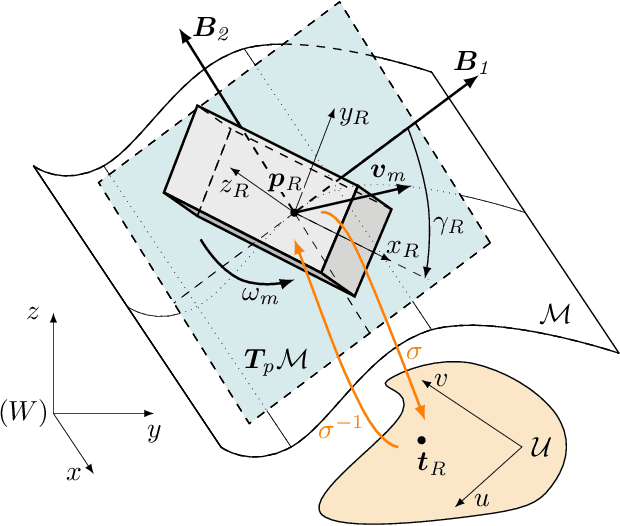
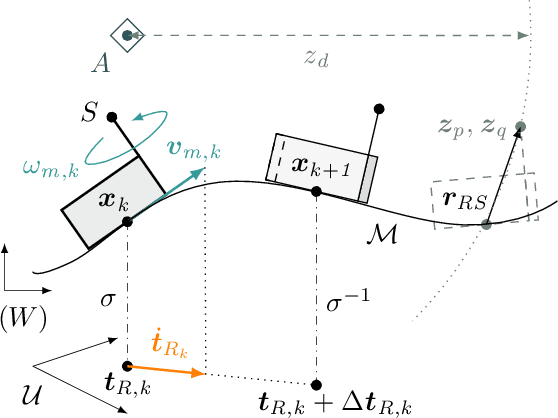
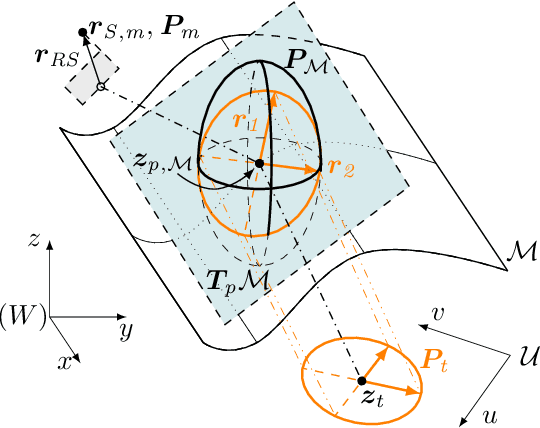
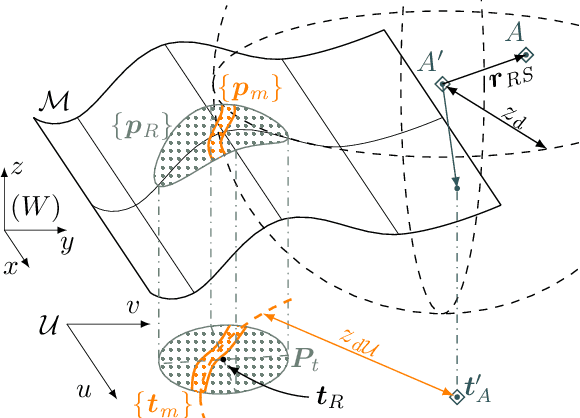
Aiming to enhance the consistency and thus long-term accuracy of Extended Kalman Filters for terrestrial vehicle localization, this paper introduces the Manifold Error State Extended Kalman Filter (M-ESEKF). By representing the robot's pose in a space with reduced dimensionality, the approach ensures feasible estimates on generic smooth surfaces, without introducing artificial constraints or simplifications that may degrade a filter's performance. The accompanying measurement models are compatible with common loosely- and tightly-coupled sensor modalities and also implicitly account for the ground geometry. We extend the formulation by introducing a novel correction scheme that embeds additional domain knowledge into the sensor data, giving more accurate uncertainty approximations and further enhancing filter consistency. The proposed estimator is seamlessly integrated into a validated modular state estimation framework, demonstrating compatibility with existing implementations. Extensive Monte Carlo simulations across diverse scenarios and dynamic sensor configurations show that the M-ESEKF outperforms classical filter formulations in terms of consistency and stability. Moreover, it eliminates the need for scenario-specific parameter tuning, enabling its application in a variety of real-world settings.