 Add to Chrome
 Add to Firefox
 Add to Edge
A Multi-Label Temporal Convolutional Framework for Transcription Factor Binding Characterization
Mar 12, 2026
Transcription factors (TFs) regulate gene expression through complex and co-operative mechanisms. While many TFs act together, the logic underlying TFs binding and their interactions is not fully understood yet. Most current approaches for TF binding site prediction focus on individual TFs and binary classification tasks, without a full analysis of the possible interactions among various TFs. In this paper we investigate DNA TF binding site recognition as a multi-label classification problem, achieving reliable predictions for multiple TFs on DNA sequences retrieved in public repositories. Our deep learning models are based on Temporal Convolutional Networks (TCNs), which are able to predict multiple TF binding profiles, capturing correlations among TFs andtheir cooperative regulatory mechanisms. Our results suggest that multi-label learning leading to reliable predictive performances can reveal biologically meaningful motifs and co-binding patterns consistent with known TF interactions, while also suggesting novel relationships and cooperation among TFs.

PainPoints: A Framework for Language-based Detection of Chronic Pain and Expert-Collaborative Text-Summarization
Sep 14, 2022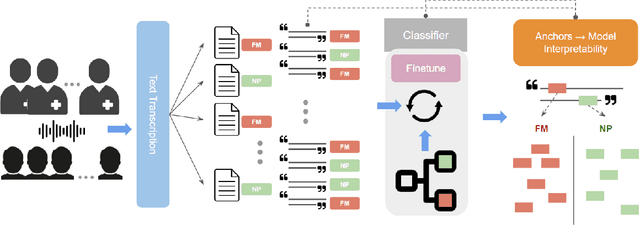
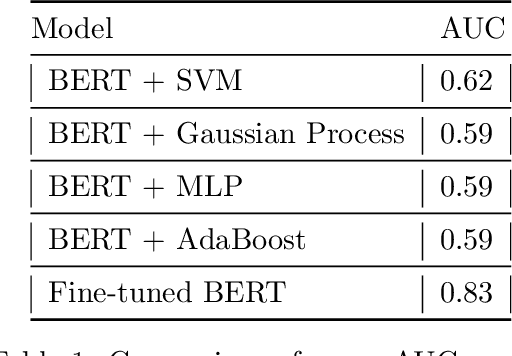
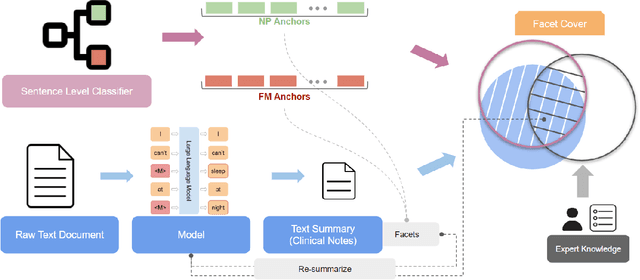
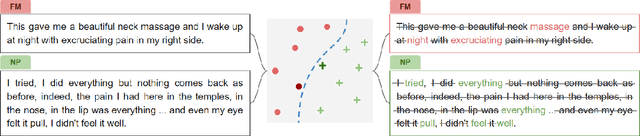
Chronic pain is a pervasive disorder which is often very disabling and is associated with comorbidities such as depression and anxiety. Neuropathic Pain (NP) is a common sub-type which is often caused due to nerve damage and has a known pathophysiology. Another common sub-type is Fibromyalgia (FM) which is described as musculoskeletal, diffuse pain that is widespread through the body. The pathophysiology of FM is poorly understood, making it very hard to diagnose. Standard medications and treatments for FM and NP differ from one another and if misdiagnosed it can cause an increase in symptom severity. To overcome this difficulty, we propose a novel framework, PainPoints, which accurately detects the sub-type of pain and generates clinical notes via summarizing the patient interviews. Specifically, PainPoints makes use of large language models to perform sentence-level classification of the text obtained from interviews of FM and NP patients with a reliable AUC of 0.83. Using a sufficiency-based interpretability approach, we explain how the fine-tuned model accurately picks up on the nuances that patients use to describe their pain. Finally, we generate summaries of these interviews via expert interventions by introducing a novel facet-based approach. PainPoints thus enables practitioners to add/drop facets and generate a custom summary based on the notion of "facet-coverage" which is also introduced in this work.