 Add to Chrome
 Add to Firefox
 Add to Edge
Context Shapes LLMs Retrieval-Augmented Fact-Checking Effectiveness
Feb 15, 2026
Large language models (LLMs) show strong reasoning abilities across diverse tasks, yet their performance on extended contexts remains inconsistent. While prior research has emphasized mid-context degradation in question answering, this study examines the impact of context in LLM-based fact verification. Using three datasets (HOVER, FEVEROUS, and ClimateFEVER) and five open-source models accross different parameters sizes (7B, 32B and 70B parameters) and model families (Llama-3.1, Qwen2.5 and Qwen3), we evaluate both parametric factual knowledge and the impact of evidence placement across varying context lengths. We find that LLMs exhibit non-trivial parametric knowledge of factual claims and that their verification accuracy generally declines as context length increases. Similarly to what has been shown in previous works, in-context evidence placement plays a critical role with accuracy being consistently higher when relevant evidence appears near the beginning or end of the prompt and lower when placed mid-context. These results underscore the importance of prompt structure in retrieval-augmented fact-checking systems.

A Shared Geometry of Difficulty in Multilingual Language Models
Jan 19, 2026Predicting problem-difficulty in large language models (LLMs) refers to estimating how difficult a task is according to the model itself, typically by training linear probes on its internal representations. In this work, we study the multilingual geometry of problem-difficulty in LLMs by training linear probes using the AMC subset of the Easy2Hard benchmark, translated into 21 languages. We found that difficulty-related signals emerge at two distinct stages of the model internals, corresponding to shallow (early-layers) and deep (later-layers) internal representations, that exhibit functionally different behaviors. Probes trained on deep representations achieve high accuracy when evaluated on the same language but exhibit poor cross-lingual generalization. In contrast, probes trained on shallow representations generalize substantially better across languages, despite achieving lower within-language performance. Together, these results suggest that LLMs first form a language-agnostic representation of problem difficulty, which subsequently becomes language-specific. This closely aligns with existing findings in LLM interpretability showing that models tend to operate in an abstract conceptual space before producing language-specific outputs. We demonstrate that this two-stage representational process extends beyond semantic content to high-level meta-cognitive properties such as problem-difficulty estimation.
Query-Document Dense Vectors for LLM Relevance Judgment Bias Analysis
Jan 05, 2026Large Language Models (LLMs) have been used as relevance assessors for Information Retrieval (IR) evaluation collection creation due to reduced cost and increased scalability as compared to human assessors. While previous research has looked at the reliability of LLMs as compared to human assessors, in this work, we aim to understand if LLMs make systematic mistakes when judging relevance, rather than just understanding how good they are on average. To this aim, we propose a novel representational method for queries and documents that allows us to analyze relevance label distributions and compare LLM and human labels to identify patterns of disagreement and localize systematic areas of disagreement. We introduce a clustering-based framework that embeds query-document (Q-D) pairs into a joint semantic space, treating relevance as a relational property. Experiments on TREC Deep Learning 2019 and 2020 show that systematic disagreement between humans and LLMs is concentrated in specific semantic clusters rather than distributed randomly. Query-level analyses reveal recurring failures, most often in definition-seeking, policy-related, or ambiguous contexts. Queries with large variation in agreement across their clusters emerge as disagreement hotspots, where LLMs tend to under-recall relevant content or over-include irrelevant material. This framework links global diagnostics with localized clustering to uncover hidden weaknesses in LLM judgments, enabling bias-aware and more reliable IR evaluation.
How Do Experts Make Sense of Integrated Process Models?
May 28, 2025A range of integrated modeling approaches have been developed to enable a holistic representation of business process logic together with all relevant business rules. These approaches address inherent problems with separate documentation of business process models and business rules. In this study, we explore how expert process workers make sense of the information provided through such integrated modeling approaches. To do so, we complement verbal protocol analysis with eye-tracking metrics to reveal nuanced user behaviours involved in the main phases of sensemaking, namely information foraging and information processing. By studying expert process workers engaged in tasks based on integrated modeling of business processes and rules, we provide insights that pave the way for a better understanding of sensemaking practices and improved development of business process and business rule integration approaches. Our research underscores the importance of offering personalized support mechanisms that increase the efficacy and efficiency of sensemaking practices for process knowledge workers.
LLM-based Semantic Augmentation for Harmful Content Detection
Apr 22, 2025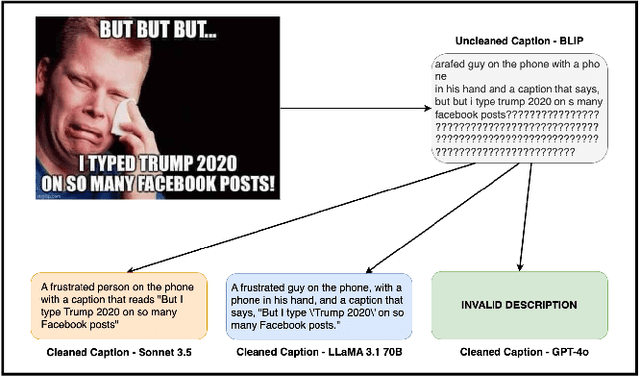
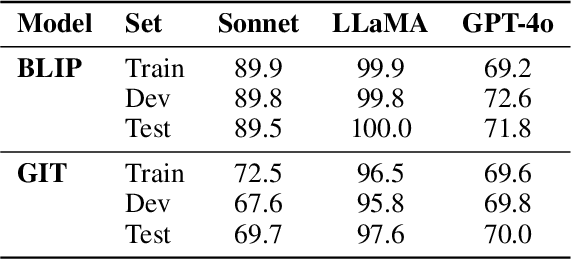

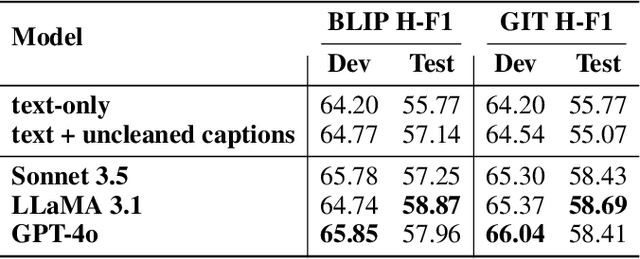
Recent advances in large language models (LLMs) have demonstrated strong performance on simple text classification tasks, frequently under zero-shot settings. However, their efficacy declines when tackling complex social media challenges such as propaganda detection, hateful meme classification, and toxicity identification. Much of the existing work has focused on using LLMs to generate synthetic training data, overlooking the potential of LLM-based text preprocessing and semantic augmentation. In this paper, we introduce an approach that prompts LLMs to clean noisy text and provide context-rich explanations, thereby enhancing training sets without substantial increases in data volume. We systematically evaluate on the SemEval 2024 multi-label Persuasive Meme dataset and further validate on the Google Jigsaw toxic comments and Facebook hateful memes datasets to assess generalizability. Our results reveal that zero-shot LLM classification underperforms on these high-context tasks compared to supervised models. In contrast, integrating LLM-based semantic augmentation yields performance on par with approaches that rely on human-annotated data, at a fraction of the cost. These findings underscore the importance of strategically incorporating LLMs into machine learning (ML) pipeline for social media classification tasks, offering broad implications for combating harmful content online.
Spotting Persuasion: A Low-cost Model for Persuasion Detection in Political Ads on Social Media
Mar 18, 2025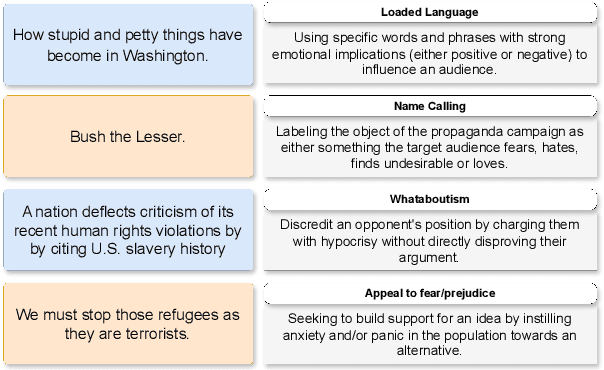

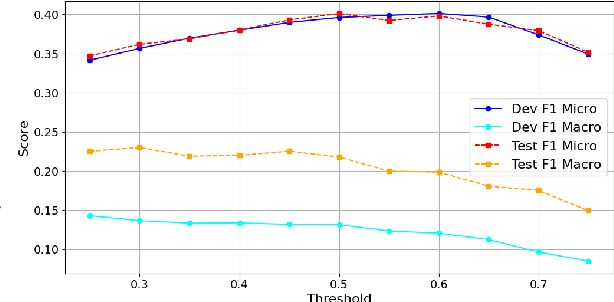

In the realm of political advertising, persuasion operates as a pivotal element within the broader framework of propaganda, exerting profound influences on public opinion and electoral outcomes. In this paper, we (1) introduce a lightweight model for persuasive text detection that achieves state-of-the-art performance in Subtask 3 of SemEval 2023 Task 3, while significantly reducing the computational resource requirements; and (2) leverage the proposed model to gain insights into political campaigning strategies on social media platforms by applying it to a real-world dataset we curated, consisting of Facebook political ads from the 2022 Australian Federal election campaign. Our study shows how subtleties can be found in persuasive political advertisements and presents a pragmatic approach to detect and analyze such strategies with limited resources, enhancing transparency in social media political campaigns.
Leveraging Semantic Type Dependencies for Clinical Named Entity Recognition
Mar 07, 2025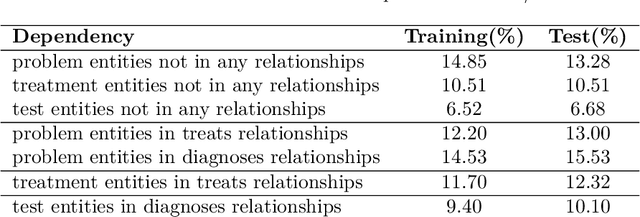

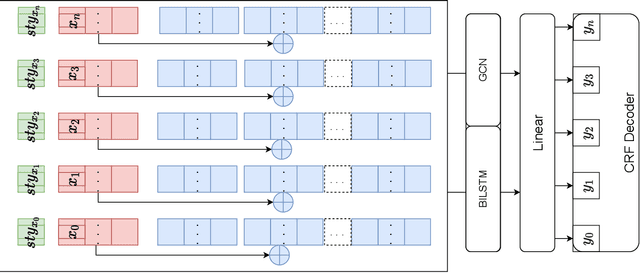
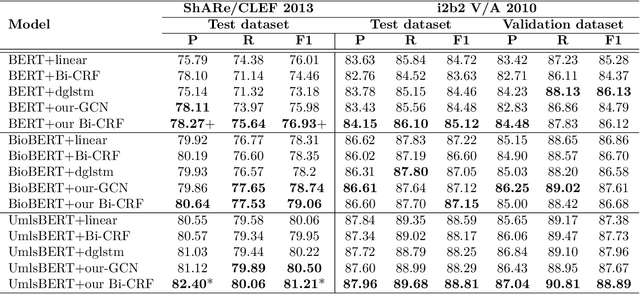
Previous work on clinical relation extraction from free-text sentences leveraged information about semantic types from clinical knowledge bases as a part of entity representations. In this paper, we exploit additional evidence by also making use of domain-specific semantic type dependencies. We encode the relation between a span of tokens matching a Unified Medical Language System (UMLS) concept and other tokens in the sentence. We implement our method and compare against different named entity recognition (NER) architectures (i.e., BiLSTM-CRF and BiLSTM-GCN-CRF) using different pre-trained clinical embeddings (i.e., BERT, BioBERT, UMLSBert). Our experimental results on clinical datasets show that in some cases NER effectiveness can be significantly improved by making use of domain-specific semantic type dependencies. Our work is also the first study generating a matrix encoding to make use of more than three dependencies in one pass for the NER task.
Are Large Language Models Good Data Preprocessors?
Feb 24, 2025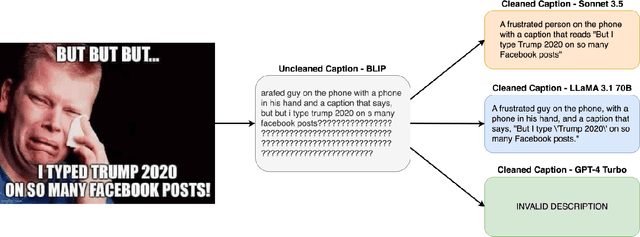
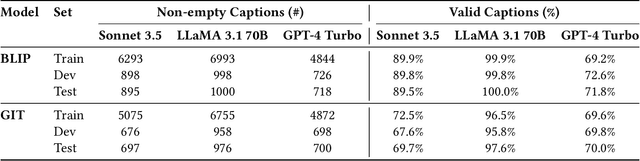
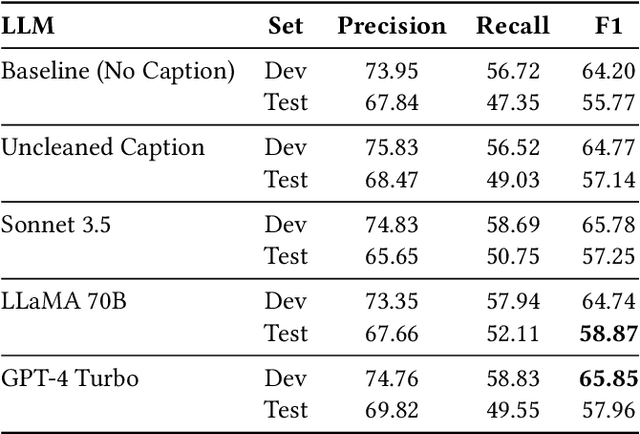
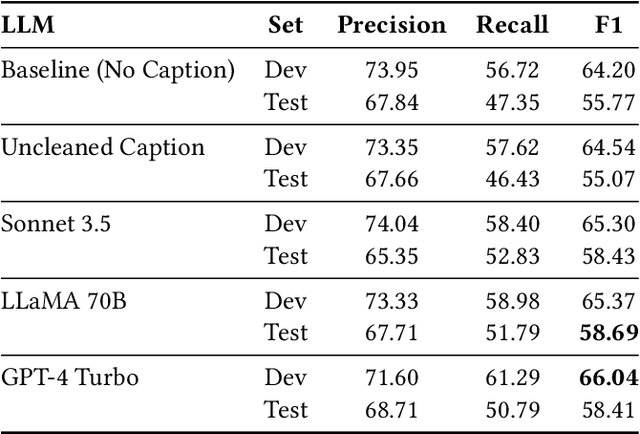
High-quality textual training data is essential for the success of multimodal data processing tasks, yet outputs from image captioning models like BLIP and GIT often contain errors and anomalies that are difficult to rectify using rule-based methods. While recent work addressing this issue has predominantly focused on using GPT models for data preprocessing on relatively simple public datasets, there is a need to explore a broader range of Large Language Models (LLMs) and tackle more challenging and diverse datasets. In this study, we investigate the use of multiple LLMs, including LLaMA 3.1 70B, GPT-4 Turbo, and Sonnet 3.5 v2, to refine and clean the textual outputs of BLIP and GIT. We assess the impact of LLM-assisted data cleaning by comparing downstream-task (SemEval 2024 Subtask "Multilabel Persuasion Detection in Memes") models trained on cleaned versus non-cleaned data. While our experimental results show improvements when using LLM-cleaned captions, statistical tests reveal that most of these improvements are not significant. This suggests that while LLMs have the potential to enhance data cleaning and repairing, their effectiveness may be limited depending on the context they are applied to, the complexity of the task, and the level of noise in the text. Our findings highlight the need for further research into the capabilities and limitations of LLMs in data preprocessing pipelines, especially when dealing with challenging datasets, contributing empirical evidence to the ongoing discussion about integrating LLMs into data preprocessing pipelines.
Plan-Then-Execute: An Empirical Study of User Trust and Team Performance When Using LLM Agents As A Daily Assistant
Feb 03, 2025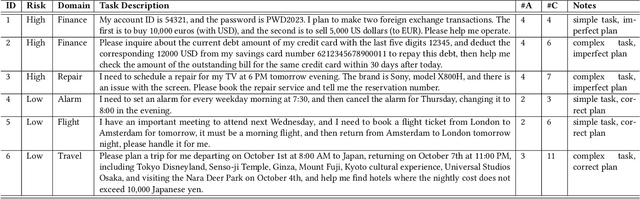

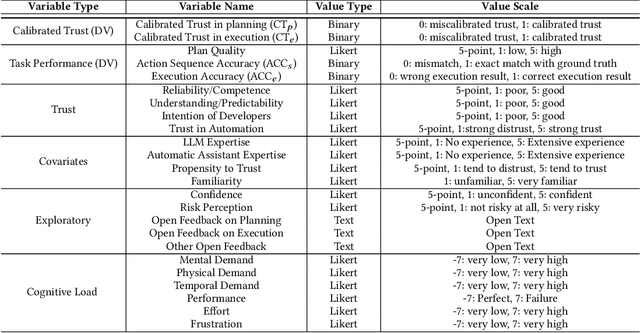

Since the explosion in popularity of ChatGPT, large language models (LLMs) have continued to impact our everyday lives. Equipped with external tools that are designed for a specific purpose (e.g., for flight booking or an alarm clock), LLM agents exercise an increasing capability to assist humans in their daily work. Although LLM agents have shown a promising blueprint as daily assistants, there is a limited understanding of how they can provide daily assistance based on planning and sequential decision making capabilities. We draw inspiration from recent work that has highlighted the value of 'LLM-modulo' setups in conjunction with humans-in-the-loop for planning tasks. We conducted an empirical study (N = 248) of LLM agents as daily assistants in six commonly occurring tasks with different levels of risk typically associated with them (e.g., flight ticket booking and credit card payments). To ensure user agency and control over the LLM agent, we adopted LLM agents in a plan-then-execute manner, wherein the agents conducted step-wise planning and step-by-step execution in a simulation environment. We analyzed how user involvement at each stage affects their trust and collaborative team performance. Our findings demonstrate that LLM agents can be a double-edged sword -- (1) they can work well when a high-quality plan and necessary user involvement in execution are available, and (2) users can easily mistrust the LLM agents with plans that seem plausible. We synthesized key insights for using LLM agents as daily assistants to calibrate user trust and achieve better overall task outcomes. Our work has important implications for the future design of daily assistants and human-AI collaboration with LLM agents.
SubData: A Python Library to Collect and Combine Datasets for Evaluating LLM Alignment on Downstream Tasks
Dec 21, 2024With the release of ever more capable large language models (LLMs), researchers in NLP and related disciplines have started to explore the usability of LLMs for a wide variety of different annotation tasks. Very recently, a lot of this attention has shifted to tasks that are subjective in nature. Given that the latest generations of LLMs have digested and encoded extensive knowledge about different human subpopulations and individuals, the hope is that these models can be trained, tuned or prompted to align with a wide range of different human perspectives. While researchers already evaluate the success of this alignment via surveys and tests, there is a lack of resources to evaluate the alignment on what oftentimes matters the most in NLP; the actual downstream tasks. To fill this gap we present SubData, a Python library that offers researchers working on topics related to subjectivity in annotation tasks a convenient way of collecting, combining and using a range of suitable datasets.