 Add to Chrome
 Add to Firefox
 Add to Edge
LLMs Encode Relevance as a Layer-Wise Cross-Lingual Signal
Jul 17, 2026
Large language models (LLMs) are increasingly used in information retrieval (IR) pipelines as relevance judges and re-rankers. Yet most analyses remain output-centric, evaluating generated labels or scores while offering limited insight into how relevance is represented inside the model. In this work, we study whether query-document (q-d) relevance is linearly decodable from residual-stream activations in instruction-tuned LLMs, how this signal compares with generated relevance judgments, and whether it transfers across languages. Using the TREC DL20 and MIRACL evaluation collections, we guide medium-scale LLMs (4-9B parameters) with UMBRELA-style relevance judgment prompts, extract last-token activations from every transformer layer, and train linear probes to predict relevance labels. We compare probe predictions with generated judgments and use TREC DL20 to test whether probe-derived pseudo-labels preserve system rankings against human judgments. Our results suggest that q-d relevance is encoded as a depth-dependent signal: probe performance is weak in early layers and strongest in middle-to-late layers, indicating that relevance becomes more linearly accessible after contextual integration. Most importantly, in several models, validation-selected probes match or outperform generated judgments and better preserve system rankings, revealing a separation between internal relevance representation and external expression. Multilingual experiments suggest partial cross-language portability, although transfer remains weaker than within-language decoding. Overall, this work provides a representation-level perspective on LLM-based relevance assessment. Layer-wise probing can help diagnose where relevance emerges, when generated judgments fail to reflect internally available evidence, and how relevance representations vary across languages, datasets, and model families.

Context Shapes LLMs Retrieval-Augmented Fact-Checking Effectiveness
Feb 15, 2026Large language models (LLMs) show strong reasoning abilities across diverse tasks, yet their performance on extended contexts remains inconsistent. While prior research has emphasized mid-context degradation in question answering, this study examines the impact of context in LLM-based fact verification. Using three datasets (HOVER, FEVEROUS, and ClimateFEVER) and five open-source models accross different parameters sizes (7B, 32B and 70B parameters) and model families (Llama-3.1, Qwen2.5 and Qwen3), we evaluate both parametric factual knowledge and the impact of evidence placement across varying context lengths. We find that LLMs exhibit non-trivial parametric knowledge of factual claims and that their verification accuracy generally declines as context length increases. Similarly to what has been shown in previous works, in-context evidence placement plays a critical role with accuracy being consistently higher when relevant evidence appears near the beginning or end of the prompt and lower when placed mid-context. These results underscore the importance of prompt structure in retrieval-augmented fact-checking systems.
A Shared Geometry of Difficulty in Multilingual Language Models
Jan 19, 2026Predicting problem-difficulty in large language models (LLMs) refers to estimating how difficult a task is according to the model itself, typically by training linear probes on its internal representations. In this work, we study the multilingual geometry of problem-difficulty in LLMs by training linear probes using the AMC subset of the Easy2Hard benchmark, translated into 21 languages. We found that difficulty-related signals emerge at two distinct stages of the model internals, corresponding to shallow (early-layers) and deep (later-layers) internal representations, that exhibit functionally different behaviors. Probes trained on deep representations achieve high accuracy when evaluated on the same language but exhibit poor cross-lingual generalization. In contrast, probes trained on shallow representations generalize substantially better across languages, despite achieving lower within-language performance. Together, these results suggest that LLMs first form a language-agnostic representation of problem difficulty, which subsequently becomes language-specific. This closely aligns with existing findings in LLM interpretability showing that models tend to operate in an abstract conceptual space before producing language-specific outputs. We demonstrate that this two-stage representational process extends beyond semantic content to high-level meta-cognitive properties such as problem-difficulty estimation.
Spotting Persuasion: A Low-cost Model for Persuasion Detection in Political Ads on Social Media
Mar 18, 2025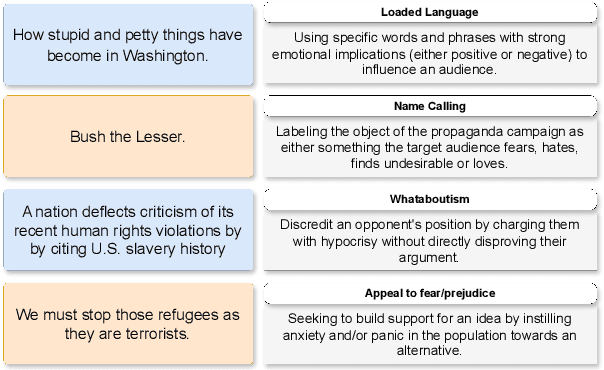

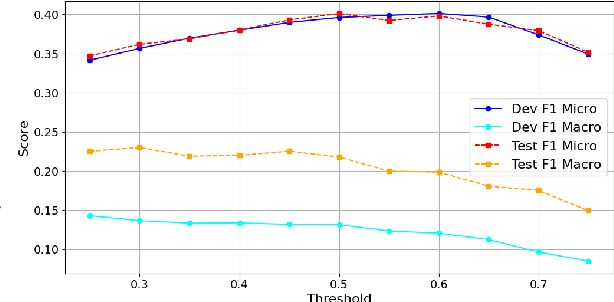

In the realm of political advertising, persuasion operates as a pivotal element within the broader framework of propaganda, exerting profound influences on public opinion and electoral outcomes. In this paper, we (1) introduce a lightweight model for persuasive text detection that achieves state-of-the-art performance in Subtask 3 of SemEval 2023 Task 3, while significantly reducing the computational resource requirements; and (2) leverage the proposed model to gain insights into political campaigning strategies on social media platforms by applying it to a real-world dataset we curated, consisting of Facebook political ads from the 2022 Australian Federal election campaign. Our study shows how subtleties can be found in persuasive political advertisements and presents a pragmatic approach to detect and analyze such strategies with limited resources, enhancing transparency in social media political campaigns.
Mapping and Influencing the Political Ideology of Large Language Models using Synthetic Personas
Dec 19, 2024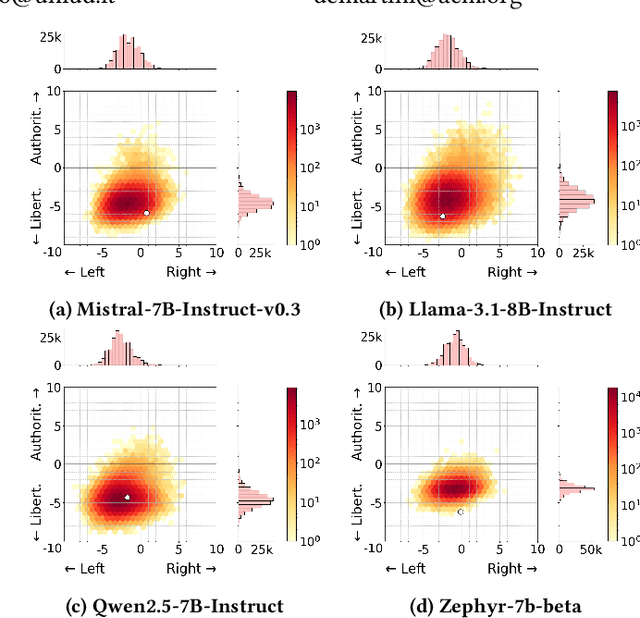
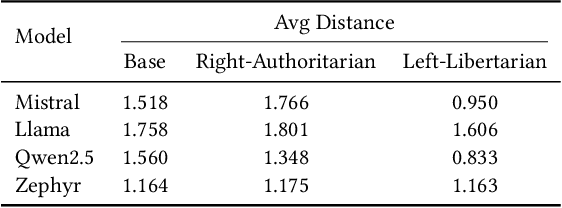
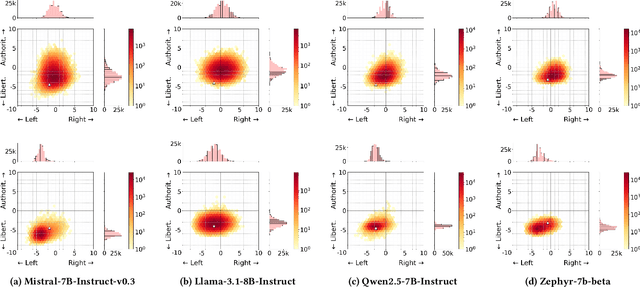
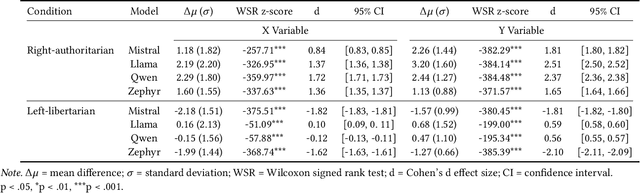
The analysis of political biases in large language models (LLMs) has primarily examined these systems as single entities with fixed viewpoints. While various methods exist for measuring such biases, the impact of persona-based prompting on LLMs' political orientation remains unexplored. In this work we leverage PersonaHub, a collection of synthetic persona descriptions, to map the political distribution of persona-based prompted LLMs using the Political Compass Test (PCT). We then examine whether these initial compass distributions can be manipulated through explicit ideological prompting towards diametrically opposed political orientations: right-authoritarian and left-libertarian. Our experiments reveal that synthetic personas predominantly cluster in the left-libertarian quadrant, with models demonstrating varying degrees of responsiveness when prompted with explicit ideological descriptors. While all models demonstrate significant shifts towards right-authoritarian positions, they exhibit more limited shifts towards left-libertarian positions, suggesting an asymmetric response to ideological manipulation that may reflect inherent biases in model training.