 Add to Chrome
 Add to Firefox
 Add to Edge
Neuromorphic Monocular Depth Estimation with Uncertainty Modeling
May 11, 2026
Event cameras offer distinct advantages over conventional frame-based sensors, including microsecond-level temporal resolution, high dynamic range, and low bandwidth. In this paper, we predict per-pixel depth distributions from monocular event streams using deep neural networks. We estimate uncertainty using Gaussian, log-normal, and evidential learning frameworks. We compare six event representations: spatio-temporal voxel grids with 1, 5, 10, and 20 temporal bins, the Compact Spatio-Temporal Representation (CSTR), and Time-Ordered Recent Event (TORE) volumes. Our U-Net-based models are trained on synthetic data and then fine-tuned on real sequences. We evaluate performance using absolute relative error, root mean squared error, and the area under the sparsification error. Quantitative results show that the representations perform similarly, while 10 bin log-normal and 5 bin evidential learning perform best across metrics. Our experiments demonstrate that uncertainty estimation can be successfully integrated into event-based monocular depth estimation, and be used to indicate pixels with reliable depth.

A Framework for Reducing the Complexity of Geometric Vision Problems and its Application to Two-View Triangulation with Approximation Bounds
Mar 11, 2025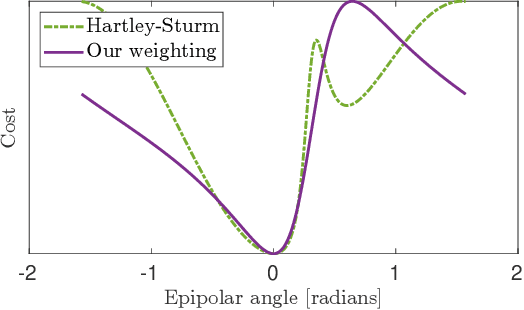
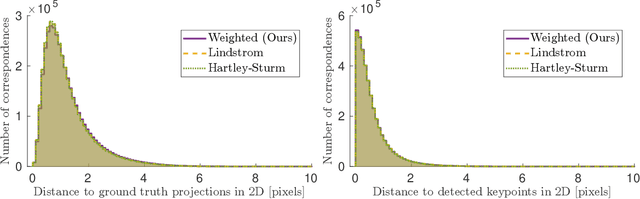
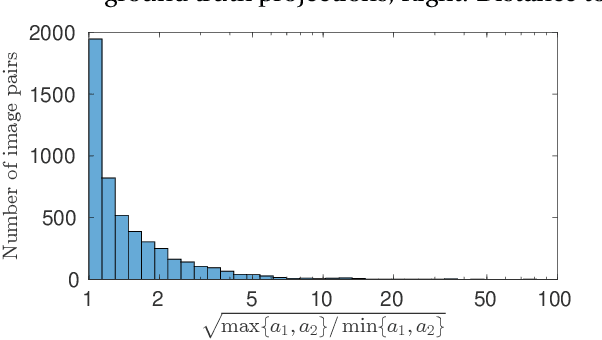
In this paper, we present a new framework for reducing the computational complexity of geometric vision problems through targeted reweighting of the cost functions used to minimize reprojection errors. Triangulation - the task of estimating a 3D point from noisy 2D projections across multiple images - is a fundamental problem in multiview geometry and Structure-from-Motion (SfM) pipelines. We apply our framework to the two-view case and demonstrate that optimal triangulation, which requires solving a univariate polynomial of degree six, can be simplified through cost function reweighting reducing the polynomial degree to two. This reweighting yields a closed-form solution while preserving strong geometric accuracy. We derive optimal weighting strategies, establish theoretical bounds on the approximation error, and provide experimental results on real data demonstrating the effectiveness of the proposed approach compared to standard methods. Although this work focuses on two-view triangulation, the framework generalizes to other geometric vision problems.
Revisiting Sampson Approximations for Geometric Estimation Problems
Jan 13, 2024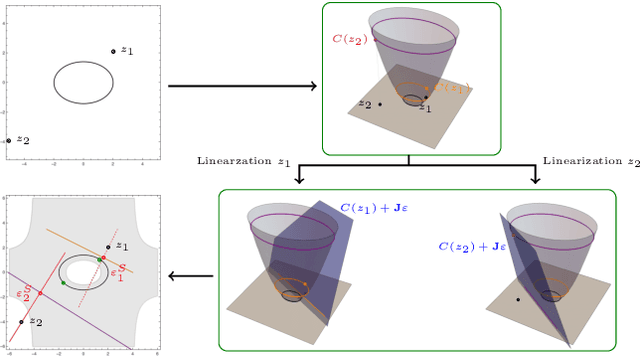
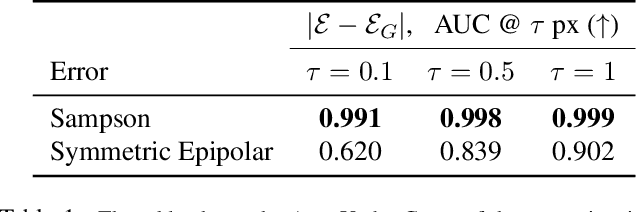
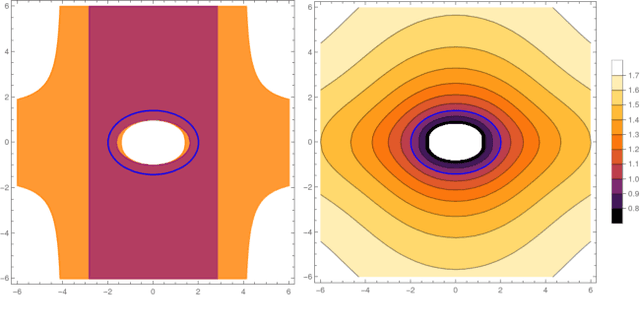
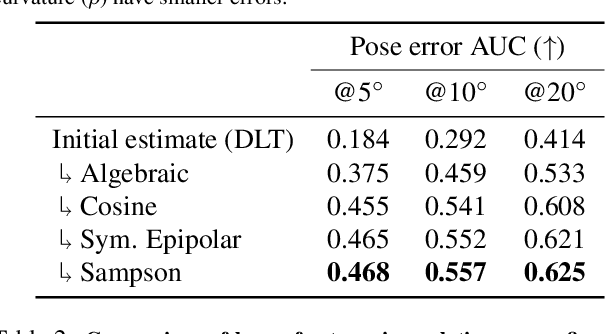
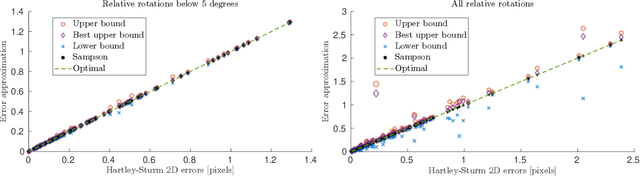
Many problems in computer vision can be formulated as geometric estimation problems, i.e. given a collection of measurements (e.g. point correspondences) we wish to fit a model (e.g. an essential matrix) that agrees with our observations. This necessitates some measure of how much an observation ``agrees" with a given model. A natural choice is to consider the smallest perturbation that makes the observation exactly satisfy the constraints. However, for many problems, this metric is expensive or otherwise intractable to compute. The so-called Sampson error approximates this geometric error through a linearization scheme. For epipolar geometry, the Sampson error is a popular choice and in practice known to yield very tight approximations of the corresponding geometric residual (the reprojection error). In this paper we revisit the Sampson approximation and provide new theoretical insights as to why and when this approximation works, as well as provide explicit bounds on the tightness under some mild assumptions. Our theoretical results are validated in several experiments on real data and in the context of different geometric estimation tasks.