 Add to Chrome
 Add to Firefox
 Add to Edge
Prediction-Powered Active Testing
Jul 09, 2026
Active testing provides a label--efficient approach to risk estimation by adaptively selecting which test points should be labelled. However, existing estimators fail to exploit the informative predictions of powerful black--box models, even though such predictions are increasingly available in settings where labels remain expensive. To address this, we propose \textbf{Prediction--Powered Active Testing (PPAT)}, a novel label--efficient risk estimation framework that combines the unbiased LURE estimator \citep{farquhar2021statistical} with a prediction--powered control variate. Rather than using proxy predictions as biased pseudo--labels, PPAT uses them to residualise the loss, preserving unbiasedness while reducing variance. Beyond the estimator itself, PPAT also changes which points should be acquired: we derive oracle and practical surrogate--based acquisition rules tailored to reducing the variance of our estimator. Moreover, we establish asymptotic normality for PPAT, yielding asymptotically valid confidence intervals and thus a principled estimate of the uncertainty around our estimates. Across tabular regression and image--classification tasks, PPAT outperforms existing methods in risk estimation, while its confidence intervals attain the target coverage with substantially fewer labels and smaller widths.

Robust Bayes-Assisted Conformal Prediction
Jul 05, 2026Bayes-assisted conformal prediction combines the strengths of Bayesian modelling with exact, distribution-free frequentist coverage guarantees. Although conformal validity is preserved even when the Bayesian working model (BWM) is misspecified, the size of the resulting prediction sets can degrade substantially when the prior is poorly aligned with the observed data. We address this limitation by introducing RoBAS (Robust Bayes-Assisted Shrinkage): a Bayes-assisted framework for constructing robust nonconformity scores, with two instantiations: one induced by a heavy-tailed BWM, and a closed-form empirical Bayes shrinkage score. The resulting scores adapt to the quality of the working information encoded in the prior: when this information is reliable, they exploit it to produce efficient prediction sets; when it is weak or inaccurate, they revert to the Distance-To-Average (DTA) score, a robust non-informative baseline. We evaluate the proposed scores on tabular and image regression tasks where the training distribution may differ from the calibration and test distributions, while the calibration and test data themselves remain exchangeable. We find that they are competitive with widely used scores in the absence of such shift, while substantially reducing interval widths in shifted settings.
Anytime-valid, Bayes-assisted,Prediction-Powered Inference
May 23, 2025Given a large pool of unlabelled data and a smaller amount of labels, prediction-powered inference (PPI) leverages machine learning predictions to increase the statistical efficiency of standard confidence interval procedures based solely on labelled data, while preserving their fixed-time validity. In this paper, we extend the PPI framework to the sequential setting, where labelled and unlabelled datasets grow over time. Exploiting Ville's inequality and the method of mixtures, we propose prediction-powered confidence sequence procedures that are valid uniformly over time and naturally accommodate prior knowledge on the quality of the predictions to further boost efficiency. We carefully illustrate the design choices behind our method and demonstrate its effectiveness in real and synthetic examples.
Rapidly Varying Completely Random Measures for Modeling Extremely Sparse Networks
May 19, 2025Completely random measures (CRMs) are fundamental to Bayesian nonparametric models, with applications in clustering, feature allocation, and network analysis. A key quantity of interest is the Laplace exponent, whose asymptotic behavior determines how the random structures scale. When the Laplace exponent grows nearly linearly - known as rapid variation - the induced models exhibit approximately linear growth in the number of clusters, features, or edges with sample size or network nodes. This regime is especially relevant for modeling sparse networks, yet existing CRM constructions lack tractability under rapid variation. We address this by introducing a new class of CRMs with index of variation $\alpha\in(0,1]$, defined as mixtures of stable or generalized gamma processes. These models offer interpretable parameters, include well-known CRMs as limiting cases, and retain analytical tractability through a tractable Laplace exponent and simple size-biased representation. We analyze the asymptotic properties of this CRM class and apply it to the Caron-Fox framework for sparse graphs. The resulting models produce networks with near-linear edge growth, aligning with empirical evidence from large-scale networks. Additionally, we present efficient algorithms for simulation and posterior inference, demonstrating practical advantages through experiments on real-world sparse network datasets.
FAB-PPI: Frequentist, Assisted by Bayes, Prediction-Powered Inference
Feb 04, 2025Prediction-powered inference (PPI) enables valid statistical inference by combining experimental data with machine learning predictions. When a sufficient number of high-quality predictions is available, PPI results in more accurate estimates and tighter confidence intervals than traditional methods. In this paper, we propose to inform the PPI framework with prior knowledge on the quality of the predictions. The resulting method, which we call frequentist, assisted by Bayes, PPI (FAB-PPI), improves over PPI when the observed prediction quality is likely under the prior, while maintaining its frequentist guarantees. Furthermore, when using heavy-tailed priors, FAB-PPI adaptively reverts to standard PPI in low prior probability regions. We demonstrate the benefits of FAB-PPI in real and synthetic examples.
Deep neural networks with dependent weights: Gaussian Process mixture limit, heavy tails, sparsity and compressibility
May 17, 2022
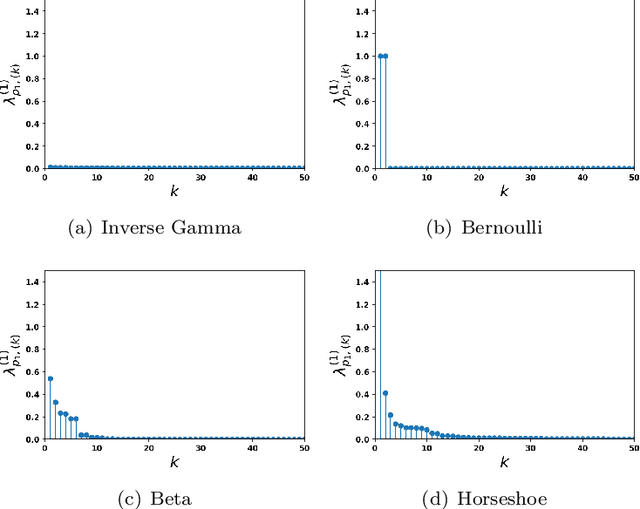
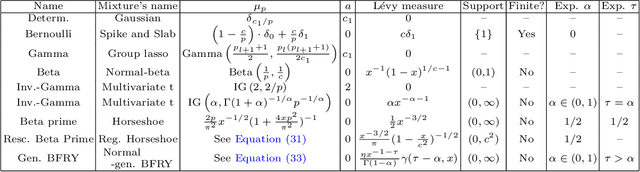
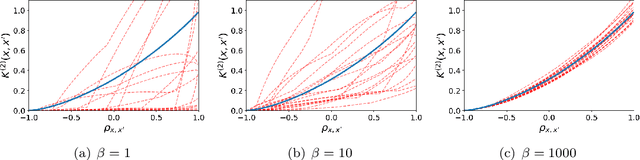
This article studies the infinite-width limit of deep feedforward neural networks whose weights are dependent, and modelled via a mixture of Gaussian distributions. Each hidden node of the network is assigned a nonnegative random variable that controls the variance of the outgoing weights of that node. We make minimal assumptions on these per-node random variables: they are iid and their sum, in each layer, converges to some finite random variable in the infinite-width limit. Under this model, we show that each layer of the infinite-width neural network can be characterised by two simple quantities: a non-negative scalar parameter and a L\'evy measure on the positive reals. If the scalar parameters are strictly positive and the L\'evy measures are trivial at all hidden layers, then one recovers the classical Gaussian process (GP) limit, obtained with iid Gaussian weights. More interestingly, if the L\'evy measure of at least one layer is non-trivial, we obtain a mixture of Gaussian processes (MoGP) in the large-width limit. The behaviour of the neural network in this regime is very different from the GP regime. One obtains correlated outputs, with non-Gaussian distributions, possibly with heavy tails. Additionally, we show that, in this regime, the weights are compressible, and feature learning is possible. Many sparsity-promoting neural network models can be recast as special cases of our approach, and we discuss their infinite-width limits; we also present an asymptotic analysis of the pruning error. We illustrate some of the benefits of the MoGP regime over the GP regime in terms of representation learning and compressibility on simulated, MNIST and Fashion MNIST datasets.
Non-exchangeable feature allocation models with sublinear growth of the feature sizes
Mar 30, 2020
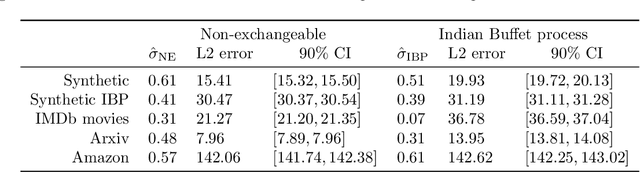
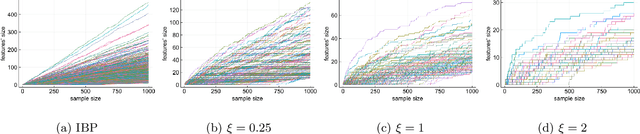

Feature allocation models are popular models used in different applications such as unsupervised learning or network modeling. In particular, the Indian buffet process is a flexible and simple one-parameter feature allocation model where the number of features grows unboundedly with the number of objects. The Indian buffet process, like most feature allocation models, satisfies a symmetry property of exchangeability: the distribution is invariant under permutation of the objects. While this property is desirable in some cases, it has some strong implications. Importantly, the number of objects sharing a particular feature grows linearly with the number of objects. In this article, we describe a class of non-exchangeable feature allocation models where the number of objects sharing a given feature grows sublinearly, where the rate can be controlled by a tuning parameter. We derive the asymptotic properties of the model, and show that such model provides a better fit and better predictive performances on various datasets.
A unified construction for series representations and finite approximations of completely random measures
May 26, 2019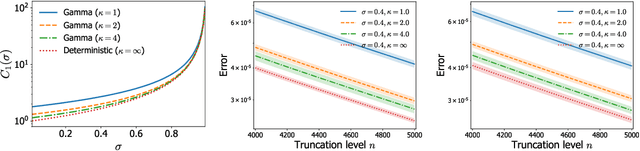
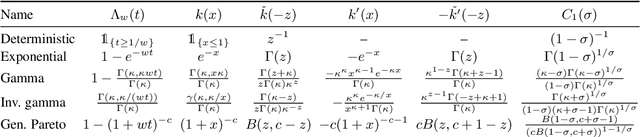
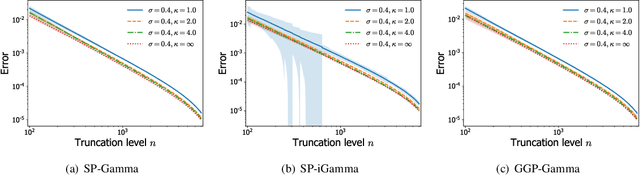
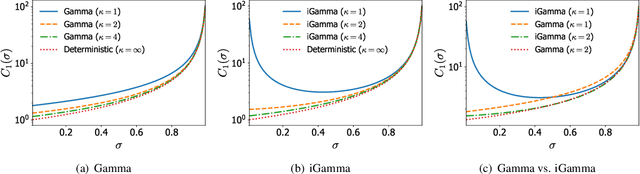
Infinite-activity completely random measures (CRMs) have become important building blocks of complex Bayesian nonparametric models. They have been successfully used in various applications such as clustering, density estimation, latent feature models, survival analysis or network science. Popular infinite-activity CRMs include the (generalized) gamma process and the (stable) beta process. However, except in some specific cases, exact simulation or scalable inference with these models is challenging and finite-dimensional approximations are often considered. In this work, we propose a general and unified framework to derive both series representations and finite-dimensional approximations of CRMs. Our framework can be seen as an extension of constructions based on size-biased sampling of Poisson point process [Perman1992]. It includes as special cases several known series representations as well as novel ones. In particular, we show that one can get novel series representations for the generalized gamma process and the stable beta process. We also provide some analysis of the truncation error.
Beyond the Chinese Restaurant and Pitman-Yor processes: Statistical Models with Double Power-law Behavior
Feb 13, 2019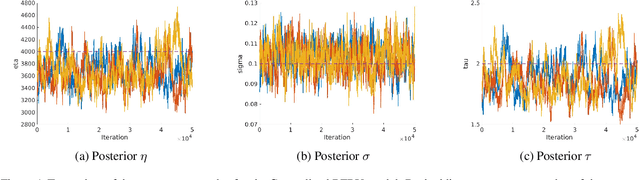
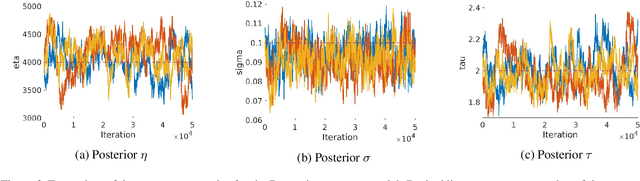
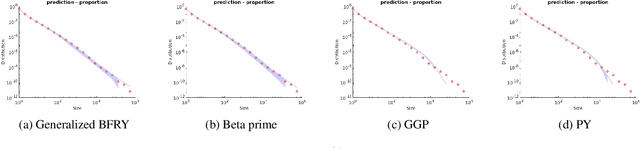
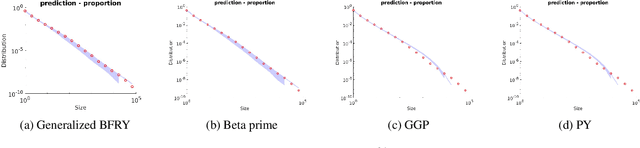
Bayesian nonparametric approaches, in particular the Pitman-Yor process and the associated two-parameter Chinese Restaurant process, have been successfully used in applications where the data exhibit a power-law behavior. Examples include natural language processing, natural images or networks. There is also growing empirical evidence that some datasets exhibit a two-regime power-law behavior: one regime for small frequencies, and a second regime, with a different exponent, for high frequencies. In this paper, we introduce a class of completely random measures which are doubly regularly-varying. Contrary to the Pitman-Yor process, we show that when completely random measures in this class are normalized to obtain random probability measures and associated random partitions, such partitions exhibit a double power-law behavior. We discuss in particular three models within this class: the beta prime process (Broderick et al. (2015, 2018), a novel process called generalized BFRY process, and a mixture construction. We derive efficient Markov chain Monte Carlo algorithms to estimate the parameters of these models. Finally, we show that the proposed models provide a better fit than the Pitman-Yor process on various datasets.
Modelling sparsity, heterogeneity, reciprocity and community structure in temporal interaction data
Oct 26, 2018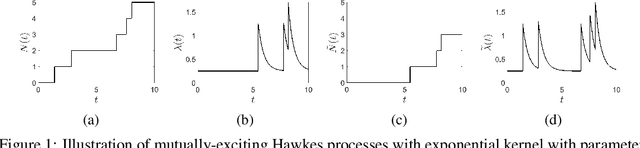
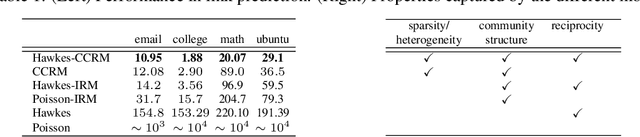
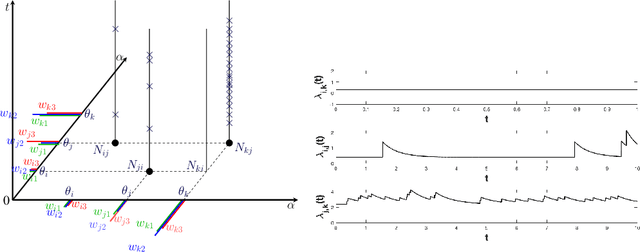

We propose a novel class of network models for temporal dyadic interaction data. Our goal is to capture a number of important features often observed in social interactions: sparsity, degree heterogeneity, community structure and reciprocity. We propose a family of models based on self-exciting Hawkes point processes in which events depend on the history of the process. The key component is the conditional intensity function of the Hawkes Process, which captures the fact that interactions may arise as a response to past interactions (reciprocity), or due to shared interests between individuals (community structure). In order to capture the sparsity and degree heterogeneity, the base (non time dependent) part of the intensity function builds on compound random measures following Todeschini et al. (2016). We conduct experiments on a variety of real-world temporal interaction data and show that the proposed model outperforms many competing approaches for link prediction, and leads to interpretable parameters.