 Add to Chrome
 Add to Firefox
 Add to Edge
Conformal Prediction for Molecular Properties under Label Shift
Aug 18, 2026
Drug discovery and development underpins healthcare but remains costly and failure-prone. A critical bottleneck lies in predicting molecular properties such as solubility, potency, and toxicity, which directly determine whether a candidate can advance from preclinical to clinical trials. Artificial Intelligence (AI) has accelerated this process, yet its reliability is often undermined by distribution shift, as experimental conditions frequently diverge from training data. In addition, conventional point predictions provide only single-value estimates, offering limited guidance for high-stakes experimental design. We address these challenges with a conformal prediction framework tailored to label shift. By weighting conformal scores using marginal label probability ratios, our method produces statistically rigorous prediction intervals without retraining. This enables robust uncertainty quantification even when property distributions drift, directly tackling one of the most pervasive obstacles to applying AI in real-world drug development. By moving beyond accuracy alone to provide actionable confidence measures, our approach enhances the trustworthiness of AI-driven predictions. This further aligns predictive modeling with regulatory demands for transparency and uncertainty reporting and ultimately supports more reliable decision-making in billion-dollar development pipelines.

Anytime-Valid Confirmation of Covariate Balance for Prespecified Corrections
Jul 25, 2026Many covariate-shift adaptation methods construct a correction $w(x)$, but users must still determine whether the corrected distribution is sufficiently balanced for the target stream. We study anytime-valid confirmation of prespecified corrections from sequential unlabeled target inputs. Our primary contribution is a procedure for confirming covariate balance. For a prespecified class of balancing functions and tolerances, time-uniform confidence sequences permit continuous monitoring and data-dependent stopping once all plausible target moments lie within their tolerance bands. If the correction is out of tolerance for at least one function, the probability of ever incorrectly confirming balance is at most the prescribed level. Upon stopping, the procedure yields a certificate local to the chosen functions and tolerances, yet providing an absolute downstream-adequacy statement that ordinary shift diagnostics generally do not. With finite source data, contracted bands preserve this guarantee while accounting for uncertainty in weighted source moments, whereas expanded bands support only compatibility diagnostics. As complementary information, we study a source-calibrated likelihood-ratio e-process whose KL-drift identity characterizes correction directions relative to the source. Under the source-reference distribution, the probability of ever crossing its evidence threshold is controlled, but crossing does not confirm balance. We also give an exponential-tilt test for departures beyond an acceptable correction region and deploy balance-confirmed corrections in weighted conformal prediction. Experiments illustrate false-confirmation control, locality to the balancing-function class, KL-drift diagnostics, acceptable-region monitoring, finite-source effects, and downstream conformal coverage under covariate shift.
Conformal Bayes for Two-Sided Censored Gaussian Regression under Label Shift
Jul 02, 2026Prediction under label shift becomes nonstandard when responses are censored. In a two-sided censored Gaussian model, latent values below $L$ and above $U$ are recorded at the boundary values, so the observed predictive distribution is mixed, with atoms at $L$ and $U$ and a continuous density on $(L,U)$. In this paper we develop conformal Bayes for this mixed-space setting by combining posterior predictive tilting with weighted conformal calibration. Under a two-sided Tobit Gaussian Bayesian prediction head with a Laplace posterior approximation, the tilted predictive distribution has left-atom, interior, and right-atom components, with a three-term closed-form normalizer. The resulting prediction set is a mixed highest density region that can combine boundary atoms with an interior interval and can reduce to atom-only sets under strong censoring. The main technical issue is that latent label shift does not directly give an ordinary density ratio on the observed censored scale. A latent exponential tilt induces tail-averaged atom weights at the censored boundaries, while the interior ratio remains density based. This yields a mixed observed-space calibration weight with two atom ratios and one interior density ratio. The weight corrects the calibration measure, while predictive tilting gives target-adapted mixed-HDR geometry. Synthetic experiments show that weighted tilted conformal Bayes restores marginal coverage with smaller sets than weighted source-score calibration, while revealing a trade-off between marginal coverage and component-wise behavior across atoms and interior observations.
Null-Calibrated Conformal Selection via Target-Membership Scores
Jun 21, 2026Conformal selection aims to identify test candidates whose unknown responses fall in a target region while controlling the false discovery rate. Existing methods often inherit prediction-oriented nonconformity scores, such as residual or clipped residual scores, from conformal prediction. We argue that the natural score for selection is instead the target-membership probability. This score directly addresses the binary event being selected, and any monotone transform of it gives the Neyman--Pearson oracle ranking at a fixed null selection level. This distinction is irrelevant for mean-monotone targets, where conventional scores induce essentially the same ranking, but becomes important for interval-valued, variance-driven, multimodal, or multi-condition targets, where prediction-oriented scores can be misaligned with selection power. We study membership-score-based conformal selection and isolate one conformal calibration route, Null-Calibrated Conformal Selection (NCCS), which ranks test scores against confirmed non-target calibration examples. Under null exchangeability, NCCS yields finite-sample valid null p-values, which can be combined with BY under arbitrary dependence or with BH under standard positive-dependence conditions. Experiments support the score principle: membership scores match conventional scores on mean-monotone targets, substantially improve over mean-score selection on variance-driven targets, and, when calibrated by NCCS, trade power for finite-sample null validity in rare-target regimes where direct empirical-FDP thresholding can be anti-conservative.
Conformal Candidate Certification for Offline Model-Based Optimization
Jun 13, 2026Offline model-based optimization (MBO) proposes candidates by optimizing a surrogate trained on a fixed historical dataset. Because candidates are deliberately out-of-distribution, surrogate rankings are least reliable exactly where the optimizer is most aggressive, yet existing methods provide no per-candidate statistical certificate that a design meets a target threshold. We propose \emph{Conformal Candidate Certification} (CCC), a post-hoc wrapper that attaches a calibrated one-sided lower bound to each candidate and advances only those whose bound exceeds the target. We show that entropy-regularized surrogate maximization induces a Gibbs-tilted proposal, so the same surrogate supplies importance weights for weighted conformal prediction without a separate density-ratio estimation step. In a controlled synthetic study, CCC certifies $16.7\%$ of an aggressive proposal pool with empirical coverage 0.990 at nominal 0.90, while standard conformal prediction ignoring the covariate shift collapses to 0.416 coverage.
Anytime-Valid Confirmation of Label-Shift Corrections
Jun 12, 2026In small-batch scientific deployments, labeled target outcomes may be too scarce for reliable shift estimation even when unlabeled target inputs are available. We address the complementary setting where the practitioner has a pre-specified label-shift correction from domain knowledge and asks whether incoming labeled outcomes support it. We show that the per-observation likelihood ratio between a label-shift-corrected predictive and the source predictive is a conditional e-value, so its running product is a nonnegative martingale and Ville's inequality yields an anytime-valid confirmation rule. The log martingale equals the cumulative negative log-predictive density (NLPD) gap between the source and the corrected predictive, converting routine model monitoring into a formal sequential test. Rejection means the incoming data support the posited correction relative to the source predictive, but it is not a precise estimate of the degree of shift. Closed forms are available for GP sources with Gaussian label-shift ratios. GP regression simulations validate Type I control, finite-sample power, miscalibration sensitivity, and the small-batch advantage of a reliable prior over label-based re-estimation.
Conformal Bayes under Label Shift: Post-Hoc Calibration vs. In-Training Adaptation
Jun 10, 2026Conformal Bayes combines Bayesian posterior predictives with conformal calibration to produce prediction sets that are both statistically valid and geometrically efficient. We study conformal Bayes under label shift from a unified perspective, identifying two complementary approaches that restore nominal target-domain coverage through importance-weighted conformal calibration but operate through independent mechanisms. \emph{Post-hoc calibration} tilts the posterior predictive toward the target domain and corrects the conformal threshold via an importance-weighted quantile, leaving the parameter posterior unchanged. \emph{In-training adaptation} tilts the parameter posterior itself to the target domain, producing a corrected predictive whose highest predictive density region serves as the highest predictive density (HPD) based prediction set under the fitted target predictive; efficiency is model-dependent and does not imply finite-sample conditional optimality. Two controlled experiments show that in an unbiased training regime both strategies achieve valid coverage equally, while in a lead-optimization regime in-training adaptation acts as a debiasing operator, reducing interval width at unchanged coverage.
On Uncertainty Estimation by Tree-based Surrogate Models in Sequential Model-based Optimization
Feb 22, 2022
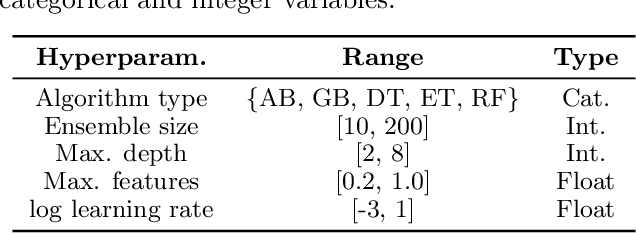
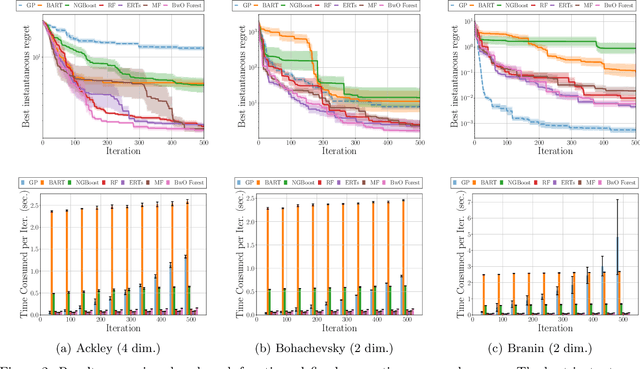
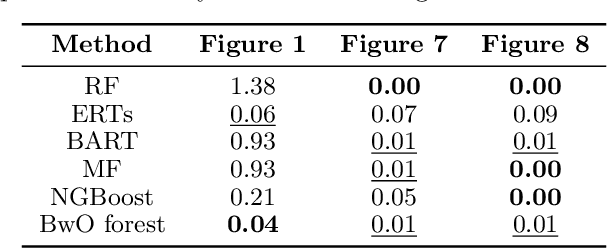
Sequential model-based optimization sequentially selects a candidate point by constructing a surrogate model with the history of evaluations, to solve a black-box optimization problem. Gaussian process (GP) regression is a popular choice as a surrogate model, because of its capability of calculating prediction uncertainty analytically. On the other hand, an ensemble of randomized trees is another option and has practical merits over GPs due to its scalability and easiness of handling continuous/discrete mixed variables. In this paper we revisit various ensembles of randomized trees to investigate their behavior in the perspective of prediction uncertainty estimation. Then, we propose a new way of constructing an ensemble of randomized trees, referred to as BwO forest, where bagging with oversampling is employed to construct bootstrapped samples that are used to build randomized trees with random splitting. Experimental results demonstrate the validity and good performance of BwO forest over existing tree-based models in various circumstances.
Combinatorial Bayesian Optimization with Random Mapping Functions to Convex Polytope
Nov 26, 2020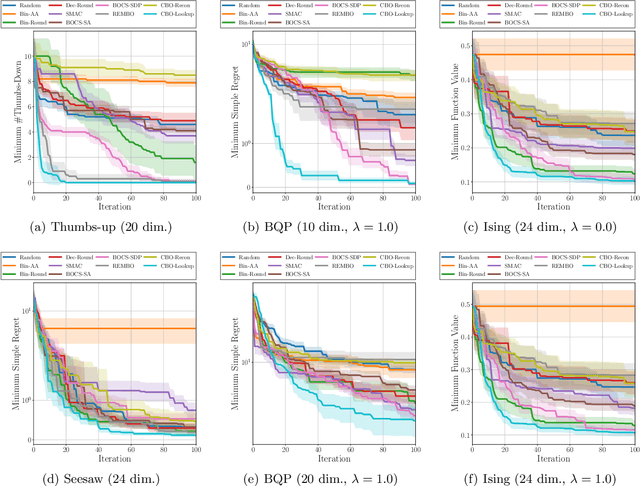
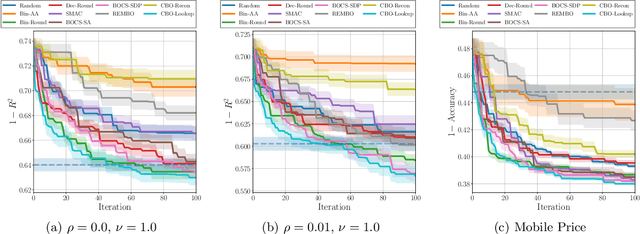
Bayesian optimization is a popular method for solving the problem of global optimization of an expensive-to-evaluate black-box function. It relies on a probabilistic surrogate model of the objective function, upon which an acquisition function is built to determine where next to evaluate the objective function. In general, Bayesian optimization with Gaussian process regression operates on a continuous space. When input variables are categorical or discrete, an extra care is needed. A common approach is to use one-hot encoded or Boolean representation for categorical variables which might yield a {\em combinatorial explosion} problem. In this paper we present a method for Bayesian optimization in a combinatorial space, which can operate well in a large combinatorial space. The main idea is to use a random mapping which embeds the combinatorial space into a convex polytope in a continuous space, on which all essential process is performed to determine a solution to the black-box optimization in the combinatorial space. We describe our {\em combinatorial Bayesian optimization} algorithm and present its regret analysis. Numerical experiments demonstrate that our method outperforms existing methods.
Sparse Network Inversion for Key Instance Detection in Multiple Instance Learning
Sep 08, 2020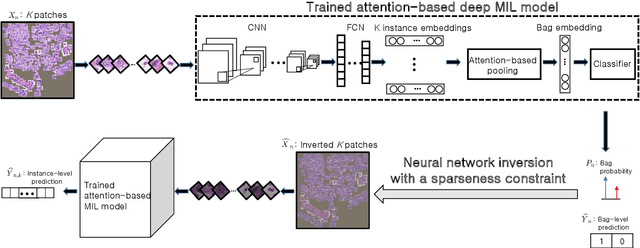
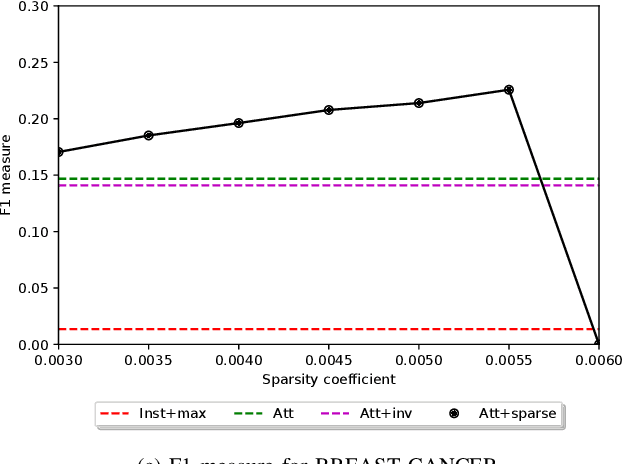
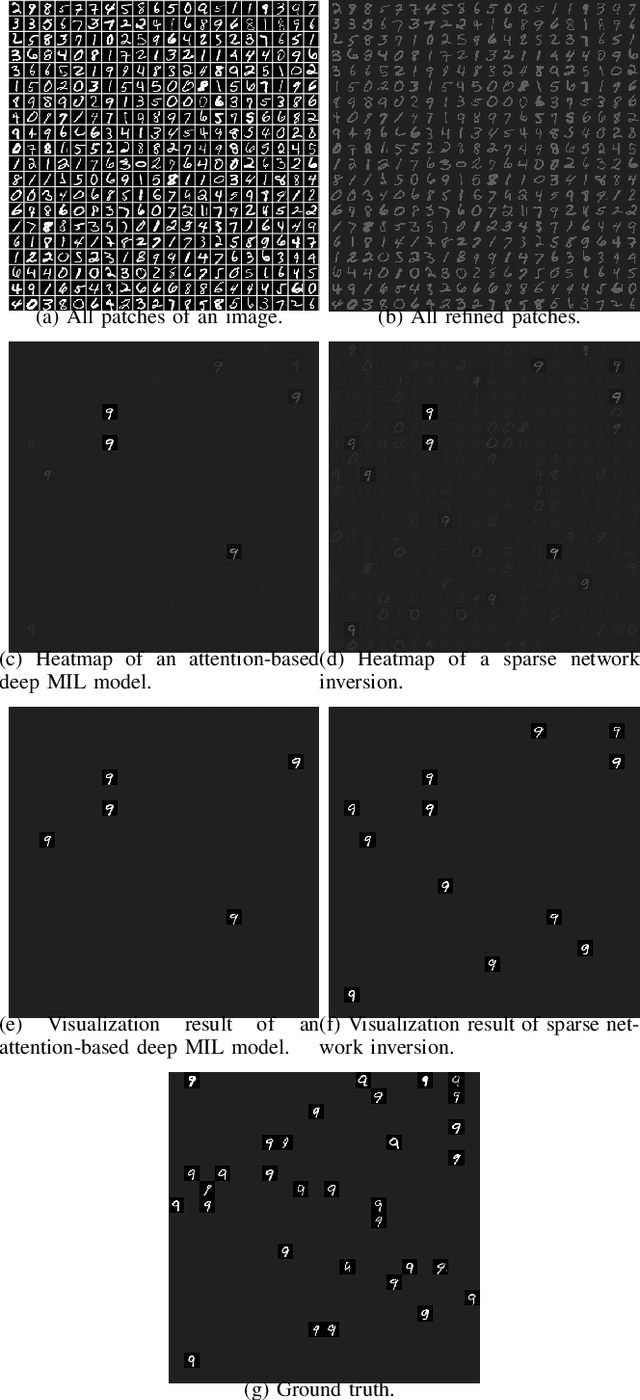
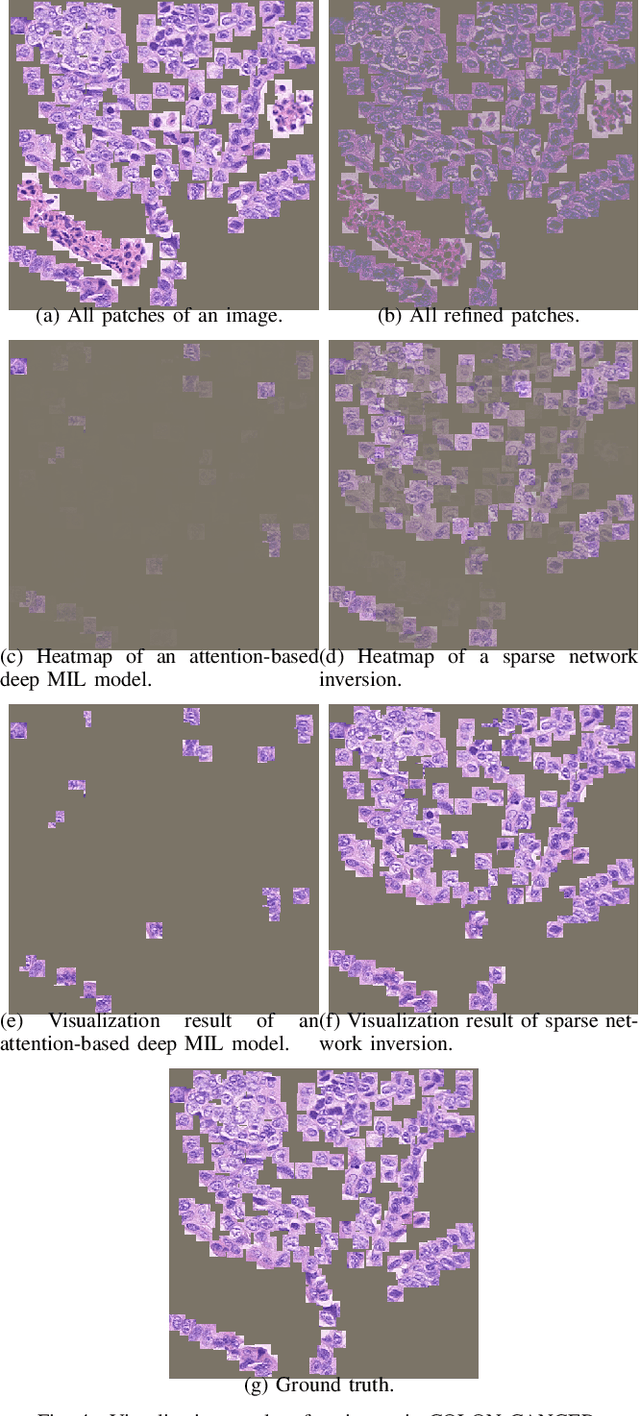
Multiple Instance Learning (MIL) involves predicting a single label for a bag of instances, given positive or negative labels at bag-level, without accessing to label for each instance in the training phase. Since a positive bag contains both positive and negative instances, it is often required to detect positive instances (key instances) when a set of instances is categorized as a positive bag. The attention-based deep MIL model is a recent advance in both bag-level classification and key instance detection (KID). However, if the positive and negative instances in a positive bag are not clearly distinguishable, the attention-based deep MIL model has limited KID performance as the attention scores are skewed to few positive instances. In this paper, we present a method to improve the attention-based deep MIL model in the task of KID. The main idea is to use the neural network inversion to find which instances made contribution to the bag-level prediction produced by the trained MIL model. Moreover, we incorporate a sparseness constraint into the neural network inversion, leading to the sparse network inversion which is solved by the proximal gradient method. Numerical experiments on an MNIST-based image MIL dataset and two real-world histopathology datasets verify the validity of our method, demonstrating the KID performance is significantly improved while the performance of bag-level prediction is maintained.