 Add to Chrome
 Add to Firefox
 Add to Edge
Optimizing Rank for High-Fidelity Implicit Neural Representations
Dec 16, 2025
Implicit Neural Representations (INRs) based on vanilla Multi-Layer Perceptrons (MLPs) are widely believed to be incapable of representing high-frequency content. This has directed research efforts towards architectural interventions, such as coordinate embeddings or specialized activation functions, to represent high-frequency signals. In this paper, we challenge the notion that the low-frequency bias of vanilla MLPs is an intrinsic, architectural limitation to learn high-frequency content, but instead a symptom of stable rank degradation during training. We empirically demonstrate that regulating the network's rank during training substantially improves the fidelity of the learned signal, rendering even simple MLP architectures expressive. Extensive experiments show that using optimizers like Muon, with high-rank, near-orthogonal updates, consistently enhances INR architectures even beyond simple ReLU MLPs. These substantial improvements hold across a diverse range of domains, including natural and medical images, and novel view synthesis, with up to 9 dB PSNR improvements over the previous state-of-the-art. Our project page, which includes code and experimental results, is available at: (https://muon-inrs.github.io).

Equivariant Differentially Private Deep Learning
Jan 30, 2023The formal privacy guarantee provided by Differential Privacy (DP) bounds the leakage of sensitive information from deep learning models. In practice, however, this comes at a severe computation and accuracy cost. The recently established state of the art (SOTA) results in image classification under DP are due to the use of heavy data augmentation and large batch sizes, leading to a drastically increased computation overhead. In this work, we propose to use more efficient models with improved feature quality by introducing steerable equivariant convolutional networks for DP training. We demonstrate that our models are able to outperform the current SOTA performance on CIFAR-10 by up to $9\%$ across different $\varepsilon$-values while reducing the number of model parameters by a factor of $35$ and decreasing the computation time by more than $90 \%$. Our results are a large step towards efficient model architectures that make optimal use of their parameters and bridge the privacy-utility gap between private and non-private deep learning for computer vision.
Bridging the Gap: Differentially Private Equivariant Deep Learning for Medical Image Analysis
Sep 09, 2022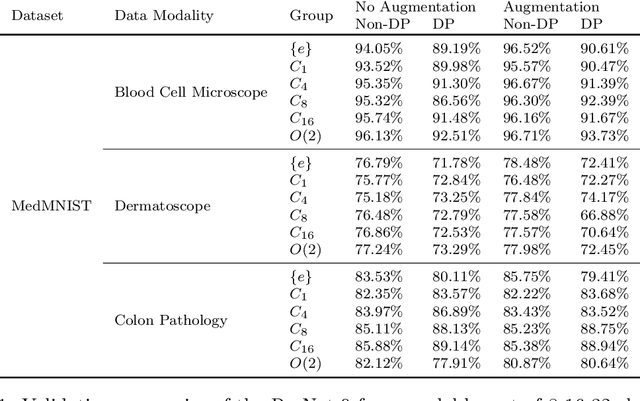
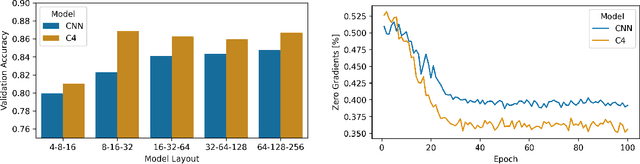
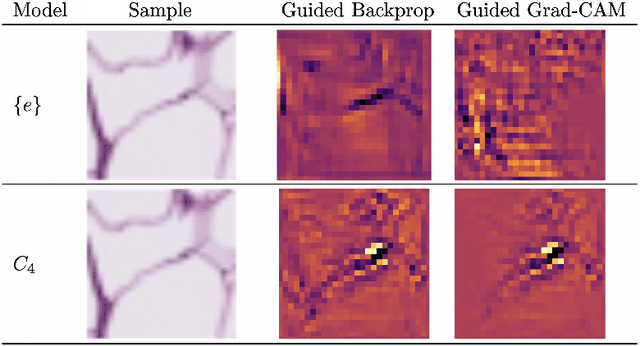
Machine learning with formal privacy-preserving techniques like Differential Privacy (DP) allows one to derive valuable insights from sensitive medical imaging data while promising to protect patient privacy, but it usually comes at a sharp privacy-utility trade-off. In this work, we propose to use steerable equivariant convolutional networks for medical image analysis with DP. Their improved feature quality and parameter efficiency yield remarkable accuracy gains, narrowing the privacy-utility gap.