 Add to Chrome
 Add to Firefox
 Add to Edge
What Transfers Under Source Shift? Definitions, Examples, and Fine-Tuning for Climate Disclosure Classification
Jul 20, 2026
Climate disclosure classification is a fundamental task for analysing corporate climate disclosures, yet such disclosures appear in many different sources -- annual reports, press releases, and earnings calls -- that differ in length, purpose, and writing style. Existing evaluations are mostly conducted within a single source, leaving open whether common LLM adaptation strategies remain effective under source shift. We reframe climate disclosure classification as a cross-source adaptation problem and study three widely used adaptation strategies -- definitions, examples, and fine-tuning -- across eleven open- and closed-source LLMs, using two corpora that share the same label space but come from different sources. We find that all strategies bring positive cross-source gains on average, but the strongest in-source strategies are not the strongest cross-source ones: similarity-based retrieval and LoRA fine-tuning gain most in-source but lose most of that advantage under source shift; randomly selected few-shot examples, a weaker in-source baseline, retain their advantage more reliably; definitions transfer most consistently, though only when their granularity matches the target text. Across these strategies, when the source changes, simpler is often safer.

Distributed Interaction Graph Construction for Dynamic DCOPs in Cooperative Multi-agent Systems
Dec 07, 2022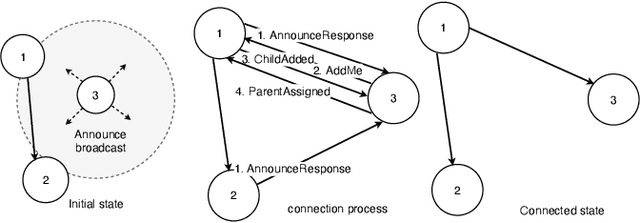
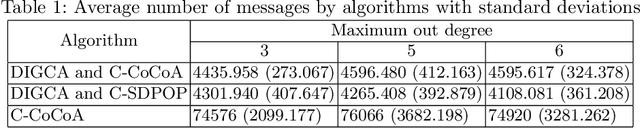
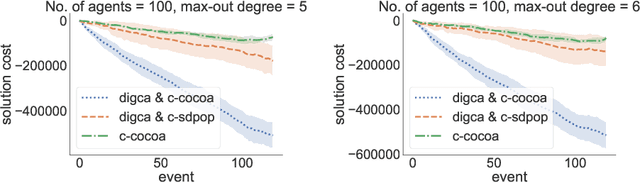
DCOP algorithms usually rely on interaction graphs to operate. In open and dynamic environments, such methods need to address how this interaction graph is generated and maintained among agents. Existing methods require reconstructing the entire graph upon detecting changes in the environment or assuming that new agents know potential neighbors to facilitate connection. We propose a novel distributed interaction graph construction algorithm to address this problem. The proposed method does not assume a predefined constraint graph and stabilizes after disruptive changes in the environment. We evaluate our approach by pairing it with existing DCOP algorithms to solve several generated dynamic problems. The experiment results show that the proposed algorithm effectively constructs and maintains a stable multi-agent interaction graph for open and dynamic environments.
A Robust Model for Trust Evaluation during Interactions between Agents in a Sociable Environment
Apr 17, 2021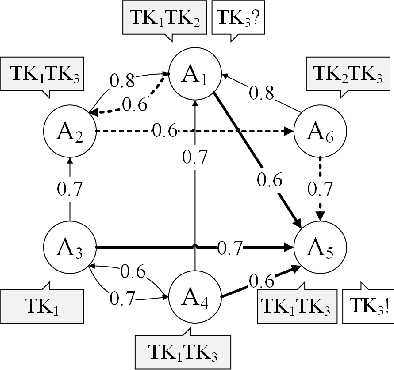
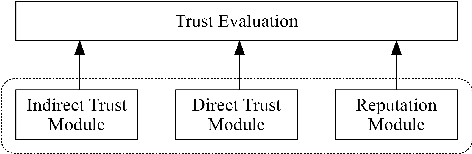
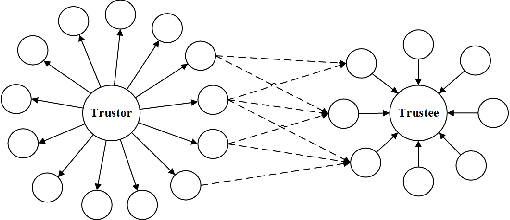
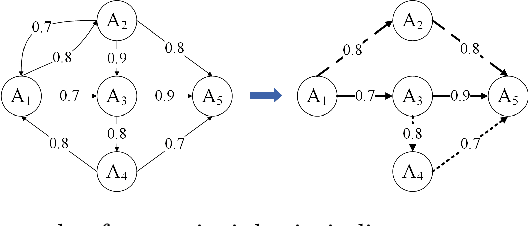
Trust evaluation is an important topic in both research and applications in sociable environments. This paper presents a model for trust evaluation between agents by the combination of direct trust, indirect trust through neighbouring links and the reputation of an agent in the environment (i.e. social network) to provide the robust evaluation. Our approach is typology independent from social network structures and in a decentralized manner without a central controller, so it can be used in broad domains.