 Add to Chrome
 Add to Firefox
 Add to Edge
Brain-Inspired Capture: Evidence-Driven Neuromimetic Perceptual Simulation for Visual Decoding
Apr 20, 2026
Visual decoding of neurophysiological signals is a critical challenge for brain-computer interfaces (BCIs) and computational neuroscience. However, current approaches are often constrained by the systematic and stochastic gaps between neural and visual modalities, largely neglecting the intrinsic computational mechanisms of the Human Visual System (HVS). To address this, we propose Brain-Inspired Capture (BI-Cap), a neuromimetic perceptual simulation paradigm that aligns these modalities by emulating HVS processing. Specifically, we construct a neuromimetic pipeline comprising four biologically plausible dynamic and static transformations, coupled with Mutual Information (MI)-guided dynamic blur regulation to simulate adaptive visual processing. Furthermore, to mitigate the inherent non-stationarity of neural activity, we introduce an evidence-driven latent space representation. This formulation explicitly models uncertainty, thereby ensuring robust neural embeddings. Extensive evaluations on zero-shot brain-to-image retrieval across two public benchmarks demonstrate that BI-Cap substantially outperforms state-of-the-art methods, achieving relative gains of 9.2\% and 8.0\%, respectively. We have released the source code on GitHub through the link https://github.com/flysnow1024/BI-Cap.

D4PM: A Dual-branch Driven Denoising Diffusion Probabilistic Model with Joint Posterior Diffusion Sampling for EEG Artifacts Removal
Sep 17, 2025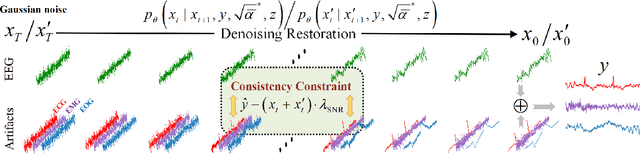
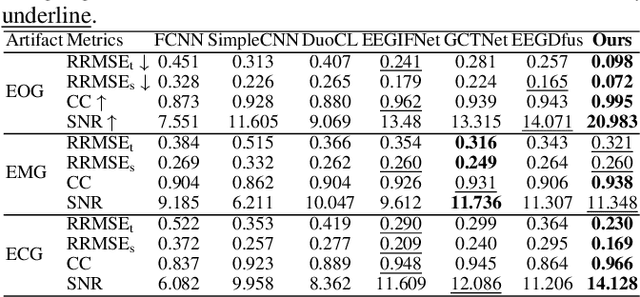
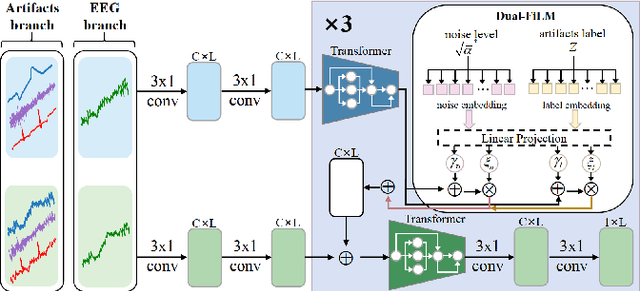
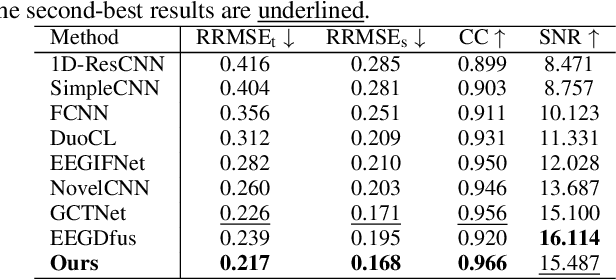
Artifact removal is critical for accurate analysis and interpretation of Electroencephalogram (EEG) signals. Traditional methods perform poorly with strong artifact-EEG correlations or single-channel data. Recent advances in diffusion-based generative models have demonstrated strong potential for EEG denoising, notably improving fine-grained noise suppression and reducing over-smoothing. However, existing methods face two main limitations: lack of temporal modeling limits interpretability and the use of single-artifact training paradigms ignore inter-artifact differences. To address these issues, we propose D4PM, a dual-branch driven denoising diffusion probabilistic model that unifies multi-type artifact removal. We introduce a dual-branch conditional diffusion architecture to implicitly model the data distribution of clean EEG and artifacts. A joint posterior sampling strategy is further designed to collaboratively integrate complementary priors for high-fidelity EEG reconstruction. Extensive experiments on two public datasets show that D4PM delivers superior denoising. It achieves new state-of-the-art performance in EOG artifact removal, outperforming all publicly available baselines. The code is available at https://github.com/flysnow1024/D4PM.