 Add to Chrome
 Add to Firefox
 Add to Edge
Rate-Aware Quantum-Inspired Trajectory Learning for Interference-Limited Multi-UAV Networks
Jun 24, 2026
Unmanned aerial vehicle (UAV) can provide on-demand, high-capacity connectivity in disaster and normal situation. However, it faces a challenge of curse of dimensionality in trajectory optimization, where interference-limited environments and vast search spaces make real-time coordination computationally expensive. To overcome this challenge, we propose the Rate-Aware Quantum-Annealed Graph Condensation (RA-QAGC) scheme, which combines rate-aware graph abstraction with decentralized reinforcement learning to enable scalable, interference-aware UAV coordination. By identifying high throughput locations and guiding UAV trajectory adaptation toward throughput-optimal regions, RA-QAGC effectively balances network capacity by maintaining quality-of-service (QoS) requirements. Simulation results demonstrate the proposal outperformed over existing schemes by achieving 59.4 Mbps total throughput and 23.9 Mbps priority-user throughput, representing gains of approximately 15% and 34%, respectively, over the baseline schemes.

From Graphs to Gates: DNS-HyXNet, A Lightweight and Deployable Sequential Model for Real-Time DNS Tunnel Detection
Dec 10, 2025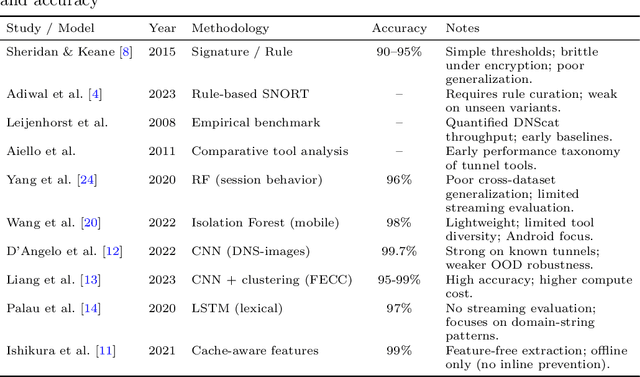
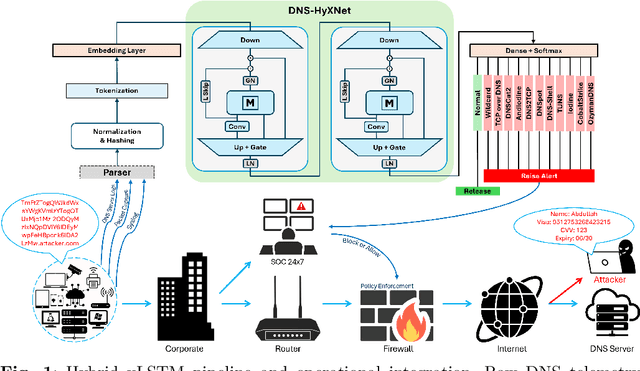
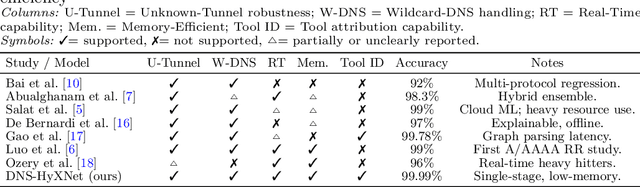
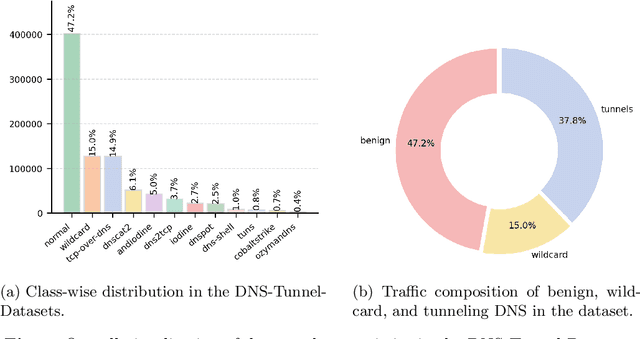
Domain Name System (DNS) tunneling remains a covert channel for data exfiltration and command-and-control communication. Although graph-based methods such as GraphTunnel achieve strong accuracy, they introduce significant latency and computational overhead due to recursive parsing and graph construction, limiting their suitability for real-time deployment. This work presents DNS-HyXNet, a lightweight extended Long Short-Term Memory (xLSTM) hybrid framework designed for efficient sequence-based DNS tunnel detection. DNS-HyXNet integrates tokenized domain embeddings with normalized numerical DNS features and processes them through a two-layer xLSTM network that directly learns temporal dependencies from packet sequences, eliminating the need for graph reconstruction and enabling single-stage multi-class classification. The model was trained and evaluated on two public benchmark datasets with carefully tuned hyperparameters to ensure low memory consumption and fast inference. Across all experimental splits of the DNS-Tunnel-Datasets, DNS-HyXNet achieved up to 99.99% accuracy, with macro-averaged precision, recall, and F1-scores exceeding 99.96%, and demonstrated a per-sample detection latency of just 0.041 ms, confirming its scalability and real-time readiness. These results show that sequential modeling with xLSTM can effectively replace computationally expensive recursive graph generation, offering a deployable and energy-efficient alternative for real-time DNS tunnel detection on commodity hardware.