 Add to Chrome
 Add to Firefox
 Add to Edge
DocShield: Towards AI Document Safety via Evidence-Grounded Agentic Reasoning
Apr 03, 2026
The rapid progress of generative AI has enabled increasingly realistic text-centric image forgeries, posing major challenges to document safety. Existing forensic methods mainly rely on visual cues and lack evidence-based reasoning to reveal subtle text manipulations. Detection, localization, and explanation are often treated as isolated tasks, limiting reliability and interpretability. To tackle these challenges, we propose DocShield, the first unified framework formulating text-centric forgery analysis as a visual-logical co-reasoning problem. At its core, a novel Cross-Cues-aware Chain of Thought (CCT) mechanism enables implicit agentic reasoning, iteratively cross-validating visual anomalies with textual semantics to produce consistent, evidence-grounded forensic analysis. We further introduce a Weighted Multi-Task Reward for GRPO-based optimization, aligning reasoning structure, spatial evidence, and authenticity prediction. Complementing the framework, we construct RealText-V1, a multilingual dataset of document-like text images with pixel-level manipulation masks and expert-level textual explanations. Extensive experiments show DocShield significantly outperforms existing methods, improving macro-average F1 by 41.4% over specialized frameworks and 23.4% over GPT-4o on T-IC13, with consistent gains on the challenging T-SROIE benchmark. Our dataset, model, and code will be publicly released.

LogicLens: Visual-Logical Co-Reasoning for Text-Centric Forgery Analysis
Dec 25, 2025Sophisticated text-centric forgeries, fueled by rapid AIGC advancements, pose a significant threat to societal security and information authenticity. Current methods for text-centric forgery analysis are often limited to coarse-grained visual analysis and lack the capacity for sophisticated reasoning. Moreover, they typically treat detection, grounding, and explanation as discrete sub-tasks, overlooking their intrinsic relationships for holistic performance enhancement. To address these challenges, we introduce LogicLens, a unified framework for Visual-Textual Co-reasoning that reformulates these objectives into a joint task. The deep reasoning of LogicLens is powered by our novel Cross-Cues-aware Chain of Thought (CCT) mechanism, which iteratively cross-validates visual cues against textual logic. To ensure robust alignment across all tasks, we further propose a weighted multi-task reward function for GRPO-based optimization. Complementing this framework, we first designed the PR$^2$ (Perceiver, Reasoner, Reviewer) pipeline, a hierarchical and iterative multi-agent system that generates high-quality, cognitively-aligned annotations. Then, we constructed RealText, a diverse dataset comprising 5,397 images with fine-grained annotations, including textual explanations, pixel-level segmentation, and authenticity labels for model training. Extensive experiments demonstrate the superiority of LogicLens across multiple benchmarks. In a zero-shot evaluation on T-IC13, it surpasses the specialized framework by 41.4% and GPT-4o by 23.4% in macro-average F1 score. Moreover, on the challenging dense-text T-SROIE dataset, it establishes a significant lead over other MLLM-based methods in mF1, CSS, and the macro-average F1. Our dataset, model, and code will be made publicly available.
A Survey on Deep Learning-based Spatio-temporal Action Detection
Aug 03, 2023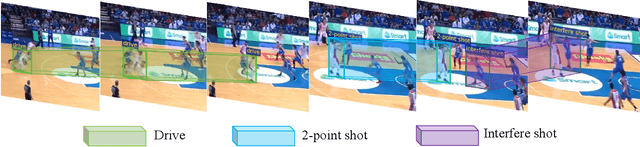
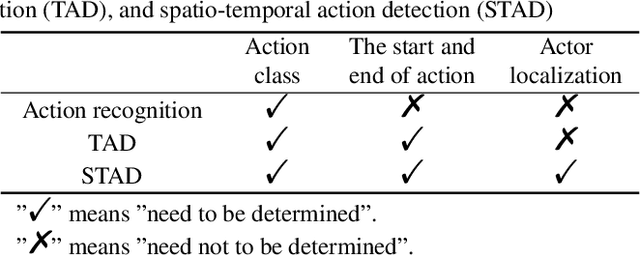
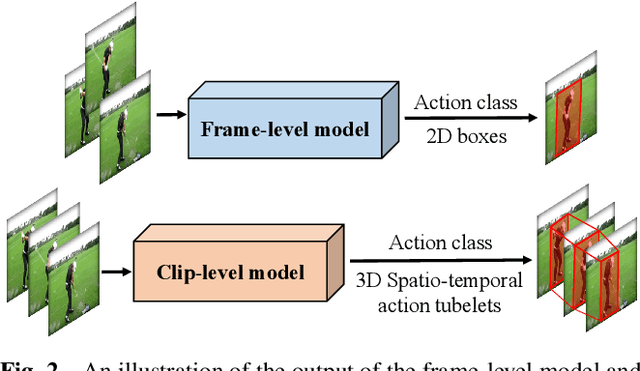
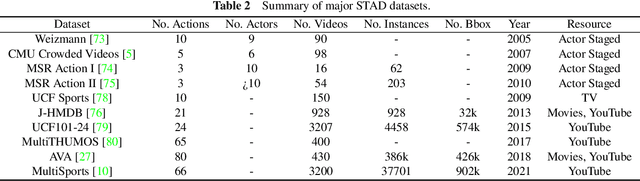
Spatio-temporal action detection (STAD) aims to classify the actions present in a video and localize them in space and time. It has become a particularly active area of research in computer vision because of its explosively emerging real-world applications, such as autonomous driving, visual surveillance, entertainment, etc. Many efforts have been devoted in recent years to building a robust and effective framework for STAD. This paper provides a comprehensive review of the state-of-the-art deep learning-based methods for STAD. Firstly, a taxonomy is developed to organize these methods. Next, the linking algorithms, which aim to associate the frame- or clip-level detection results together to form action tubes, are reviewed. Then, the commonly used benchmark datasets and evaluation metrics are introduced, and the performance of state-of-the-art models is compared. At last, this paper is concluded, and a set of potential research directions of STAD are discussed.