 Add to Chrome
 Add to Firefox
 Add to Edge
Do Image-Text Metrics Respect Semantic Invariances?
May 23, 2026
Reference-free image-to-text evaluators are now standard for scoring image-caption alignment, yet it is unclear whether they respect semantic invariances. We present an invariance probe on five popular evaluators (CLIPScore, PAC-S, UMIC, FLEUR, and a deterministic LLM judge) under semantics-preserving perturbations along three axes -- spatial (flips, context-preserving repositioning, light rotations), object (scale, category), and socio-linguistic framing (cultural/economic adjectives with neutral and length-matched controls). Across curated slices of three detection datasets and three caption evaluation suites, we find consistent non-semantic sensitivities, where benign spatial edits and simple phrasing changes shift scores by $\approx$6--9\% on average, and for systems separated by just 0.7\%, these shifts can cause ranking flips in up to $\sim$37\% of cases, particularly under spatial changes. A small human study also supports this finding and confirms that annotators generally judge perturbed pairs as equally correct, so these shifts reflect metric behavior rather than semantic change. We further propose invariance-calibrated scoring, a post-hoc adjustment that roughly halves median absolute sensitivity while retaining correlation with learned caption evaluators.

CommonLID: Re-evaluating State-of-the-Art Language Identification Performance on Web Data
Jan 25, 2026Language identification (LID) is a fundamental step in curating multilingual corpora. However, LID models still perform poorly for many languages, especially on the noisy and heterogeneous web data often used to train multilingual language models. In this paper, we introduce CommonLID, a community-driven, human-annotated LID benchmark for the web domain, covering 109 languages. Many of the included languages have been previously under-served, making CommonLID a key resource for developing more representative high-quality text corpora. We show CommonLID's value by using it, alongside five other common evaluation sets, to test eight popular LID models. We analyse our results to situate our contribution and to provide an overview of the state of the art. In particular, we highlight that existing evaluations overestimate LID accuracy for many languages in the web domain. We make CommonLID and the code used to create it available under an open, permissive license.
FlexDoc: Parameterized Sampling for Diverse Multilingual Synthetic Documents for Training Document Understanding Models
Oct 02, 2025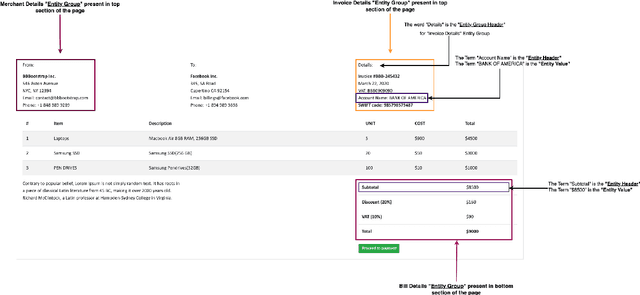
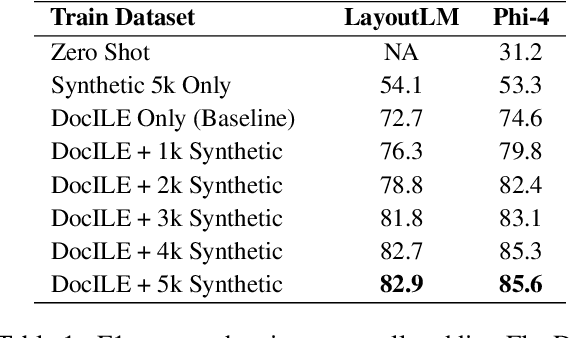
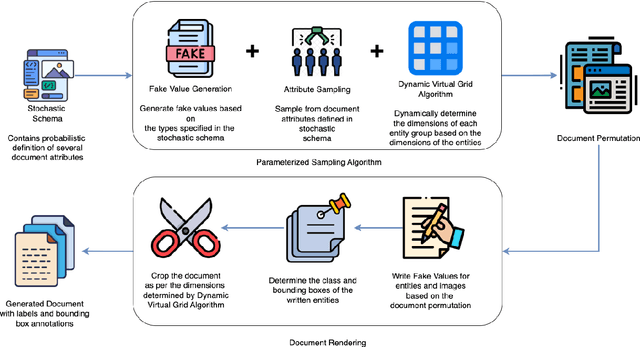
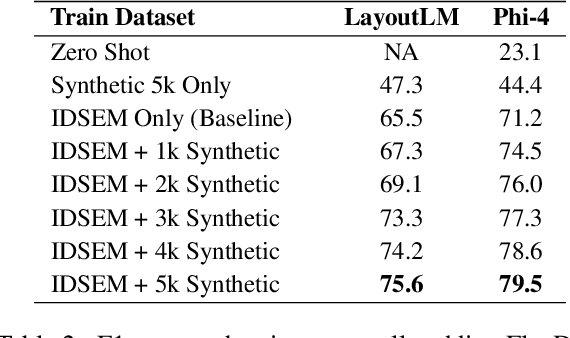
Developing document understanding models at enterprise scale requires large, diverse, and well-annotated datasets spanning a wide range of document types. However, collecting such data is prohibitively expensive due to privacy constraints, legal restrictions, and the sheer volume of manual annotation needed - costs that can scale into millions of dollars. We introduce FlexDoc, a scalable synthetic data generation framework that combines Stochastic Schemas and Parameterized Sampling to produce realistic, multilingual semi-structured documents with rich annotations. By probabilistically modeling layout patterns, visual structure, and content variability, FlexDoc enables the controlled generation of diverse document variants at scale. Experiments on Key Information Extraction (KIE) tasks demonstrate that FlexDoc-generated data improves the absolute F1 Score by up to 11% when used to augment real datasets, while reducing annotation effort by over 90% compared to traditional hard-template methods. The solution is in active deployment, where it has accelerated the development of enterprise-grade document understanding models while significantly reducing data acquisition and annotation costs.