 Add to Chrome
 Add to Firefox
 Add to Edge
RECOMP: Improving Retrieval-Augmented LMs with Compression and Selective Augmentation
Oct 06, 2023
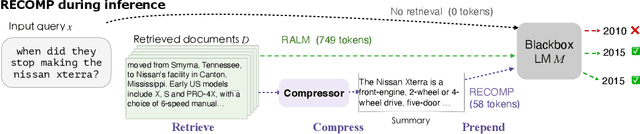
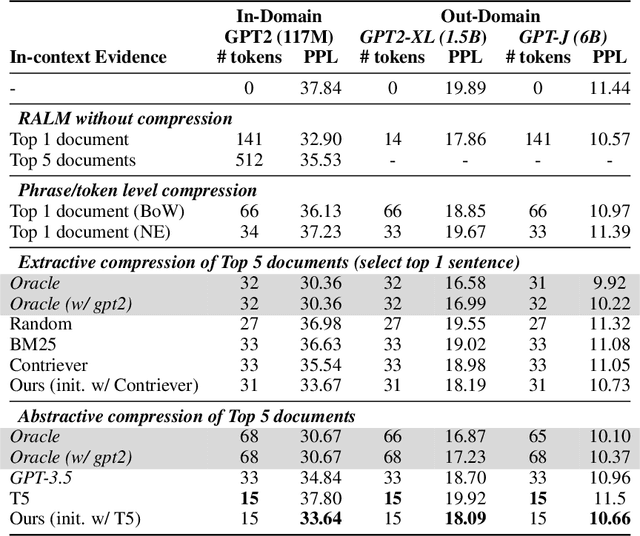
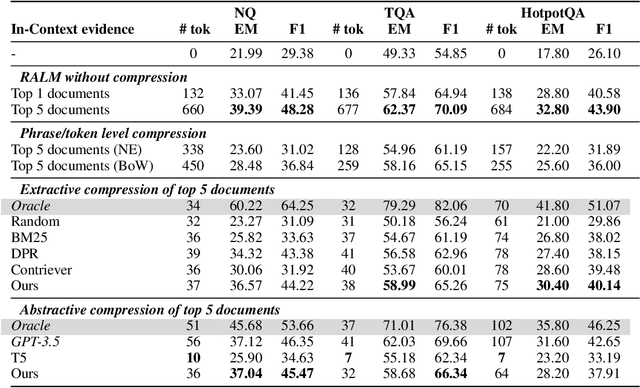
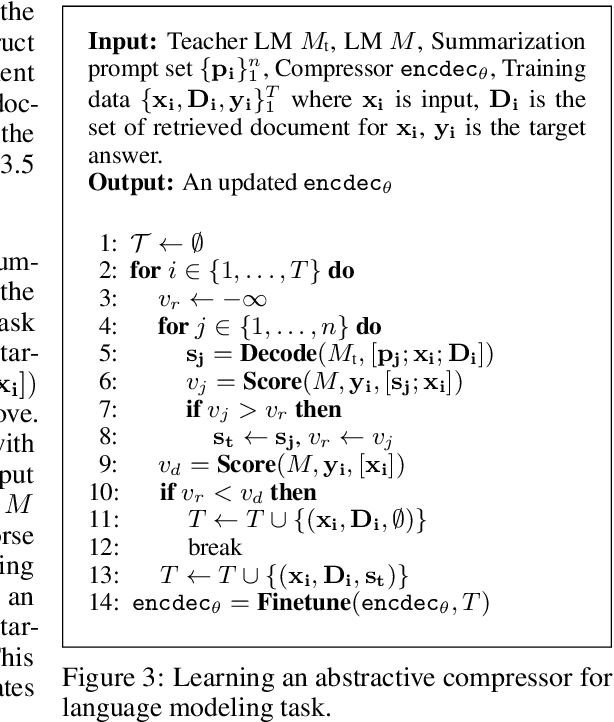
Retrieving documents and prepending them in-context at inference time improves performance of language model (LMs) on a wide range of tasks. However, these documents, often spanning hundreds of words, make inference substantially more expensive. We propose compressing the retrieved documents into textual summaries prior to in-context integration. This not only reduces the computational costs but also relieves the burden of LMs to identify relevant information in long retrieved documents. We present two compressors -- an extractive compressor which selects useful sentences from retrieved documents and an abstractive compressor which generates summaries by synthesizing information from multiple documents. Both compressors are trained to improve LMs' performance on end tasks when the generated summaries are prepended to the LMs' input, while keeping the summary concise.If the retrieved documents are irrelevant to the input or offer no additional information to LM, our compressor can return an empty string, implementing selective augmentation.We evaluate our approach on language modeling task and open domain question answering task. We achieve a compression rate of as low as 6% with minimal loss in performance for both tasks, significantly outperforming the off-the-shelf summarization models. We show that our compressors trained for one LM can transfer to other LMs on the language modeling task and provide summaries largely faithful to the retrieved documents.

Development and Evaluation of Three Chatbots for Postpartum Mood and Anxiety Disorders
Aug 14, 2023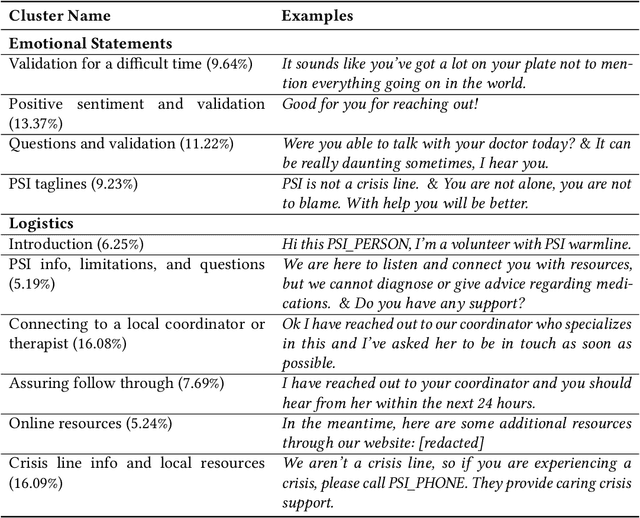
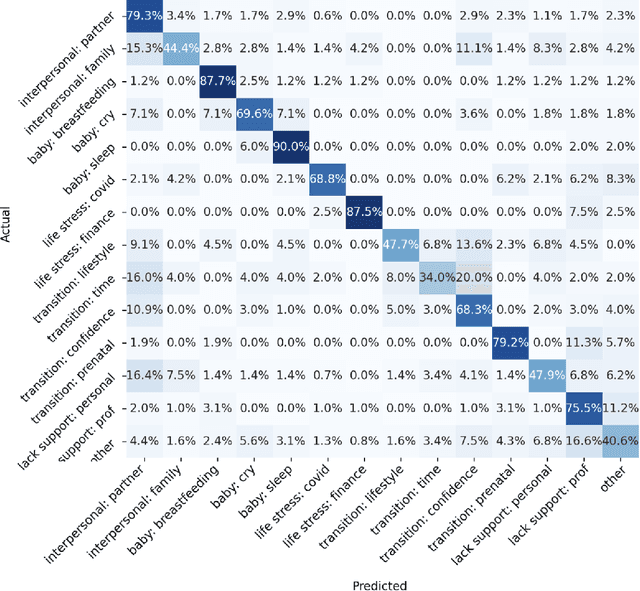
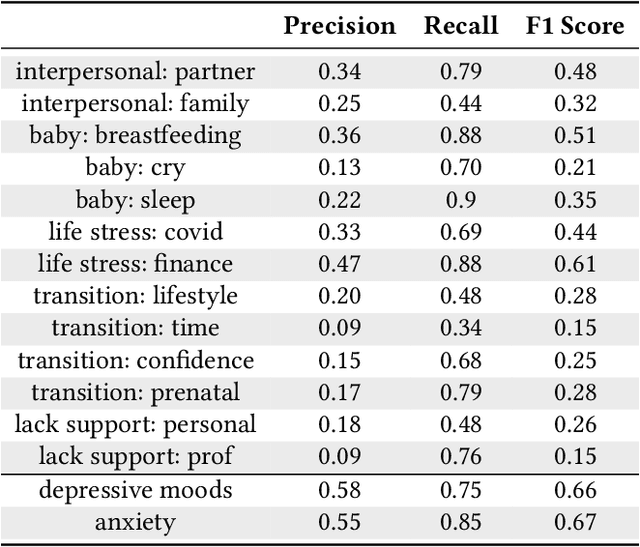

In collaboration with Postpartum Support International (PSI), a non-profit organization dedicated to supporting caregivers with postpartum mood and anxiety disorders, we developed three chatbots to provide context-specific empathetic support to postpartum caregivers, leveraging both rule-based and generative models. We present and evaluate the performance of our chatbots using both machine-based metrics and human-based questionnaires. Overall, our rule-based model achieves the best performance, with outputs that are close to ground truth reference and contain the highest levels of empathy. Human users prefer the rule-based chatbot over the generative chatbot for its context-specific and human-like replies. Our generative chatbot also produced empathetic responses and was described by human users as engaging. However, limitations in the training dataset often result in confusing or nonsensical responses. We conclude by discussing practical benefits of rule-based vs. generative models for supporting individuals with mental health challenges. In light of the recent surge of ChatGPT and BARD, we also discuss the possibilities and pitfalls of large language models for digital mental healthcare.
Propagating Knowledge Updates to LMs Through Distillation
Jun 15, 2023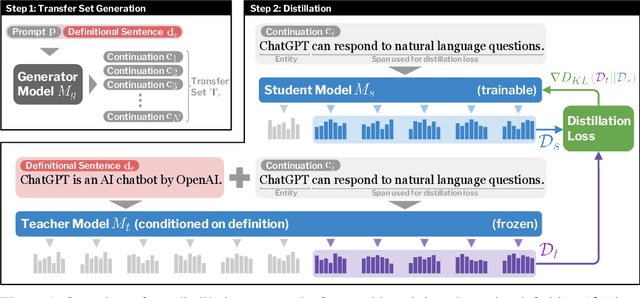
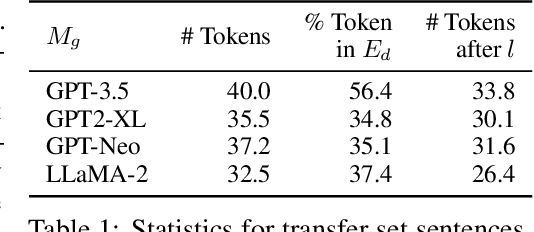
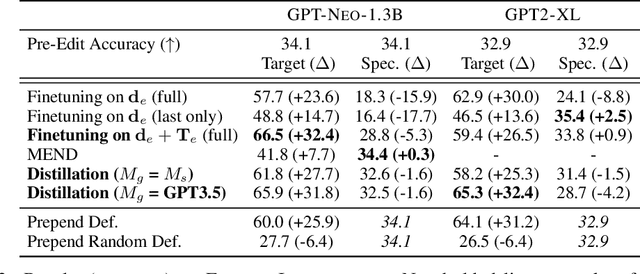
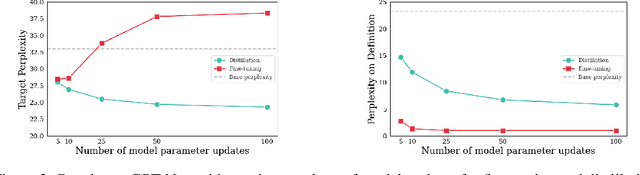
Modern language models have the capacity to store and use immense amounts of knowledge about real-world entities, but it remains unclear how to update their implicit "knowledge bases.'' While prior methods for updating knowledge in LMs successfully inject facts, updated LMs then fail to make inferences based on these injected facts. In this work, we demonstrate that a context distillation-based approach can both impart knowledge about entities and propagate that knowledge to enable broader inferences. Our approach consists of two stages: transfer set generation and distillation on the transfer set. We first generate a transfer set by simply prompting a language model to generate a continuation from the entity definition. Then, we update the model parameters so that the distribution of the LM (the student) matches the distribution of the LM conditioned on the definition (the teacher) on the transfer set. Our experiments demonstrate that this approach is more effective in propagating knowledge updates compared to fine-tuning and other gradient-based knowledge-editing methods without compromising performance in other contexts, even when injecting the definitions of up to 150 entities at once.
When to Use Efficient Self Attention? Profiling Text, Speech and Image Transformer Variants
Jun 14, 2023
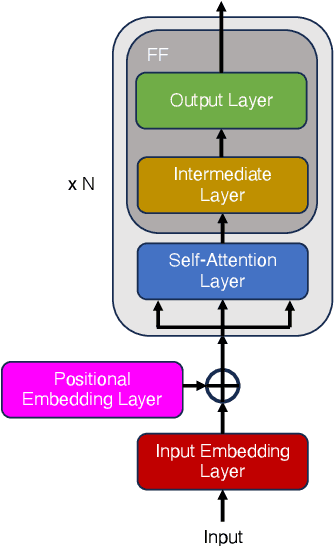
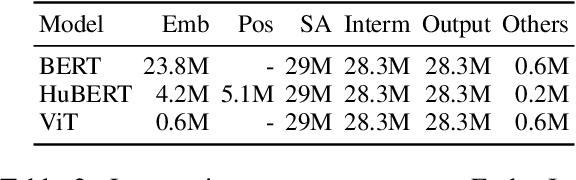
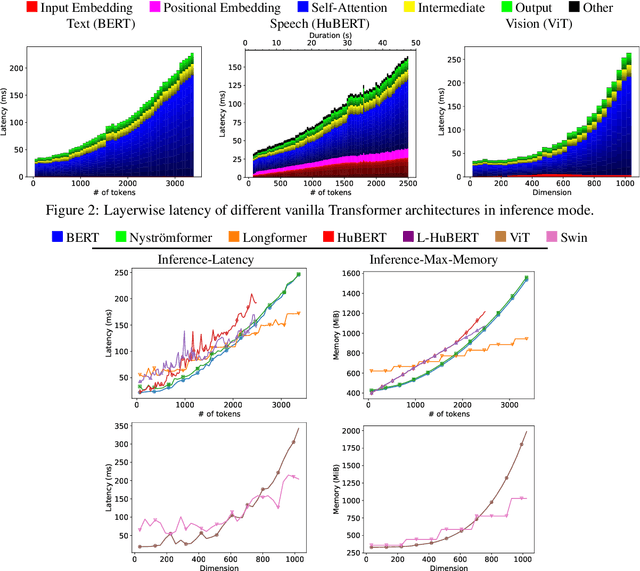
We present the first unified study of the efficiency of self-attention-based Transformer variants spanning text, speech and vision. We identify input length thresholds (tipping points) at which efficient Transformer variants become more efficient than vanilla models, using a variety of efficiency metrics (latency, throughput, and memory). To conduct this analysis for speech, we introduce L-HuBERT, a novel local-attention variant of a self-supervised speech model. We observe that these thresholds are (a) much higher than typical dataset sequence lengths and (b) dependent on the metric and modality, showing that choosing the right model depends on modality, task type (long-form vs. typical context) and resource constraints (time vs. memory). By visualising the breakdown of the computational costs for transformer components, we also show that non-self-attention components exhibit significant computational costs. We release our profiling toolkit at https://github.com/ajd12342/profiling-transformers .
Concise Answers to Complex Questions: Summarization of Long-form Answers
May 30, 2023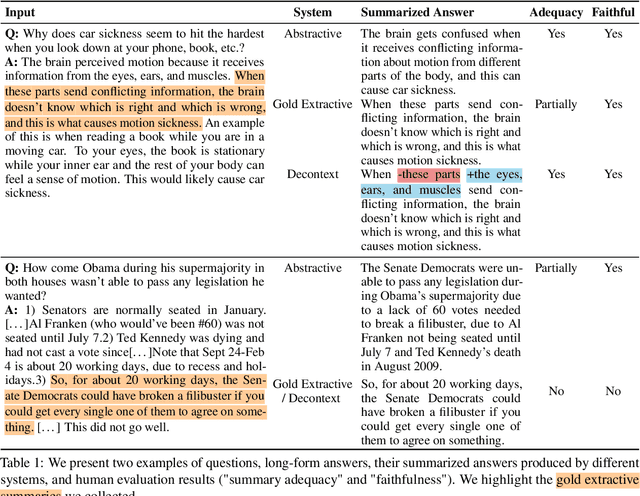
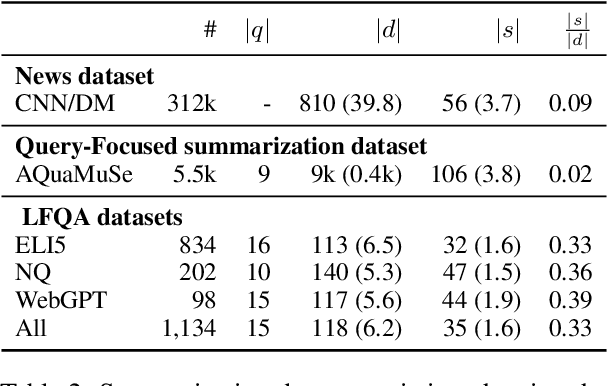
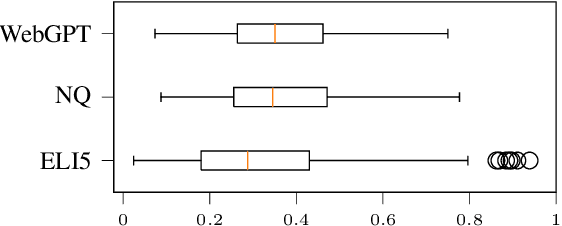
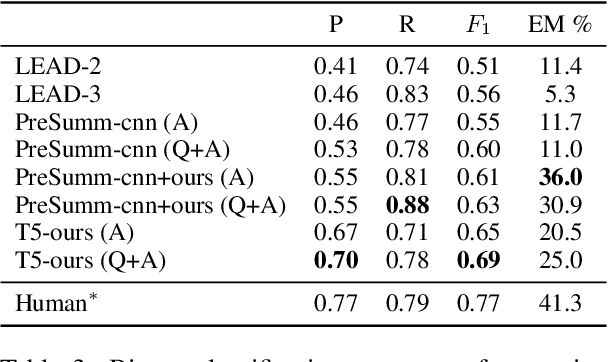
Long-form question answering systems provide rich information by presenting paragraph-level answers, often containing optional background or auxiliary information. While such comprehensive answers are helpful, not all information is required to answer the question (e.g. users with domain knowledge do not need an explanation of background). Can we provide a concise version of the answer by summarizing it, while still addressing the question? We conduct a user study on summarized answers generated from state-of-the-art models and our newly proposed extract-and-decontextualize approach. We find a large proportion of long-form answers (over 90%) in the ELI5 domain can be adequately summarized by at least one system, while complex and implicit answers are challenging to compress. We observe that decontextualization improves the quality of the extractive summary, exemplifying its potential in the summarization task. To promote future work, we provide an extractive summarization dataset covering 1K long-form answers and our user study annotations. Together, we present the first study on summarizing long-form answers, taking a step forward for QA agents that can provide answers at multiple granularities.
A Critical Evaluation of Evaluations for Long-form Question Answering
May 29, 2023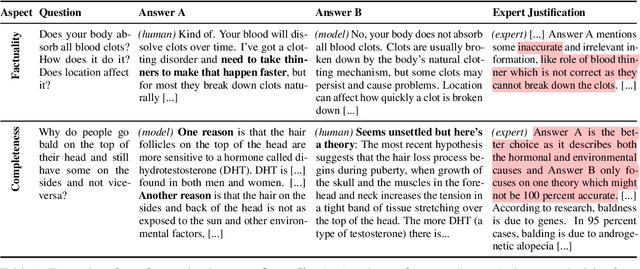
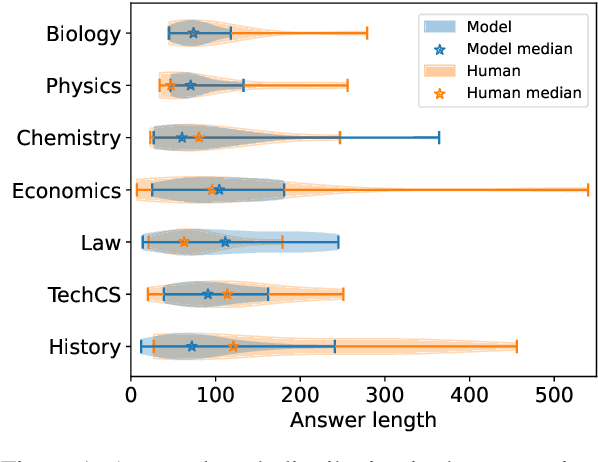
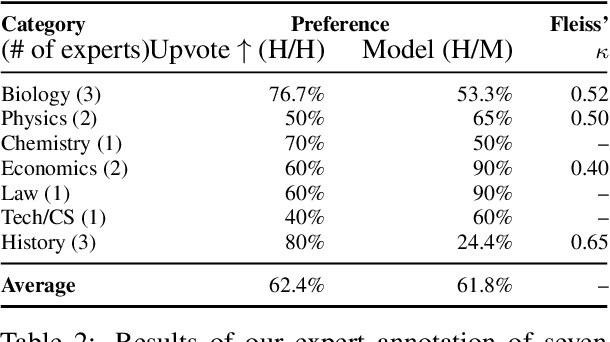
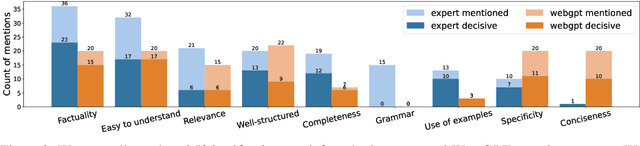
Long-form question answering (LFQA) enables answering a wide range of questions, but its flexibility poses enormous challenges for evaluation. We perform the first targeted study of the evaluation of long-form answers, covering both human and automatic evaluation practices. We hire domain experts in seven areas to provide preference judgments over pairs of answers, along with free-form justifications for their choices. We present a careful analysis of experts' evaluation, which focuses on new aspects such as the comprehensiveness of the answer. Next, we examine automatic text generation metrics, finding that no existing metrics are predictive of human preference judgments. However, some metrics correlate with fine-grained aspects of answers (e.g., coherence). We encourage future work to move away from a single "overall score" of the answer and adopt a multi-faceted evaluation, targeting aspects such as factuality and completeness. We publicly release all of our annotations and code to spur future work into LFQA evaluation.
Mitigating Temporal Misalignment by Discarding Outdated Facts
May 24, 2023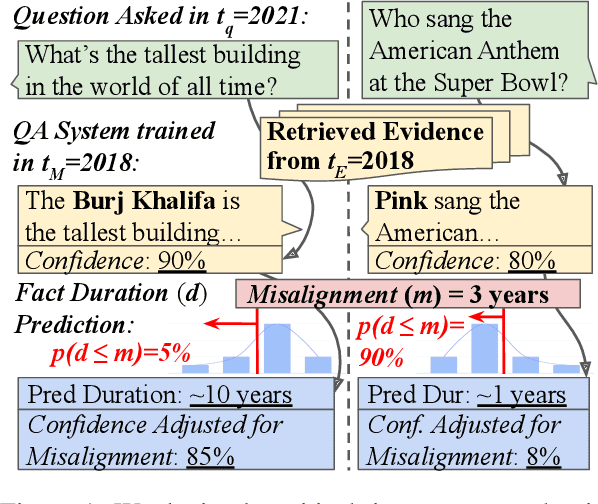
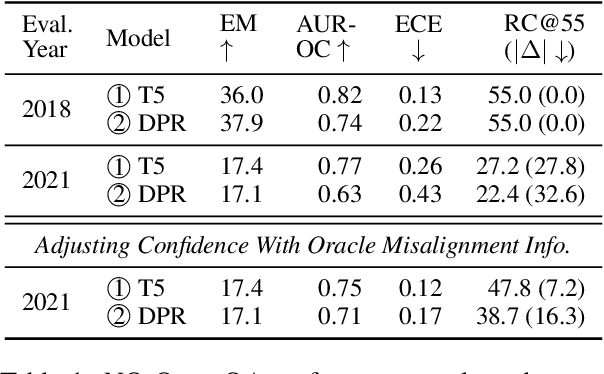
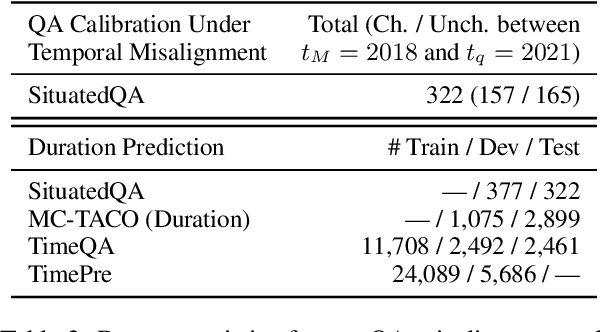
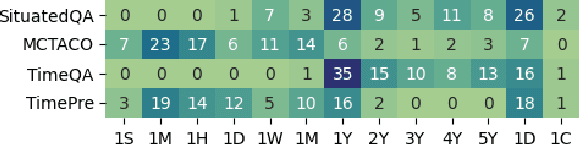
While large language models are able to retain vast amounts of world knowledge seen during pretraining, such knowledge is prone to going out of date and is nontrivial to update. Furthermore, these models are often used under temporal misalignment, tasked with answering questions about the present, despite having only been trained on data collected in the past. To mitigate the effects of temporal misalignment, we propose fact duration prediction: the task of predicting how long a given fact will remain true. In our experiments, we demonstrate how identifying facts that are prone to rapid change can help models avoid from reciting outdated information and identify which predictions require seeking out up-to-date knowledge sources. We also show how modeling fact duration improves calibration for knowledge-intensive tasks, such as open-retrieval question answering, under temporal misalignment by discarding volatile facts. Our data and code will be released publicly at https://github.com/mikejqzhang/mitigating_misalignment.
Unit-based Speech-to-Speech Translation Without Parallel Data
May 24, 2023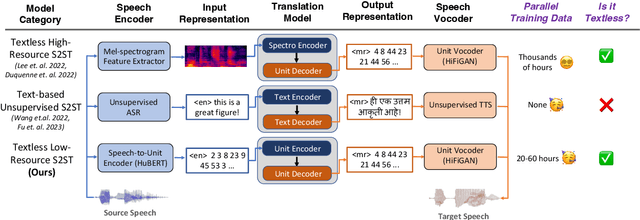
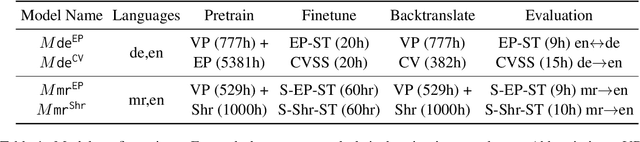
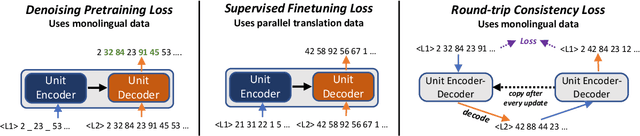
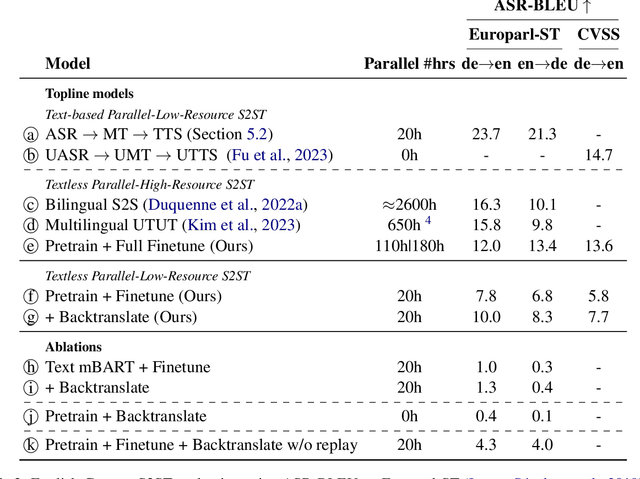
We propose an unsupervised speech-to-speech translation (S2ST) system that does not rely on parallel data between the source and target languages. Our approach maps source and target language speech signals into automatically discovered, discrete units and reformulates the problem as unsupervised unit-to-unit machine translation. We develop a three-step training procedure that involves (a) pre-training an unit-based encoder-decoder language model with a denoising objective (b) training it with word-by-word translated utterance pairs created by aligning monolingual text embedding spaces and (c) running unsupervised backtranslation bootstrapping off of the initial translation model. Our approach avoids mapping the speech signal into text and uses speech-to-unit and unit-to-speech models instead of automatic speech recognition and text to speech models. We evaluate our model on synthetic-speaker Europarl-ST English-German and German-English evaluation sets, finding that unit-based translation is feasible under this constrained scenario, achieving 9.29 ASR-BLEU in German to English and 8.07 in English to German.
Continually Improving Extractive QA via Human Feedback
May 21, 2023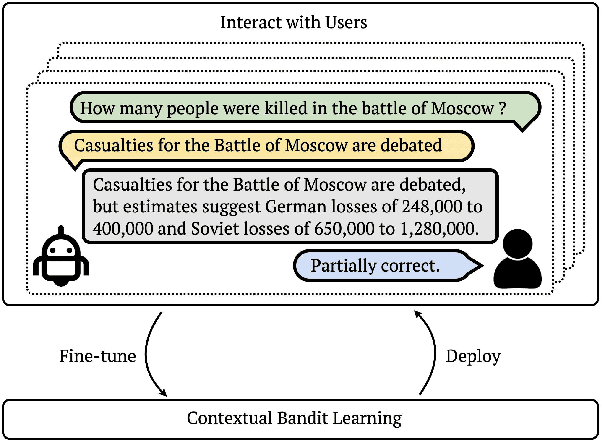
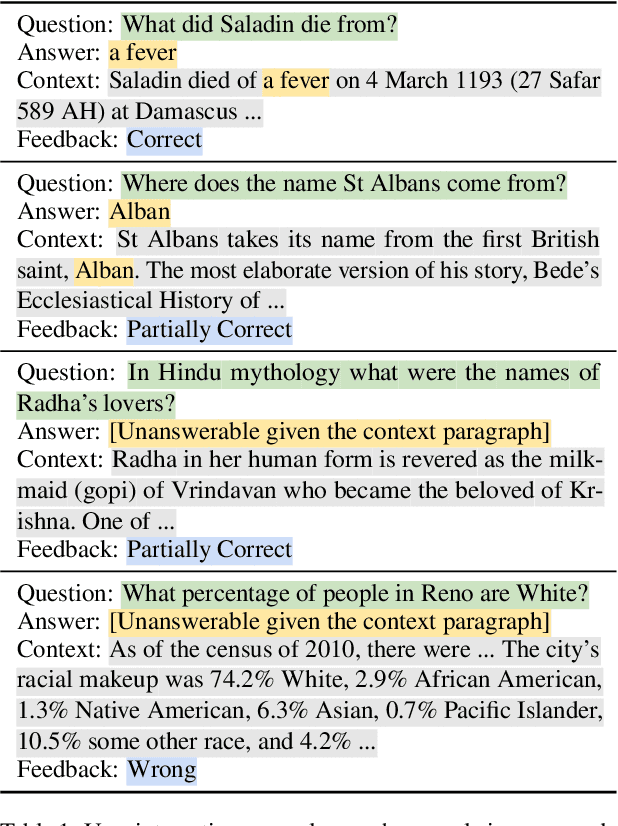
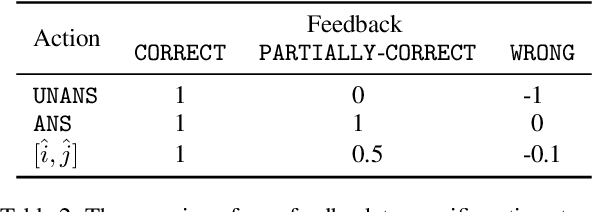
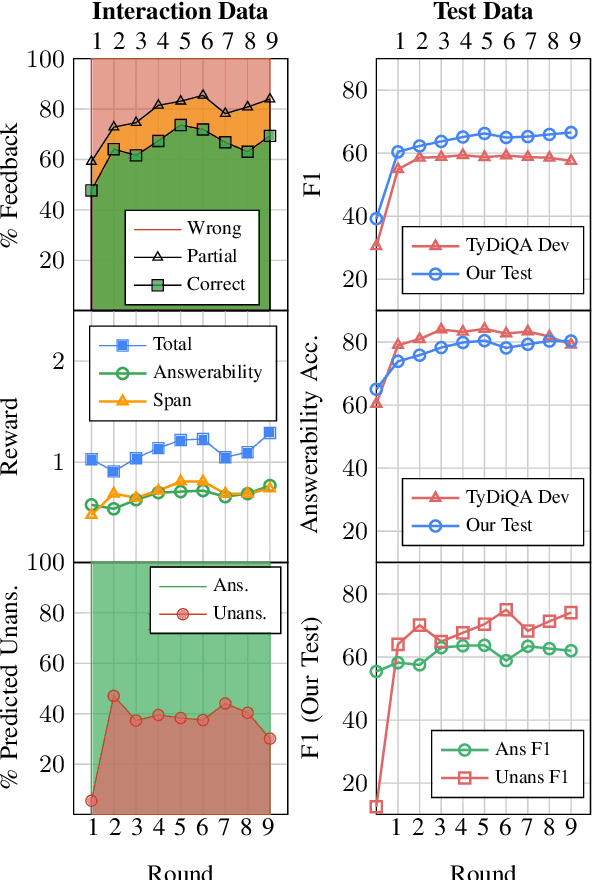
We study continually improving an extractive question answering (QA) system via human user feedback. We design and deploy an iterative approach, where information-seeking users ask questions, receive model-predicted answers, and provide feedback. We conduct experiments involving thousands of user interactions under diverse setups to broaden the understanding of learning from feedback over time. Our experiments show effective improvement from user feedback of extractive QA models over time across different data regimes, including significant potential for domain adaptation.
Complex Claim Verification with Evidence Retrieved in the Wild
May 19, 2023Evidence retrieval is a core part of automatic fact-checking. Prior work makes simplifying assumptions in retrieval that depart from real-world use cases: either no access to evidence, access to evidence curated by a human fact-checker, or access to evidence available long after the claim has been made. In this work, we present the first fully automated pipeline to check real-world claims by retrieving raw evidence from the web. We restrict our retriever to only search documents available prior to the claim's making, modeling the realistic scenario where an emerging claim needs to be checked. Our pipeline includes five components: claim decomposition, raw document retrieval, fine-grained evidence retrieval, claim-focused summarization, and veracity judgment. We conduct experiments on complex political claims in the ClaimDecomp dataset and show that the aggregated evidence produced by our pipeline improves veracity judgments. Human evaluation finds the evidence summary produced by our system is reliable (it does not hallucinate information) and relevant to answering key questions about a claim, suggesting that it can assist fact-checkers even when it cannot surface a complete evidence set.