 Add to Chrome
 Add to Firefox
 Add to Edge
Music-Source-Separation-Training (MSST): A Unified Framework for Training and Evaluating Music Demixing Models
Jul 25, 2026
Music Source Separation (MSS), the task of recovering individual sound components (stems) from a polyphonic mixture, is central to applications ranging from karaoke and remixing to audio restoration and content production. The separation quality depends on engineering decisions across the entire pipeline: model choice, training data preparation and augmentation, loss function and metrics choice, training configuration, validation, and post-processing. This paper presents MSST (Music-Source-Separation-Training) - a universal open-source framework for MSS tasks, which unifies training, validation, and inference for a broad range of modern demixing model families under a single, configuration-driven interface. The framework supports various model architectures, data preprocessing and augmentations, multiple loss functions and evaluation metrics, which helps with fast iterations and ablation studies. Additionally, the framework supports a range of practical techniques that improve separation quality, such as sliding-window inference with cross-fading, test-time augmentation, model ensembling, and fine-tuning via Low-Rank Adaptation (LORA). Our ablation studies demonstrate improvements of MSS using the above techniques. By consolidating these components into a reproducible, YAML-configurable framework, MSST lowers the barrier to systematic experimentation and enables rapid iteration from idea to verifiable result.

Fully convolutional Siamese neural networks for buildings damage assessment from satellite images
Oct 31, 2021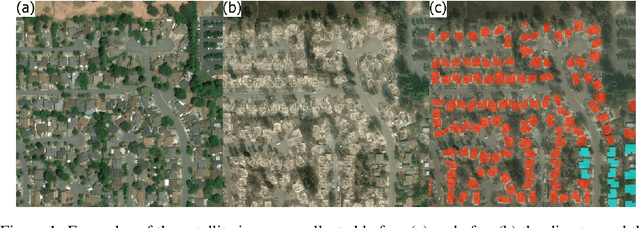
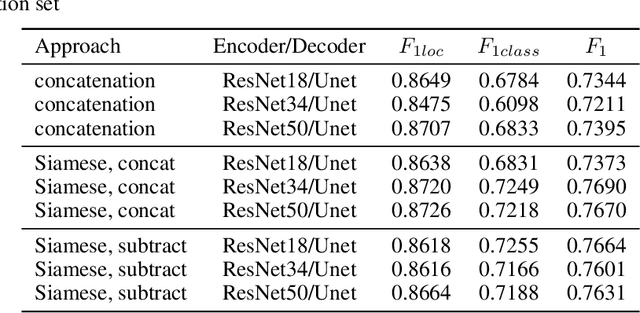
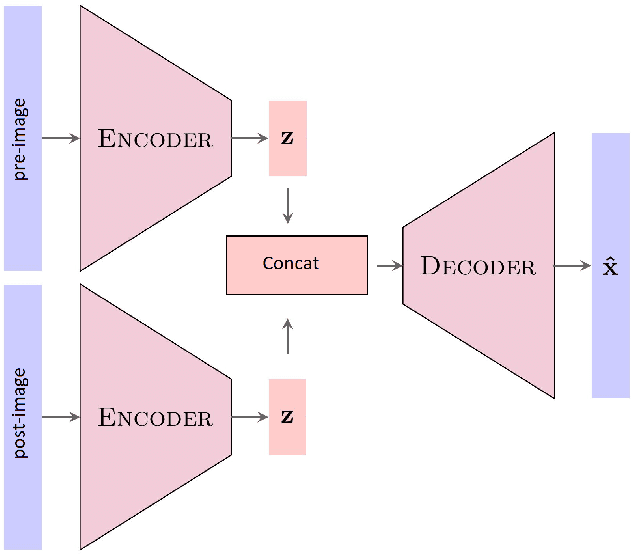
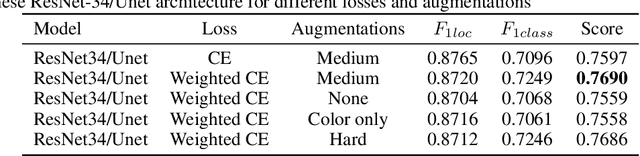
Damage assessment after natural disasters is needed to distribute aid and forces to recovery from damage dealt optimally. This process involves acquiring satellite imagery for the region of interest, localization of buildings, and classification of the amount of damage caused by nature or urban factors to buildings. In case of natural disasters, this means processing many square kilometers of the area to judge whether a particular building had suffered from the damaging factors. In this work, we develop a computational approach for an automated comparison of the same region's satellite images before and after the disaster, and classify different levels of damage in buildings. Our solution is based on Siamese neural networks with encoder-decoder architecture. We include an extensive ablation study and compare different encoders, decoders, loss functions, augmentations, and several methods to combine two images. The solution achieved one of the best results in the Computer Vision for Building Damage Assessment competition.
3D Convolutional Neural Networks for Stalled Brain Capillary Detection
Apr 04, 2021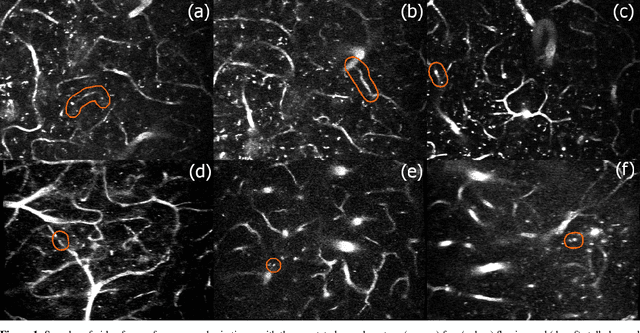
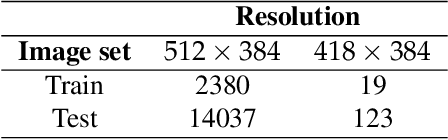
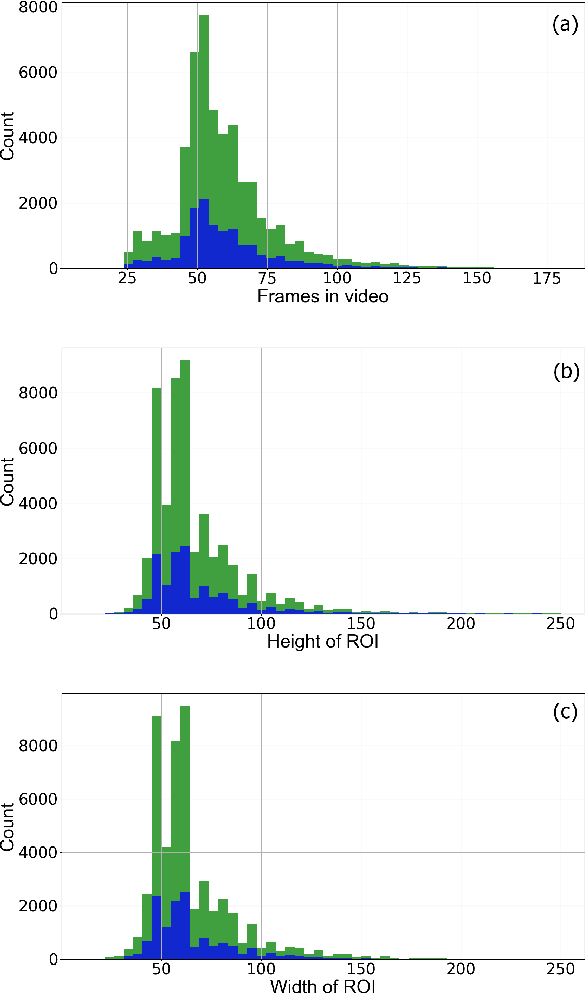

Adequate blood supply is critical for normal brain function. Brain vasculature dysfunctions such as stalled blood flow in cerebral capillaries are associated with cognitive decline and pathogenesis in Alzheimer's disease. Recent advances in imaging technology enabled generation of high-quality 3D images that can be used to visualize stalled blood vessels. However, localization of stalled vessels in 3D images is often required as the first step for downstream analysis, which can be tedious, time-consuming and error-prone, when done manually. Here, we describe a deep learning-based approach for automatic detection of stalled capillaries in brain images based on 3D convolutional neural networks. Our networks employed custom 3D data augmentations and were used weight transfer from pre-trained 2D models for initialization. We used an ensemble of several 3D models to produce the winning submission to the Clog Loss: Advance Alzheimer's Research with Stall Catchers machine learning competition that challenged the participants with classifying blood vessels in 3D image stacks as stalled or flowing. In this setting, our approach outperformed other methods and demonstrated state-of-the-art results, achieving 0.85 Matthews correlation coefficient, 85% sensitivity, and 99.3% specificity. The source code for our solution is made publicly available.
Deep Learning for Automatic Pneumonia Detection
May 28, 2020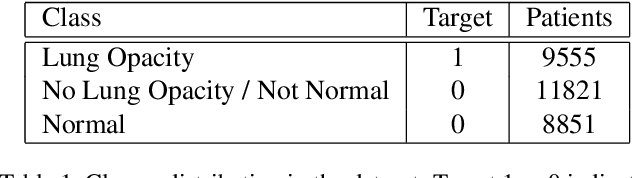
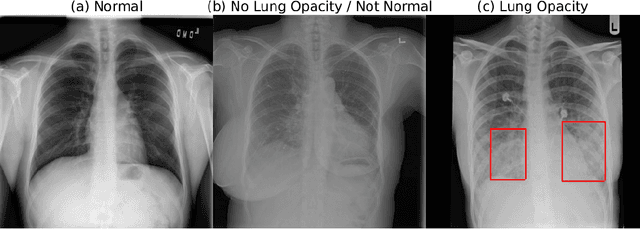
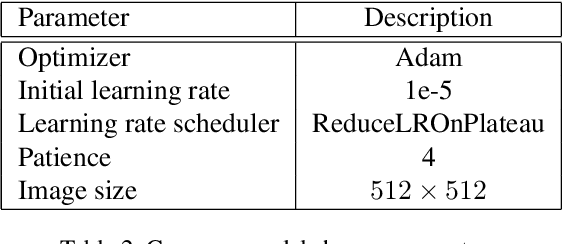
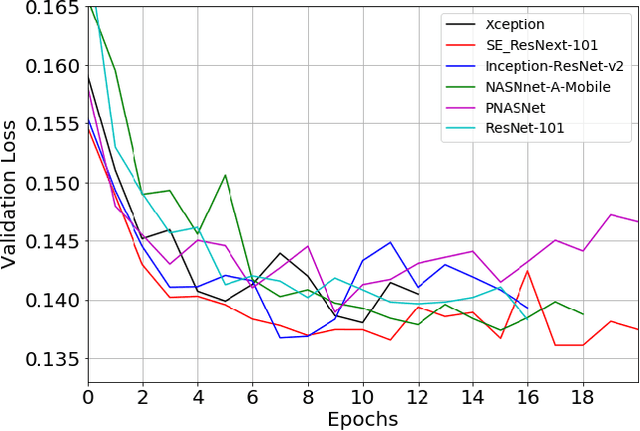
Pneumonia is the leading cause of death among young children and one of the top mortality causes worldwide. The pneumonia detection is usually performed through examine of chest X-ray radiograph by highly-trained specialists. This process is tedious and often leads to a disagreement between radiologists. Computer-aided diagnosis systems showed the potential for improving diagnostic accuracy. In this work, we develop the computational approach for pneumonia regions detection based on single-shot detectors, squeeze-and-excitation deep convolution neural networks, augmentations and multi-task learning. The proposed approach was evaluated in the context of the Radiological Society of North America Pneumonia Detection Challenge, achieving one of the best results in the challenge.
Photometric light curves classification with machine learning
Sep 10, 2019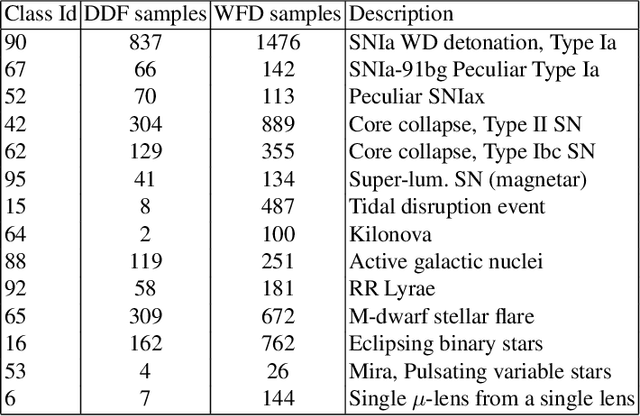
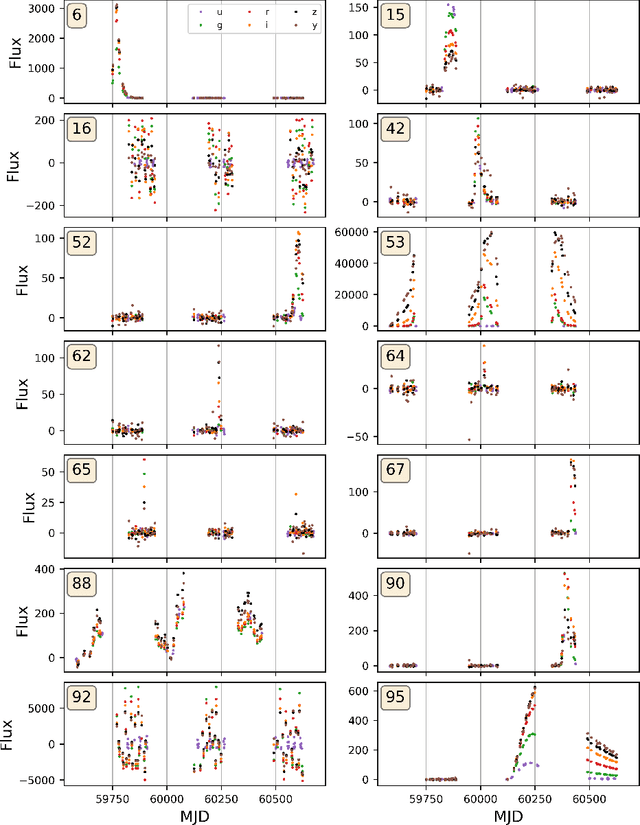
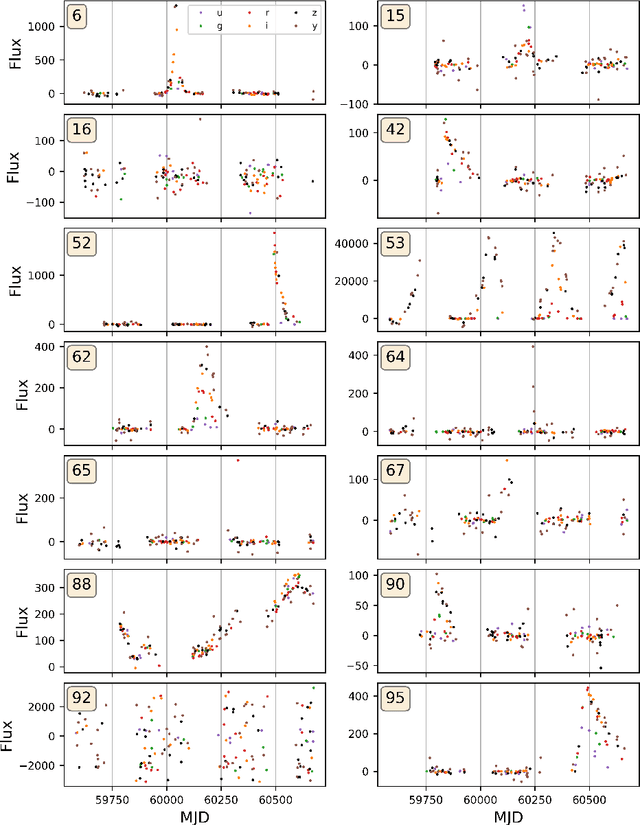
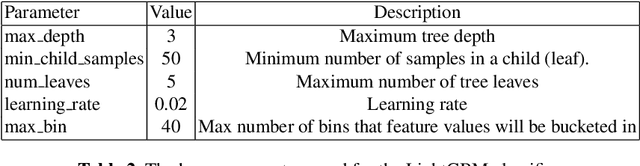
The Large Synoptic Survey Telescope will complete its survey in 2022 and produce terabytes of imaging data each night. To work with this massive onset of data, automated algorithms to classify astronomical light curves are crucial. Here, we present a method for automated classification of photometric light curves for a range of astronomical objects. Our approach is based on the gradient boosting of decision trees, feature extraction and selection, and augmentation. The solution was developed in the context of The Photometric LSST Astronomical Time Series Classification Challenge (PLAsTiCC) and achieved one of the top results in the challenge.