 Add to Chrome
 Add to Firefox
 Add to Edge
Position Bias Undermines Preference Consistency in Listwise LLM-Based Reranking
Aug 04, 2026
Large language models (LLMs) have emerged as promising listwise rerankers for recommender systems, but their reliability under equivalent candidate permutations remains unclear. Since recommendation candidates form an unordered set, a reranker should not depend on the arbitrary order used to serialize them. However, decoder-only LLM rerankers can allow input order to affect model scores, pairwise preferences, and rankings. We study how position bias affects the ranking process induced by LLM-based rerankers. Instead of measuring only changes in final ranked lists, we treat rankings produced under equivalent candidate permutations as observations of an induced preference system. We introduce an evaluation framework measuring pairwise preference instability, global preference inconsistency, and listwise output consistency. This framework characterizes candidate-order sensitivity at the pairwise, global, and output levels. Experiments across multiple LLMs, datasets, and list lengths show that these consistency measures are closely aligned, but can diverge from recommendation effectiveness and marginal position-exposure bias. Improving relevance or flattening exposure across positions does not necessarily restore stable pairwise preferences, globally coherent preference structures, or consistent ranked outputs. These results show that reducing marginal exposure skew is insufficient to establish ranking-function validity in LLM-based reranking. Code is available at https://github.com/ejbito/InvariRank .

A2TTA: Anchored-and-Agile Test-Time Adaptation for Evolving Traffic Sensor Networks
Jul 28, 2026Traffic forecasting is important for efficient traffic management and route planning in smart cities. Existing traffic forecasting studies typically assume fixed sensor graphs, overlooking the continuous evolution of real-world traffic networks, e.g., ongoing road network construction and evolving human mobility patterns. These dynamic changes can substantially degrade conventional forecasting models, motivating test-time adaptation (TTA) to efficiently adapt pretrained models during deployment. However, applying TTA to evolving traffic sensor networks remains challenging in two aspects. First, topology expansion introduces new sensors and connections, continuously reshaping the sensor graph. Second, tem- poral shifts vary in time scale and stability, requiring differentiated adaptation to long-term and short-term shifts. In this study, we address these challenges by proposing A2TTA, an Anchored-and-Agile Test-Time Adaptation framework for evolving traffic sensor networks, which transforms topology-induced forecasting errors into an expandable output calibration problem and separates tem- poral adaptation into persistent global correction and agile context-specific specialization. By jointly addressing topology evolution and multi-scale temporal shifts, A2TTA enables efficient and robust adaptation to continuously evolving traffic environments. Extensive experiments on ten real-world traffic networks demonstrate that A2TTA consistently improves forecasting performance across different backbones, datasets, and prediction horizons. Our code is available in https://github.com/lixus7/A2TTA.
Deep Contrastive Unlearning for Language Models
Mar 19, 2025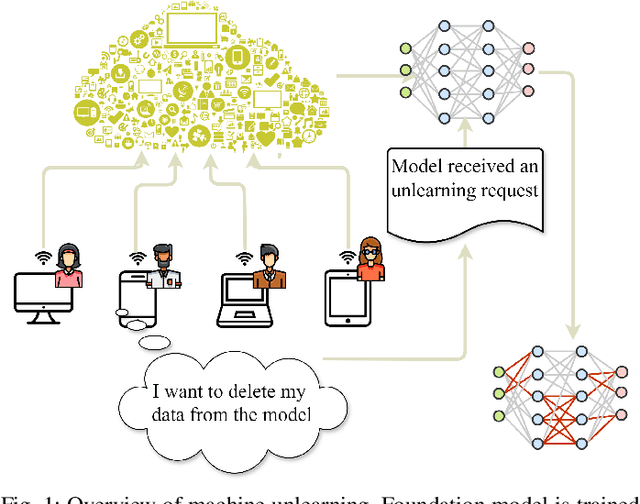
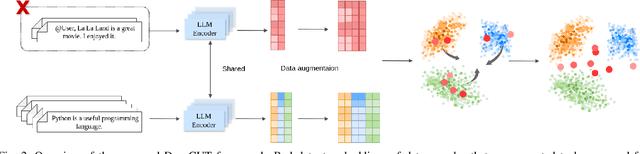
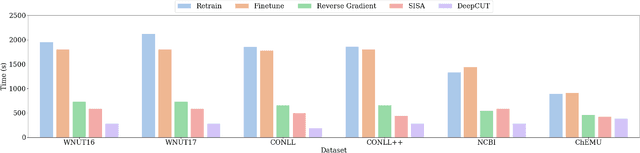
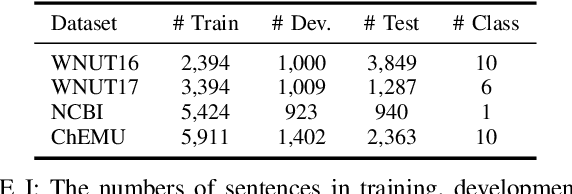
The past a few years have witnessed the great success of large language models, demonstrating powerful capabilities in comprehending textual data and generating human-like languages. Large language models achieve success by being trained on vast amounts of textual data, including online sources with copyrighted content and user-generated knowledge. However, this comes at a cost: the potential risk of exposing users' privacy and violating copyright protections. Thus, to safeguard individuals' "right to be forgotten", there has been increasing interests in machine unlearning -- the process of removing information carried by particular training samples from a model while not deteriorating its predictive quality. This is a challenging task due to the black-box nature of language models. Most existing studies focus on mitigating the impact of those forgot samples upon a model's outputs, and do not explicitly consider the geometric distributions of samples in the latent space of a model. To address this issue, we propose a machine unlearning framework, named Deep Contrastive Unlearning for fine-Tuning (DeepCUT) language models. Our proposed model achieves machine unlearning by directly optimizing the latent space of a model. Comprehensive experiments on real-world datasets demonstrate the effectiveness and efficiency of DeepCUT with consistent and significant improvement over baseline methods.
FUGNN: Harmonizing Fairness and Utility in Graph Neural Networks
May 27, 2024Fairness-aware Graph Neural Networks (GNNs) often face a challenging trade-off, where prioritizing fairness may require compromising utility. In this work, we re-examine fairness through the lens of spectral graph theory, aiming to reconcile fairness and utility within the framework of spectral graph learning. We explore the correlation between sensitive features and spectrum in GNNs, using theoretical analysis to delineate the similarity between original sensitive features and those after convolution under different spectrum. Our analysis reveals a reduction in the impact of similarity when the eigenvectors associated with the largest magnitude eigenvalue exhibit directional similarity. Based on these theoretical insights, we propose FUGNN, a novel spectral graph learning approach that harmonizes the conflict between fairness and utility. FUGNN ensures algorithmic fairness and utility by truncating the spectrum and optimizing eigenvector distribution during the encoding process. The fairness-aware eigenvector selection reduces the impact of convolution on sensitive features while concurrently minimizing the sacrifice of utility. FUGNN further optimizes the distribution of eigenvectors through a transformer architecture. By incorporating the optimized spectrum into the graph convolution network, FUGNN effectively learns node representations. Experiments on six real-world datasets demonstrate the superiority of FUGNN over baseline methods. The codes are available at https://github.com/yushuowiki/FUGNN.