 Add to Chrome
 Add to Firefox
 Add to Edge
Img2CADSeq: Image-to-CAD Generation via Sequence-Based Diffusion
May 13, 2026
Boundary Representation (BRep) is the standard format for Computer-Aided Design (CAD), yet reconstructing high-quality BReps from single-view images remains challenging due to the complexity of topological constraints and operation sequences. We present Img2CADSeq, a multi-stage pipeline that overcomes these limitations by encoding CAD sequences into a three-level hierarchical codebook. Guided by an importance prioritization, this strategy values profiles over details, compressing long sequences into a stable discrete latent space. To bridge the modality gap, we leverage a coarse-to-fine point cloud intermediate, aligning 2D visual features with 3D CAD sequences via contrastive learning to condition a VQ-Diffusion model. Supported by newly introduced CAD-220K and PrintCAD datasets, our approach ensures robust industrial domain adaptation. Extensive experiments demonstrate that Img2CADSeq significantly outperforms state-of-the-art methods, producing standard STEP files that can be directly used in commercial CAD software.

Flexible Attributed Network Embedding
Nov 27, 2018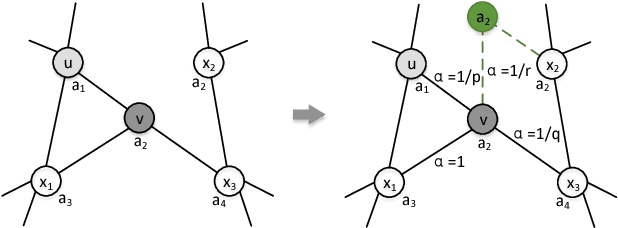
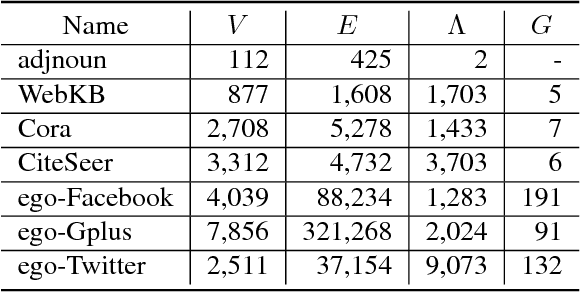
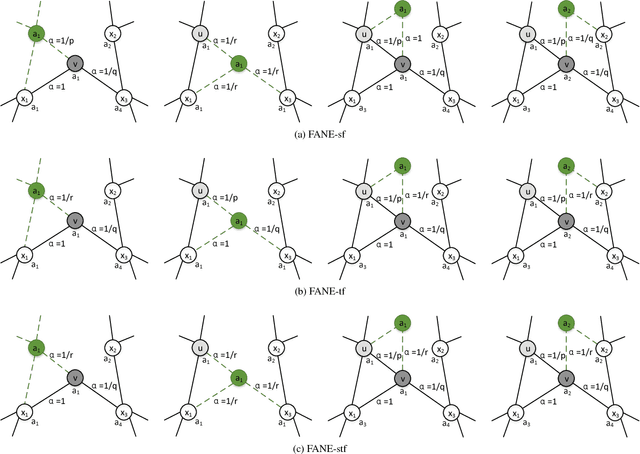
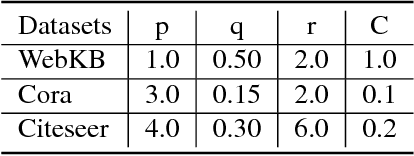
Network embedding aims to find a way to encode network by learning an embedding vector for each node in the network. The network often has property information which is highly informative with respect to the node's position and role in the network. Most network embedding methods fail to utilize this information during network representation learning. In this paper, we propose a novel framework, FANE, to integrate structure and property information in the network embedding process. In FANE, we design a network to unify heterogeneity of the two information sources, and define a new random walking strategy to leverage property information and make the two information compensate. FANE is conceptually simple and empirically powerful. It improves over the state-of-the-art methods on Cora dataset classification task by over 5%, more than 10% on WebKB dataset classification task. Experiments also show that the results improve more than the state-of-the-art methods as increasing training size. Moreover, qualitative visualization show that our framework is helpful in network property information exploration. In all, we present a new way for efficiently learning state-of-the-art task-independent representations in complex attributed networks. The source code and datasets of this paper can be obtained from https://github.com/GraphWorld/FANE.