 Add to Chrome
 Add to Firefox
 Add to Edge
Marine Engine Fault Dataset: Open-Access Data under Controlled Reference and Fault Scenario Conditions
Jul 21, 2026
Open-access datasets for marine-engine predictive maintenance remain scarce, particularly those from controlled fault experiments with documented operating conditions, subsystem-level interventions and system-level measurements. This work presents the Marine Engine Fault Dataset, an openly available dataset from a turbocharged, intercooled three-cylinder marine diesel engine operated on a testbed under both reference and fault-scenario conditions. The experimental campaign combined a reference-performance program across the 30-90% load range with scenario-based tests in which abnormal conditions were introduced after stabilized fault-free operation, enabling controlled comparison between baseline and fault-affected behaviour. Five anomaly classes were implemented through physical interventions affecting major engine subsystems: cooling-water pump cavitation, compressor air-filter clogging, air-cooler fouling, injection-valve nozzle clogging and turbine degradation induced through increased exhaust-side restriction. The released data comprise multi-sensor time-series of operating, thermal, pressure, flow and combustion-related variables, with a separate reference-performance record and metadata for structured reuse. Technical validation shows that the reference measurements remain physically coherent across the operating range and that the imposed anomalies produce interpretable response patterns consistent with the affected subsystems, including progressively distinguishable behaviour where different severities were implemented. By combining controlled fault realization, multi-load operation and system-level measurements within a real marine-engine platform, the dataset provides a well-documented benchmark for anomaly detection, fault diagnosis, degradation modelling and related condition-monitoring studies in maritime machinery.

Causal feature selection framework for stable soft sensor modeling based on time-delayed cross mapping
Jan 20, 2026Soft sensor modeling plays a crucial role in process monitoring. Causal feature selection can enhance the performance of soft sensor models in industrial applications. However, existing methods ignore two critical characteristics of industrial processes. Firstly, causal relationships between variables always involve time delays, whereas most causal feature selection methods investigate causal relationships in the same time dimension. Secondly, variables in industrial processes are often interdependent, which contradicts the decorrelation assumption of traditional causal inference methods. Consequently, soft sensor models based on existing causal feature selection approaches often lack sufficient accuracy and stability. To overcome these challenges, this paper proposes a causal feature selection framework based on time-delayed cross mapping. Time-delayed cross mapping employs state space reconstruction to effectively handle interdependent variables in causality analysis, and considers varying causal strength across time delay. Time-delayed convergent cross mapping (TDCCM) is introduced for total causal inference, and time-delayed partial cross mapping (TDPCM) is developed for direct causal inference. Then, in order to achieve automatic feature selection, an objective feature selection strategy is presented. The causal threshold is automatically determined based on the model performance on the validation set, and the causal features are then selected. Two real-world case studies show that TDCCM achieves the highest average performance, while TDPCM improves soft sensor stability and performance in the worst scenario. The code is publicly available at https://github.com/dirge1/TDPCM.
Automated Processing of eXplainable Artificial Intelligence Outputs in Deep Learning Models for Fault Diagnostics of Large Infrastructures
Mar 19, 2025Deep Learning (DL) models processing images to recognize the health state of large infrastructure components can exhibit biases and rely on non-causal shortcuts. eXplainable Artificial Intelligence (XAI) can address these issues but manually analyzing explanations generated by XAI techniques is time-consuming and prone to errors. This work proposes a novel framework that combines post-hoc explanations with semi-supervised learning to automatically identify anomalous explanations that deviate from those of correctly classified images and may therefore indicate model abnormal behaviors. This significantly reduces the workload for maintenance decision-makers, who only need to manually reclassify images flagged as having anomalous explanations. The proposed framework is applied to drone-collected images of insulator shells for power grid infrastructure monitoring, considering two different Convolutional Neural Networks (CNNs), GradCAM explanations and Deep Semi-Supervised Anomaly Detection. The average classification accuracy on two faulty classes is improved by 8% and maintenance operators are required to manually reclassify only 15% of the images. We compare the proposed framework with a state-of-the-art approach based on the faithfulness metric: the experimental results obtained demonstrate that the proposed framework consistently achieves F_1 scores larger than those of the faithfulness-based approach. Additionally, the proposed framework successfully identifies correct classifications that result from non-causal shortcuts, such as the presence of ID tags printed on insulator shells.
Reliability, Resilience and Human Factors Engineering for Trustworthy AI Systems
Nov 13, 2024As AI systems become integral to critical operations across industries and services, ensuring their reliability and safety is essential. We offer a framework that integrates established reliability and resilience engineering principles into AI systems. By applying traditional metrics such as failure rate and Mean Time Between Failures (MTBF) along with resilience engineering and human reliability analysis, we propose an integrate framework to manage AI system performance, and prevent or efficiently recover from failures. Our work adapts classical engineering methods to AI systems and outlines a research agenda for future technical studies. We apply our framework to a real-world AI system, using system status data from platforms such as openAI, to demonstrate its practical applicability. This framework aligns with emerging global standards and regulatory frameworks, providing a methodology to enhance the trustworthiness of AI systems. Our aim is to guide policy, regulation, and the development of reliable, safe, and adaptable AI technologies capable of consistent performance in real-world environments.
RmGPT: Rotating Machinery Generative Pretrained Model
Sep 26, 2024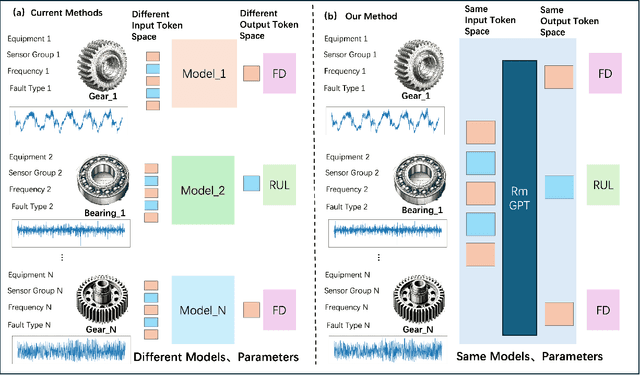
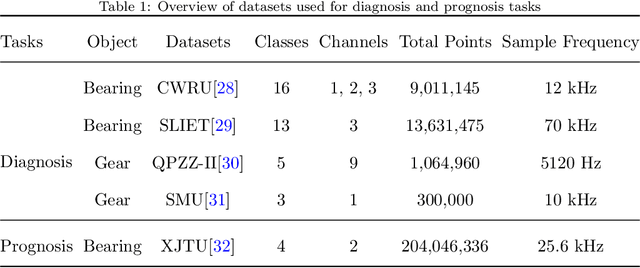
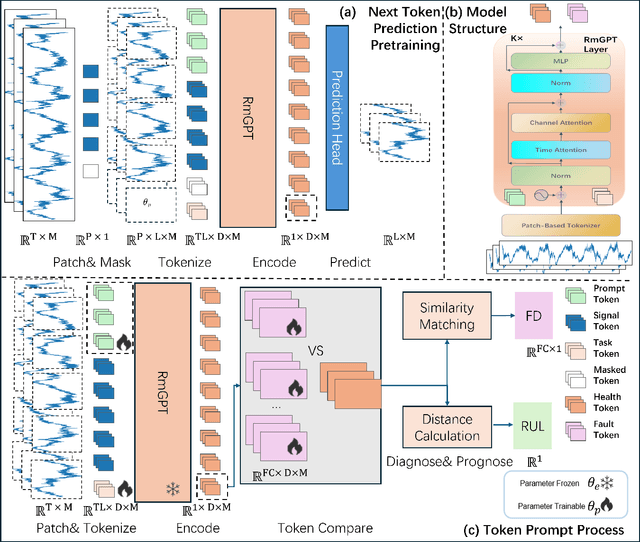
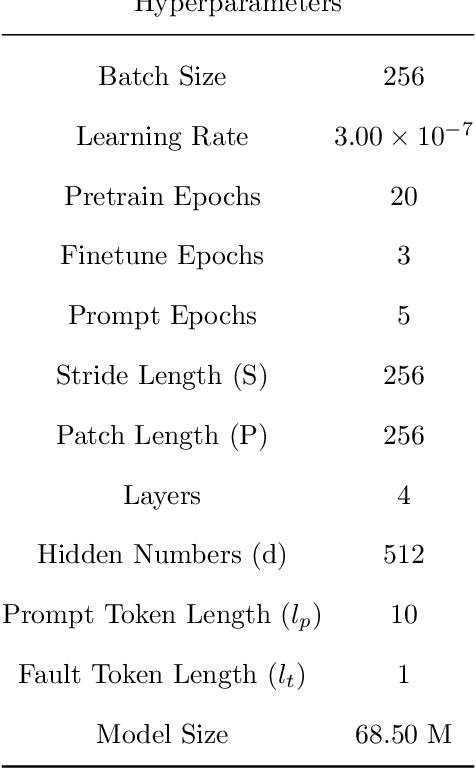
In industry, the reliability of rotating machinery is critical for production efficiency and safety. Current methods of Prognostics and Health Management (PHM) often rely on task-specific models, which face significant challenges in handling diverse datasets with varying signal characteristics, fault modes and operating conditions. Inspired by advancements in generative pretrained models, we propose RmGPT, a unified model for diagnosis and prognosis tasks. RmGPT introduces a novel token-based framework, incorporating Signal Tokens, Prompt Tokens, Time-Frequency Task Tokens and Fault Tokens to handle heterogeneous data within a unified model architecture. We leverage self-supervised learning for robust feature extraction and introduce a next signal token prediction pretraining strategy, alongside efficient prompt learning for task-specific adaptation. Extensive experiments demonstrate that RmGPT significantly outperforms state-of-the-art algorithms, achieving near-perfect accuracy in diagnosis tasks and exceptionally low errors in prognosis tasks. Notably, RmGPT excels in few-shot learning scenarios, achieving 92% accuracy in 16-class one-shot experiments, highlighting its adaptability and robustness. This work establishes RmGPT as a powerful PHM foundation model for rotating machinery, advancing the scalability and generalizability of PHM solutions.