 Add to Chrome
 Add to Firefox
 Add to Edge
Causal feature selection framework for stable soft sensor modeling based on time-delayed cross mapping
Jan 20, 2026
Soft sensor modeling plays a crucial role in process monitoring. Causal feature selection can enhance the performance of soft sensor models in industrial applications. However, existing methods ignore two critical characteristics of industrial processes. Firstly, causal relationships between variables always involve time delays, whereas most causal feature selection methods investigate causal relationships in the same time dimension. Secondly, variables in industrial processes are often interdependent, which contradicts the decorrelation assumption of traditional causal inference methods. Consequently, soft sensor models based on existing causal feature selection approaches often lack sufficient accuracy and stability. To overcome these challenges, this paper proposes a causal feature selection framework based on time-delayed cross mapping. Time-delayed cross mapping employs state space reconstruction to effectively handle interdependent variables in causality analysis, and considers varying causal strength across time delay. Time-delayed convergent cross mapping (TDCCM) is introduced for total causal inference, and time-delayed partial cross mapping (TDPCM) is developed for direct causal inference. Then, in order to achieve automatic feature selection, an objective feature selection strategy is presented. The causal threshold is automatically determined based on the model performance on the validation set, and the causal features are then selected. Two real-world case studies show that TDCCM achieves the highest average performance, while TDPCM improves soft sensor stability and performance in the worst scenario. The code is publicly available at https://github.com/dirge1/TDPCM.

Can We Find the Code? An Empirical Study of Google Scholar's Code Retrieval
Mar 02, 2025Academic codes associated with research papers are valuable resources for scholars. In specialized fields outside computer science, code availability is often limited, making effective code retrieval essential. Google Scholar is a crucial academic search tool. If a code published in the paper is not retrievable via Google Scholar, its accessibility and impact are significantly reduced. This study takes the term "accelerated degradation" combined with "reliability" as an example, and finds that, for papers published by Elsevier, only GitHub links included in abstracts are comprehensively retrieved by Google Scholar. When such links appear within the main body of a paper, even in the "Data Availability" section, they may be ignored and become unsearchable. These findings highlight the importance of strategically placing GitHub links in abstracts to enhance code discoverability on Google Scholar.
Minimum Enclosing Ball Synthetic Minority Oversampling Technique from a Geometric Perspective
Aug 07, 2024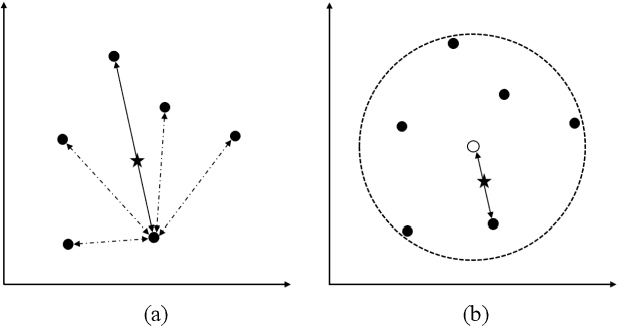
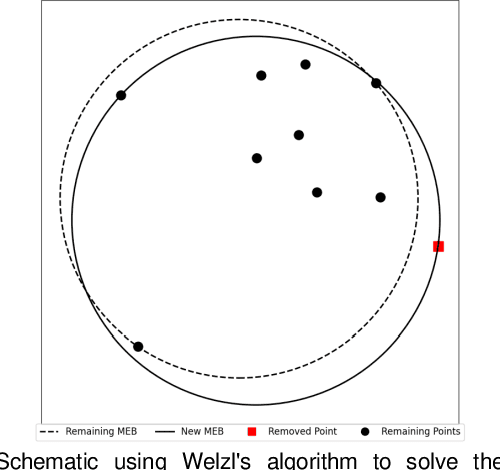
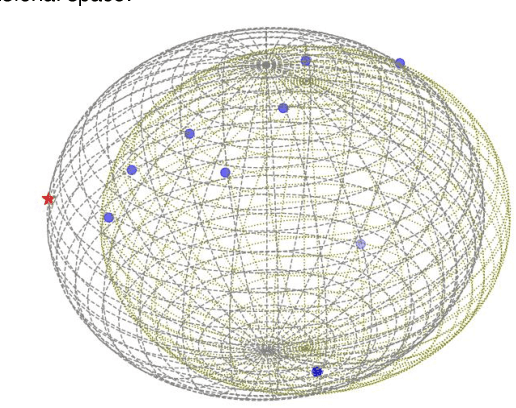
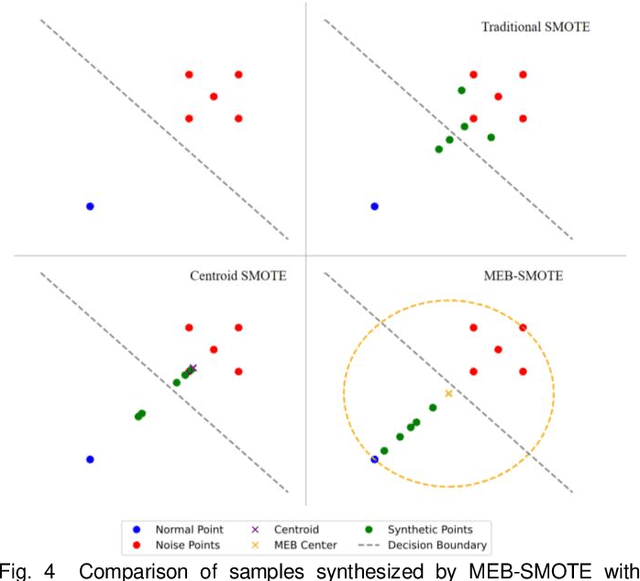
Class imbalance refers to the significant difference in the number of samples from different classes within a dataset, making it challenging to identify minority class samples correctly. This issue is prevalent in real-world classification tasks, such as software defect prediction, medical diagnosis, and fraud detection. The synthetic minority oversampling technique (SMOTE) is widely used to address class imbalance issue, which is based on interpolation between randomly selected minority class samples and their neighbors. However, traditional SMOTE and most of its variants only interpolate between existing samples, which may be affected by noise samples in some cases and synthesize samples that lack diversity. To overcome these shortcomings, this paper proposes the Minimum Enclosing Ball SMOTE (MEB-SMOTE) method from a geometry perspective. Specifically, MEB is innovatively introduced into the oversampling method to construct a representative point. Then, high-quality samples are synthesized by interpolation between this representative point and the existing samples. The rationale behind constructing a representative point is discussed, demonstrating that the center of MEB is more suitable as the representative point. To exhibit the superiority of MEB-SMOTE, experiments are conducted on 15 real-world imbalanced datasets. The results indicate that MEB-SMOTE can effectively improve the classification performance on imbalanced datasets.