 Add to Chrome
 Add to Firefox
 Add to Edge
Discriminative Barrier Functions for Safe Adversarial Imitation Learning from Observation
Jul 15, 2026
Inverse Reinforcement Learning (IRL) algorithms are powerful tools for learning from and generalizing expert demonstrations, but they often rely on unconstrained exploration, rendering them unsafe for real-world deployment. Meanwhile, Control Barrier Functions (CBFs) can guarantee the safety of control systems, but the analytical design of CBFs can be time-consuming and esoteric. In this work, we address these limitations jointly by constraining reward function candidacy during IRL to the space of CBFs, yielding a formulation that exhibits safe online control with continuous experiential improvement. Crucially, this framework enables the data-driven recovery of barrier functions directly from unlabeled expert observations. We demonstrate that the recovered barrier function is robust to unsafe states entirely absent from the expert data. Furthermore, we benchmark our method against standard IRL baselines in a simulated navigation environment, demonstrating improved safety performance. Finally, we investigate the trade-offs of planning-based versus policy-based IRL methods across both simulation and a real world obstacle avoidance task.

FactorLibrary: From Polynomials to Circuits via Recursive Subgoals
Jun 24, 2026Finding minimal arithmetic circuits for polynomials over finite fields is a combinatorially hard problem central to algebraic complexity theory. We formulate it as a reinforcement learning problem in two directions, bottom-up and top-down. To address the challenge of a fast-growing combinatorial search space, we introduce FactorLibrary, which stores factorizable subexpressions that serve as reusable subgoals across training episodes. We trained a bottom-up agent with Gumbel-PPO-MCTS and two top-down agents with PPO+MCTS and SAC. The PPO+MCTS top-down agent exhibited the most stable performance, finding certified optimal circuits up to complexity $8$ with a success rate of $91.8\%$.
CircuitBuilder: From Polynomials to Circuits via Reinforcement Learning
Mar 17, 2026Motivated by auto-proof generation and Valiant's VP vs. VNP conjecture, we study the problem of discovering efficient arithmetic circuits to compute polynomials, using addition and multiplication gates. We formulate this problem as a single-player game, where an RL agent attempts to build the circuit within a fixed number of operations. We implement an AlphaZero-style training loop and compare two approaches: Proximal Policy Optimization with Monte Carlo Tree Search (PPO+MCTS) and Soft Actor-Critic (SAC). SAC achieves the highest success rates on two-variable targets, while PPO+MCTS scales to three variables and demonstrates steady improvement on harder instances. These results suggest that polynomial circuit synthesis is a compact, verifiable setting for studying self-improving search policies.
Demonstrating Wheeled Lab: Modern Sim2Real for Low-cost, Open-source Wheeled Robotics
Feb 11, 2025
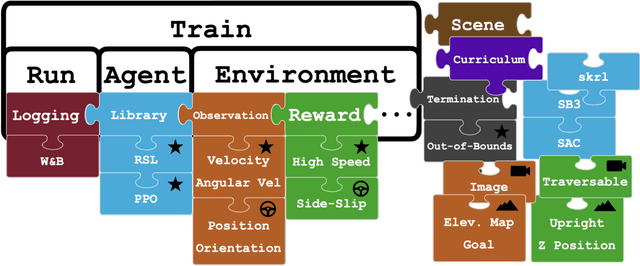
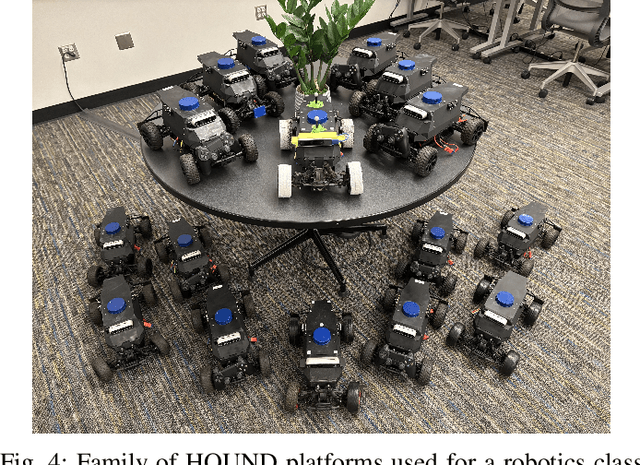
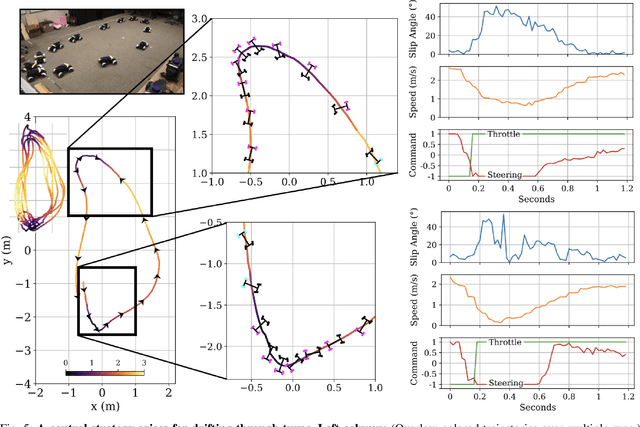
Simulation has been pivotal in recent robotics milestones and is poised to play a prominent role in the field's future. However, recent robotic advances often rely on expensive and high-maintenance platforms, limiting access to broader robotics audiences. This work introduces Wheeled Lab, a framework for the low-cost, open-source wheeled platforms that are already widely established in education and research. Through integration with Isaac Lab, Wheeled Lab introduces modern techniques in Sim2Real, such as domain randomization, sensor simulation, and end-to-end learning, to new user communities. To kickstart education and demonstrate the framework's capabilities, we develop three state-of-the-art policies for small-scale RC cars: controlled drifting, elevation traversal, and visual navigation, each trained in simulation and deployed in the real world. By bridging the gap between advanced Sim2Real methods and affordable, available robotics, Wheeled Lab aims to democratize access to cutting-edge tools, fostering innovation and education in a broader robotics context. The full stack, from hardware to software, is low cost and open-source.