 Add to Chrome
 Add to Firefox
 Add to Edge
Ambisonics Encoding of Room Impulse Responses using a Device-Agnostic Diffusion Mode
Aug 14, 2026
We address the problem of encoding room impulse responses (RIRs) into high-order Ambisonics (HOA) representations from arbitrary and potentially insufficient or incomplete microphone array measurements. This task is fundamentally ill-posed for microphone arrays with limited spatial capture capabilities, such as irregular or sparse arrays, as classical linear methods fail to reconstruct high-order spatial detail. We introduce a diffusion-based generative framework that models the statistical properties of HOA RIRs. This enables device-agnostic encoding from arbitrary microphone arrays, potentially unseen during data measurement. Our approach incorporates a posterior sampling procedure that enforces consistency between the estimated signals and the measurements while plausibly reconstructing spatial information that is unobservable from the limited measurements alone. Experiments on simulated data demonstrate that our method outperforms linear and neural baselines, achieving accurate HOA RIR estimation up to 12th order. A listening test with binaural renderings, including both simulated and measured RIRs, further confirms that the proposed method yields higher perceptual similarity to reference Ambisonics RIRs than all baselines. The flexibility and accuracy of the proposed framework opens new possibilities for scalable acoustics simulations.

Music Restoration via Latent Operator Optimization and Diffusion Model Priors
Aug 03, 2026Music restoration seeks to recover a clean signal from an observed recording degraded by an unknown effect, distortion, or corruption. Existing systems often rely on paired training data and distortion-specific supervision, which limits their use when the forward process is not known in advance. We propose LOUDAR (Latent-space Optimization of Unknown Distortion for Audio Restoration) a general-purpose restoration method that operates in the latent space of a pretrained audio autoencoder and models the unknown distortion as a learnable latent operator. At inference time, LOUDAR alternates between estimating the clean latent variable and updating the latent operator parameters. An unconditional latent diffusion model provides a prior over clean audio and regularizes this inference by steering the latent estimate toward the manifold of clean recordings. Because the degradation model is adapted per input, the approach is broadly applicable across diverse restoration problems. We evaluate LOUDAR on singing voice effect removal and restoration, as well as guitar distortion removal, and show that it consistently improves over degraded inputs and is competitive with supervised and unsupervised baselines in waveform and latent domains.
Automatic Audio Equalization with Semantic Embeddings
Jul 26, 2026This paper presents a data-driven approach to automatic blind equalization of audio by predicting log-mel spectral features and deriving an inverse filter. The method uses a deep neural network, where a pre-trained model provides semantic embeddings as a backbone, and only a lightweight head is trained. This design is intended to enhance training efficiency and generalization. Trained on both music and speech, the model is robust to noise and reverberation. Objective evaluations confirm its effectiveness, and subjective tests show performance comparable to that of an oracle that uses true log-mel spectral features, indicating that the model accurately estimates the desired characteristics, with remaining limitations attributed to the filtering stage. Overall, the results highlight the potential of the method for real-world audio enhancement applications.
Automatic Music Mixing using a Generative Model of Effect Embeddings
Nov 11, 2025Music mixing involves combining individual tracks into a cohesive mixture, a task characterized by subjectivity where multiple valid solutions exist for the same input. Existing automatic mixing systems treat this task as a deterministic regression problem, thus ignoring this multiplicity of solutions. Here we introduce MEGAMI (Multitrack Embedding Generative Auto MIxing), a generative framework that models the conditional distribution of professional mixes given unprocessed tracks. MEGAMI uses a track-agnostic effects processor conditioned on per-track generated embeddings, handles arbitrary unlabeled tracks through a permutation-equivariant architecture, and enables training on both dry and wet recordings via domain adaptation. Our objective evaluation using distributional metrics shows consistent improvements over existing methods, while listening tests indicate performances approaching human-level quality across diverse musical genres.
Unsupervised Estimation of Nonlinear Audio Effects: Comparing Diffusion-Based and Adversarial approaches
Apr 07, 2025Accurately estimating nonlinear audio effects without access to paired input-output signals remains a challenging problem.This work studies unsupervised probabilistic approaches for solving this task. We introduce a method, novel for this application, based on diffusion generative models for blind system identification, enabling the estimation of unknown nonlinear effects using black- and gray-box models. This study compares this method with a previously proposed adversarial approach, analyzing the performance of both methods under different parameterizations of the effect operator and varying lengths of available effected recordings.Through experiments on guitar distortion effects, we show that the diffusion-based approach provides more stable results and is less sensitive to data availability, while the adversarial approach is superior at estimating more pronounced distortion effects. Our findings contribute to the robust unsupervised blind estimation of audio effects, demonstrating the potential of diffusion models for system identification in music technology.
Estimation and Restoration of Unknown Nonlinear Distortion using Diffusion
Jan 10, 2025The restoration of nonlinearly distorted audio signals, alongside the identification of the applied memoryless nonlinear operation, is studied. The paper focuses on the difficult but practically important case in which both the nonlinearity and the original input signal are unknown. The proposed method uses a generative diffusion model trained unconditionally on guitar or speech signals to jointly model and invert the nonlinear system at inference time. Both the memoryless nonlinear function model and the restored audio signal are obtained as output. Successful example case studies are presented including inversion of hard and soft clipping, digital quantization, half-wave rectification, and wavefolding nonlinearities. Our results suggest that, out of the nonlinear functions tested here, the cubic Catmull-Rom spline is best suited to approximating these nonlinearities. In the case of guitar recordings, comparisons with informed and supervised methods show that the proposed blind method is at least as good as they are in terms of objective metrics. Experiments on distorted speech show that the proposed blind method outperforms general-purpose speech enhancement techniques and restores the original voice quality. The proposed method can be applied to audio effects modeling, restoration of music and speech recordings, and characterization of analog recording media.
HRTF Estimation using a Score-based Prior
Oct 02, 2024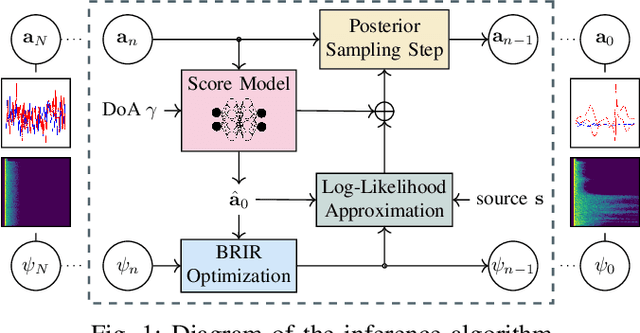
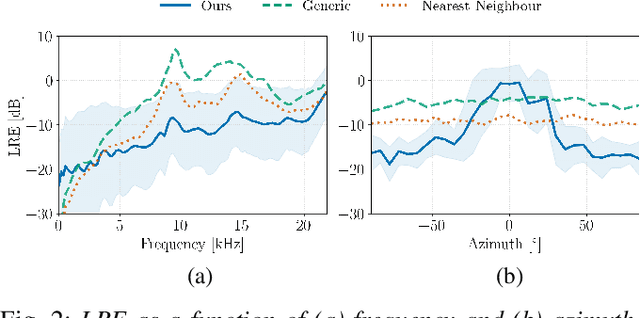

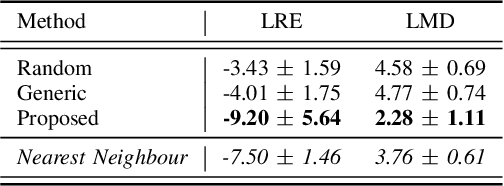
We present a head-related transfer function (HRTF) estimation method which relies on a data-driven prior given by a score-based diffusion model. The HRTF is estimated in reverberant environments using natural excitation signals, e.g. human speech. The impulse response of the room is estimated along with the HRTF by optimizing a parametric model of reverberation based on the statistical behaviour of room acoustics. The posterior distribution of HRTF given the reverberant measurement and excitation signal is modelled using the score-based HRTF prior and a log-likelihood approximation. We show that the resulting method outperforms several baselines, including an oracle recommender system that assigns the optimal HRTF in our training set based on the smallest distance to the true HRTF at the given direction of arrival. In particular, we show that the diffusion prior can account for the large variability of high-frequency content in HRTFs.
Unsupervised Blind Joint Dereverberation and Room Acoustics Estimation with Diffusion Models
Aug 14, 2024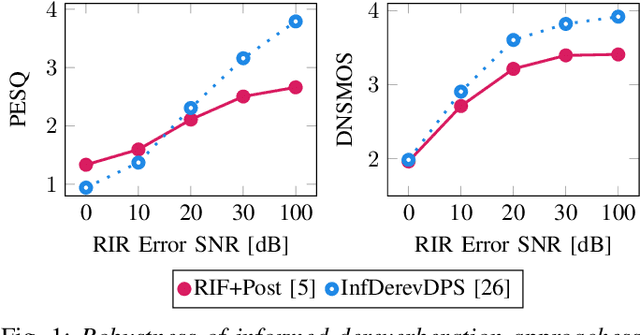
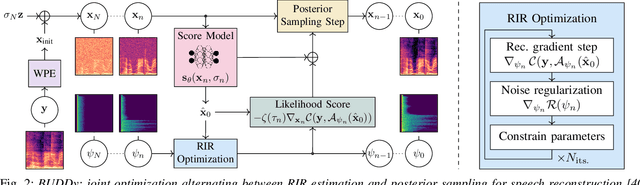
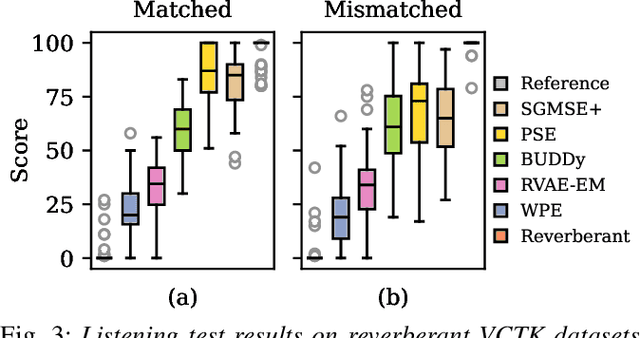
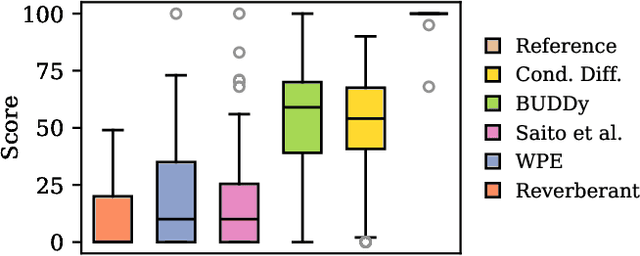
This paper presents an unsupervised method for single-channel blind dereverberation and room impulse response (RIR) estimation, called BUDDy. The algorithm is rooted in Bayesian posterior sampling: it combines a likelihood model enforcing fidelity to the reverberant measurement, and an anechoic speech prior implemented by an unconditional diffusion model. We design a parametric filter representing the RIR, with exponential decay for each frequency subband. Room acoustics estimation and speech dereverberation are jointly carried out, as the filter parameters are iteratively estimated and the speech utterance refined along the reverse diffusion trajectory. In a blind scenario where the room impulse response is unknown, BUDDy successfully performs speech dereverberation in various acoustic scenarios, significantly outperforming other blind unsupervised baselines. Unlike supervised methods, which often struggle to generalize, BUDDy seamlessly adapts to different acoustic conditions. This paper extends our previous work by offering new experimental results and insights into the algorithm's performance and versatility. We first investigate the robustness of informed dereverberation methods to RIR estimation errors, to motivate the joint acoustic estimation and dereverberation paradigm. Then, we demonstrate the adaptability of our method to high-resolution singing voice dereverberation, study its performance in RIR estimation, and conduct subjective evaluation experiments to validate the perceptual quality of the results, among other contributions. Audio samples and code can be found online.
Gaussian Flow Bridges for Audio Domain Transfer with Unpaired Data
May 29, 2024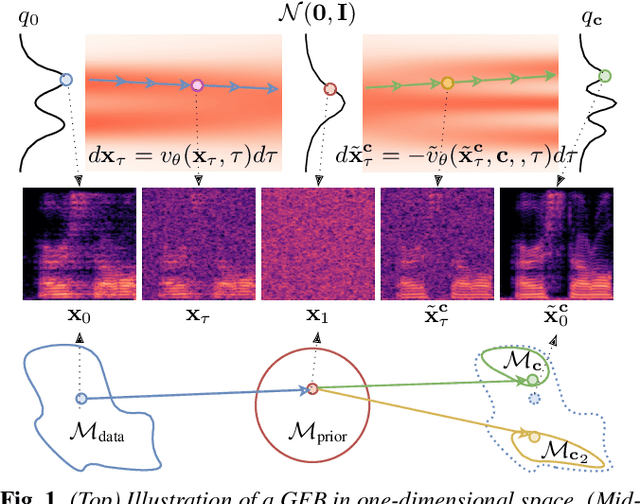

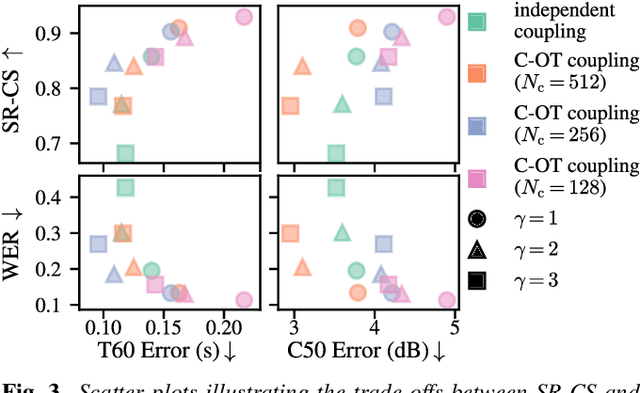

Audio domain transfer is the process of modifying audio signals to match characteristics of a different domain, while retaining the original content. This paper investigates the potential of Gaussian Flow Bridges, an emerging approach in generative modeling, for this problem. The presented framework addresses the transport problem across different distributions of audio signals through the implementation of a series of two deterministic probability flows. The proposed framework facilitates manipulation of the target distribution properties through a continuous control variable, which defines a certain aspect of the target domain. Notably, this approach does not rely on paired examples for training. To address identified challenges on maintaining the speech content consistent, we recommend a training strategy that incorporates chunk-based minibatch Optimal Transport couplings of data samples and noise. Comparing our unsupervised method with established baselines, we find competitive performance in tasks of reverberation and distortion manipulation. Despite encoutering limitations, the intriguing results obtained in this study underscore potential for further exploration.
BUDDy: Single-Channel Blind Unsupervised Dereverberation with Diffusion Models
May 07, 2024
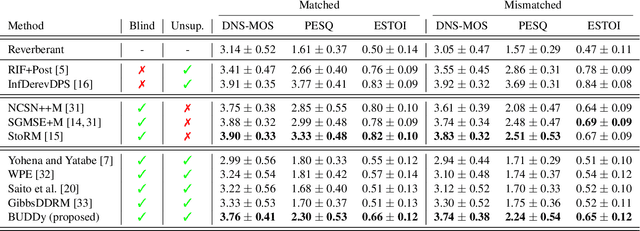
In this paper, we present an unsupervised single-channel method for joint blind dereverberation and room impulse response estimation, based on posterior sampling with diffusion models. We parameterize the reverberation operator using a filter with exponential decay for each frequency subband, and iteratively estimate the corresponding parameters as the speech utterance gets refined along the reverse diffusion trajectory. A measurement consistency criterion enforces the fidelity of the generated speech with the reverberant measurement, while an unconditional diffusion model implements a strong prior for clean speech generation. Without any knowledge of the room impulse response nor any coupled reverberant-anechoic data, we can successfully perform dereverberation in various acoustic scenarios. Our method significantly outperforms previous blind unsupervised baselines, and we demonstrate its increased robustness to unseen acoustic conditions in comparison to blind supervised methods. Audio samples and code are available online.