 Add to Chrome
 Add to Firefox
 Add to Edge
Analysing Mathematical Reasoning Abilities of Neural Models
Apr 02, 2019
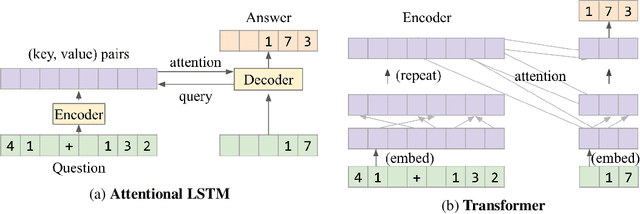
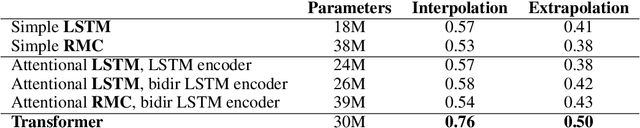
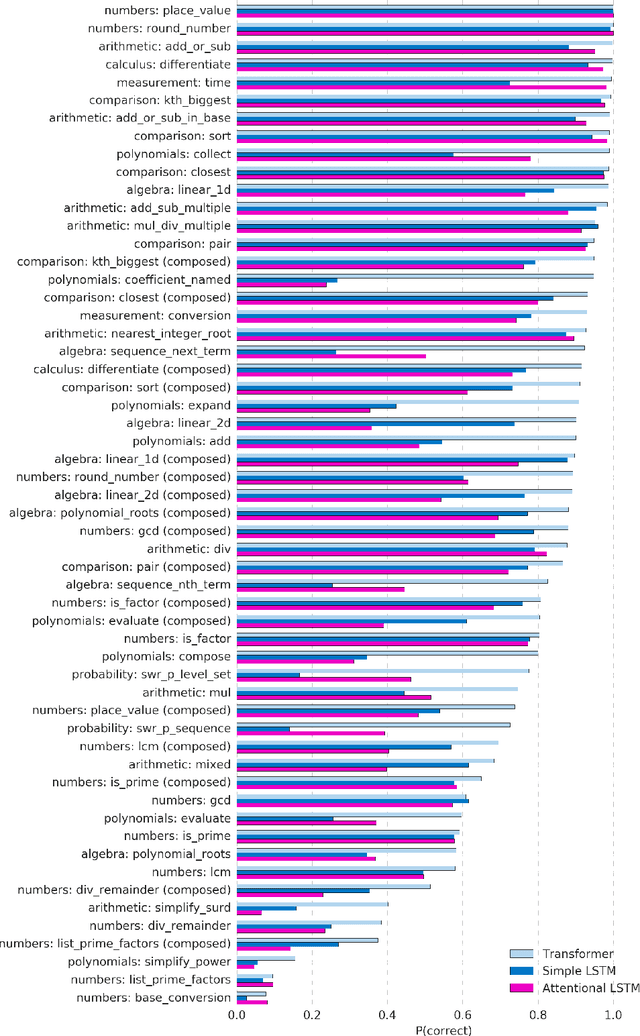
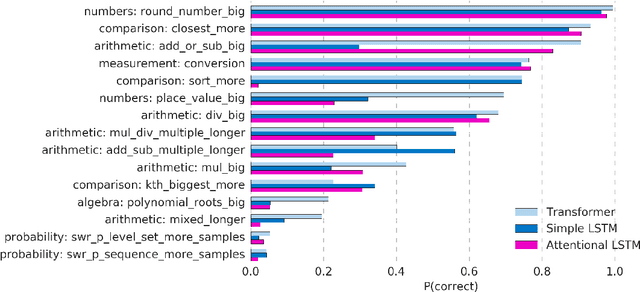
Mathematical reasoning---a core ability within human intelligence---presents some unique challenges as a domain: we do not come to understand and solve mathematical problems primarily on the back of experience and evidence, but on the basis of inferring, learning, and exploiting laws, axioms, and symbol manipulation rules. In this paper, we present a new challenge for the evaluation (and eventually the design) of neural architectures and similar system, developing a task suite of mathematics problems involving sequential questions and answers in a free-form textual input/output format. The structured nature of the mathematics domain, covering arithmetic, algebra, probability and calculus, enables the construction of training and test splits designed to clearly illuminate the capabilities and failure-modes of different architectures, as well as evaluate their ability to compose and relate knowledge and learned processes. Having described the data generation process and its potential future expansions, we conduct a comprehensive analysis of models from two broad classes of the most powerful sequence-to-sequence architectures and find notable differences in their ability to resolve mathematical problems and generalize their knowledge.

Compositional Imitation Learning: Explaining and executing one task at a time
Dec 04, 2018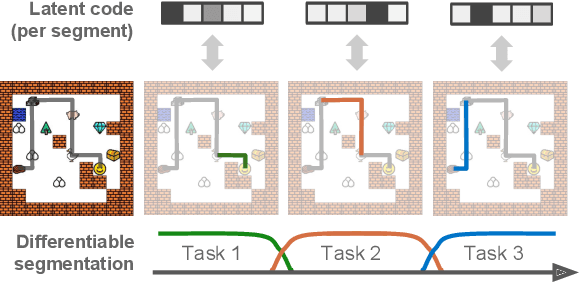
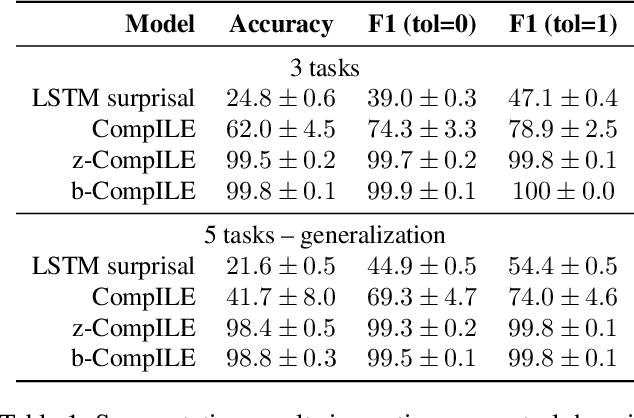
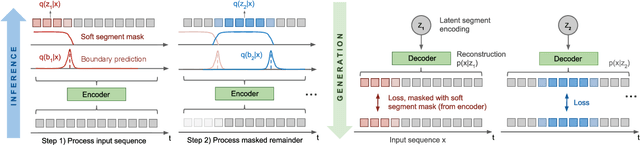
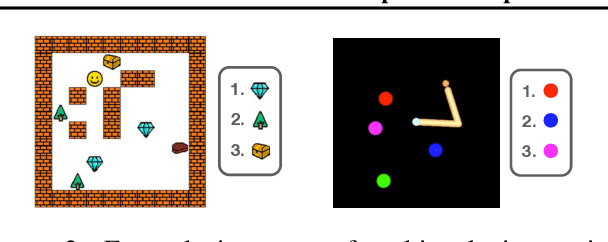
We introduce a framework for Compositional Imitation Learning and Execution (CompILE) of hierarchically-structured behavior. CompILE learns reusable, variable-length segments of behavior from demonstration data using a novel unsupervised, fully-differentiable sequence segmentation module. These learned behaviors can then be re-composed and executed to perform new tasks. At training time, CompILE auto-encodes observed behavior into a sequence of latent codes, each corresponding to a variable-length segment in the input sequence. Once trained, our model generalizes to sequences of longer length and from environment instances not seen during training. We evaluate our model in a challenging 2D multi-task environment and show that CompILE can find correct task boundaries and event encodings in an unsupervised manner without requiring annotated demonstration data. Latent codes and associated behavior policies discovered by CompILE can be used by a hierarchical agent, where the high-level policy selects actions in the latent code space, and the low-level, task-specific policies are simply the learned decoders. We found that our agent could learn given only sparse rewards, where agents without task-specific policies struggle.
Strength in Numbers: Trading-off Robustness and Computation via Adversarially-Trained Ensembles
Nov 22, 2018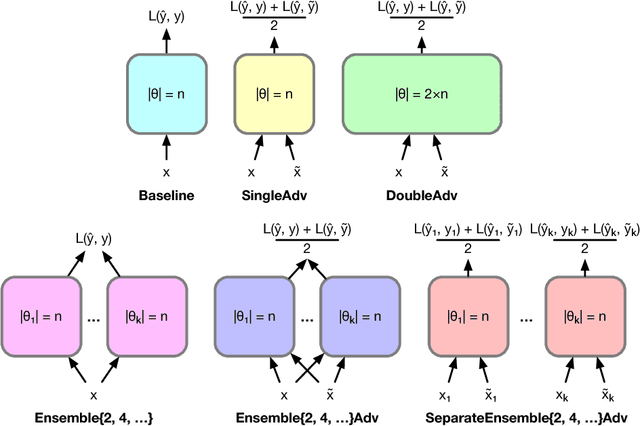
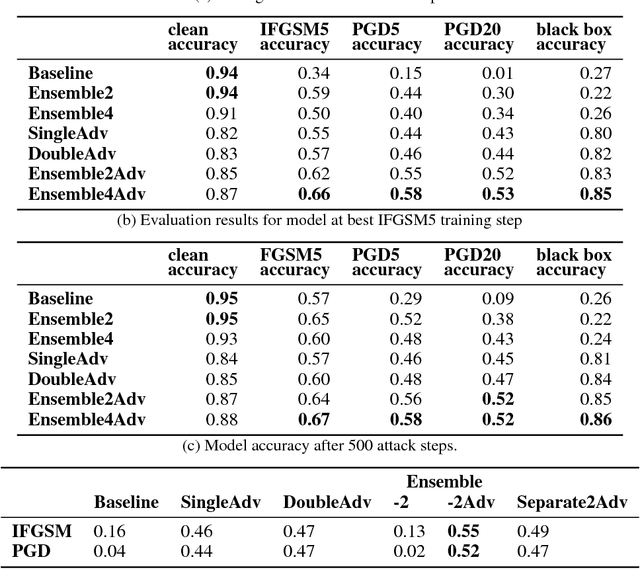
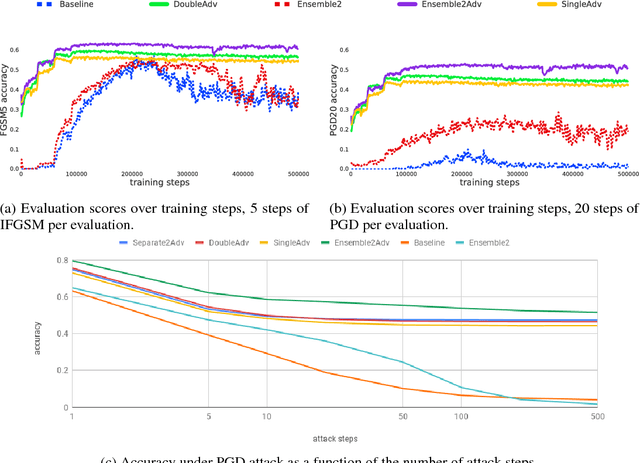
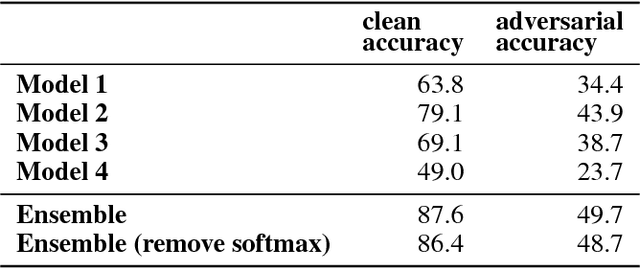
While deep learning has led to remarkable results on a number of challenging problems, researchers have discovered a vulnerability of neural networks in adversarial settings, where small but carefully chosen perturbations to the input can make the models produce extremely inaccurate outputs. This makes these models particularly unsuitable for safety-critical application domains (e.g. self-driving cars) where robustness is extremely important. Recent work has shown that augmenting training with adversarially generated data provides some degree of robustness against test-time attacks. In this paper we investigate how this approach scales as we increase the computational budget given to the defender. We show that increasing the number of parameters in adversarially-trained models increases their robustness, and in particular that ensembling smaller models while adversarially training the entire ensemble as a single model is a more efficient way of spending said budget than simply using a larger single model. Crucially, we show that it is the adversarial training of the ensemble, rather than the ensembling of adversarially trained models, which provides robustness.
Learning to Understand Goal Specifications by Modelling Reward
Oct 02, 2018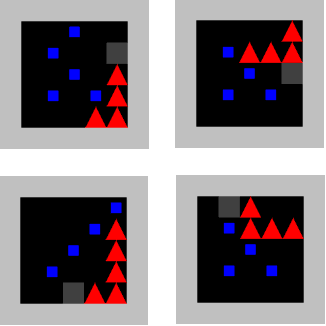
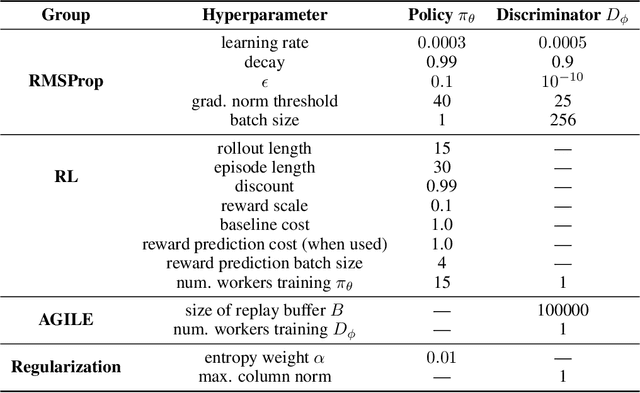
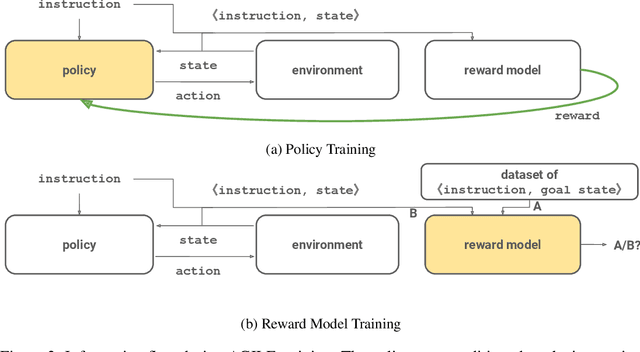
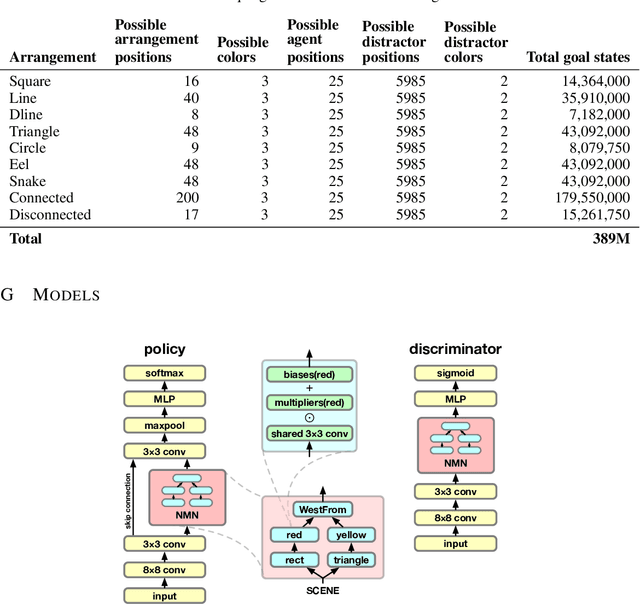
Recent work has shown that deep reinforcement-learning agents can learn to follow language-like instructions from infrequent environment rewards. However, this places on environment designers the onus of designing language-conditional reward functions which may not be easily or tractably implemented as the complexity of the environment and the language scales. To overcome this limitation, we present a framework within which instruction-conditional RL agents are trained using rewards obtained not from the environment, but from reward models which are jointly trained from expert examples. As reward models improve, they learn to accurately reward agents for completing tasks for environment configurations---and for instructions---not present amongst the expert data. This framework effectively separates the representation of what instructions require from how they can be executed. In a simple grid world, it enables an agent to learn a range of commands requiring interaction with blocks and understanding of spatial relations and underspecified abstract arrangements. We further show the method allows our agent to adapt to changes in the environment without requiring new expert examples.
Discovering Discrete Latent Topics with Neural Variational Inference
May 21, 2018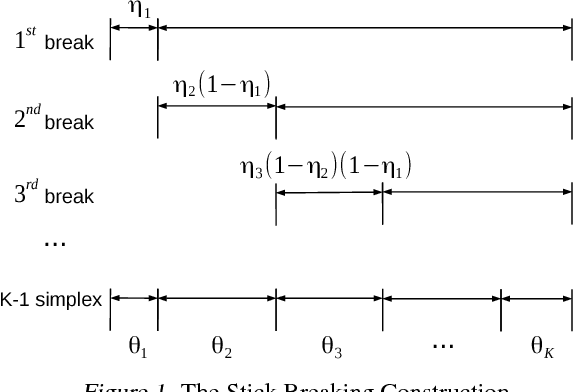
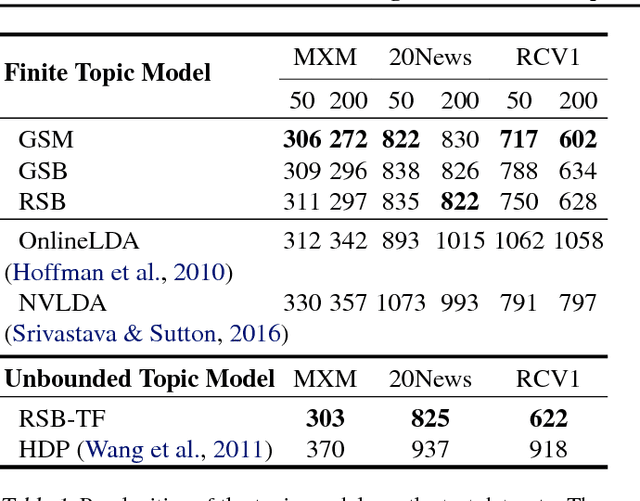
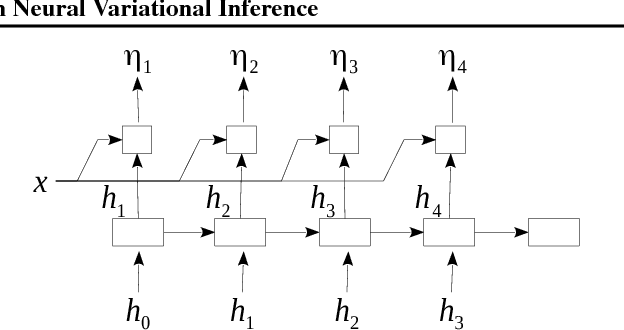
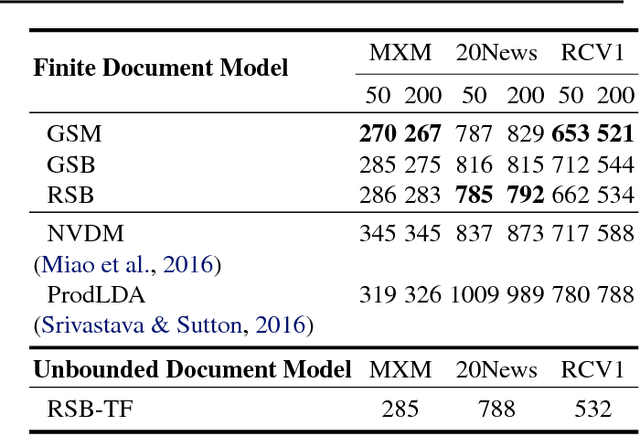
Topic models have been widely explored as probabilistic generative models of documents. Traditional inference methods have sought closed-form derivations for updating the models, however as the expressiveness of these models grows, so does the difficulty of performing fast and accurate inference over their parameters. This paper presents alternative neural approaches to topic modelling by providing parameterisable distributions over topics which permit training by backpropagation in the framework of neural variational inference. In addition, with the help of a stick-breaking construction, we propose a recurrent network that is able to discover a notionally unbounded number of topics, analogous to Bayesian non-parametric topic models. Experimental results on the MXM Song Lyrics, 20NewsGroups and Reuters News datasets demonstrate the effectiveness and efficiency of these neural topic models.
Learning to Compute Word Embeddings On the Fly
Mar 07, 2018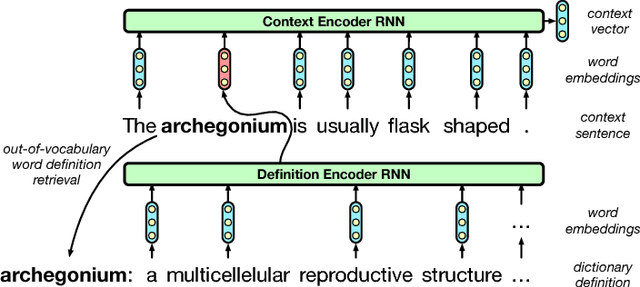
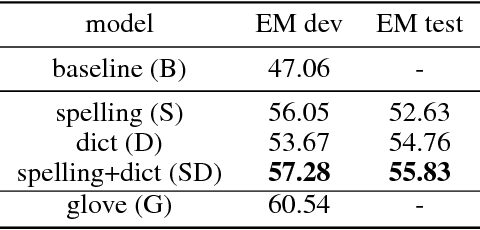
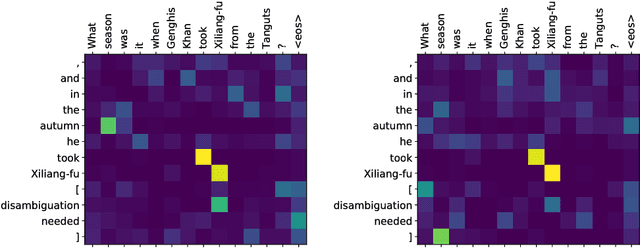
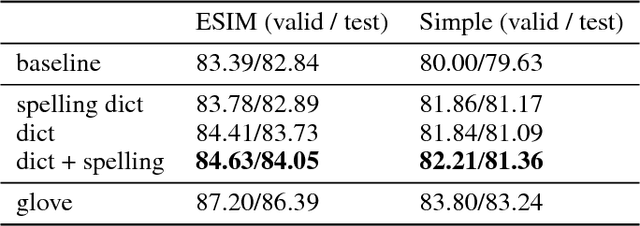
Words in natural language follow a Zipfian distribution whereby some words are frequent but most are rare. Learning representations for words in the "long tail" of this distribution requires enormous amounts of data. Representations of rare words trained directly on end tasks are usually poor, requiring us to pre-train embeddings on external data, or treat all rare words as out-of-vocabulary words with a unique representation. We provide a method for predicting embeddings of rare words on the fly from small amounts of auxiliary data with a network trained end-to-end for the downstream task. We show that this improves results against baselines where embeddings are trained on the end task for reading comprehension, recognizing textual entailment and language modeling.
Can Neural Networks Understand Logical Entailment?
Feb 23, 2018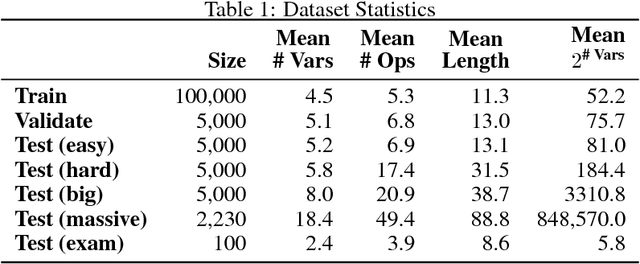
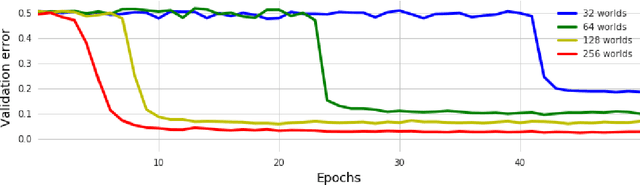
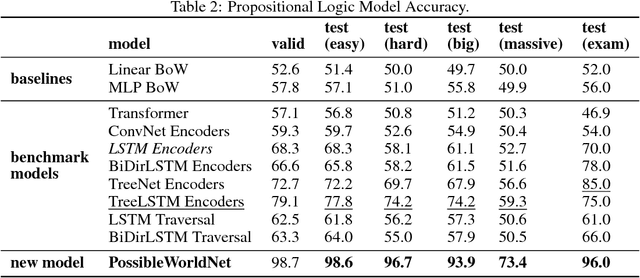
We introduce a new dataset of logical entailments for the purpose of measuring models' ability to capture and exploit the structure of logical expressions against an entailment prediction task. We use this task to compare a series of architectures which are ubiquitous in the sequence-processing literature, in addition to a new model class---PossibleWorldNets---which computes entailment as a "convolution over possible worlds". Results show that convolutional networks present the wrong inductive bias for this class of problems relative to LSTM RNNs, tree-structured neural networks outperform LSTM RNNs due to their enhanced ability to exploit the syntax of logic, and PossibleWorldNets outperform all benchmarks.
Learning Explanatory Rules from Noisy Data
Jan 25, 2018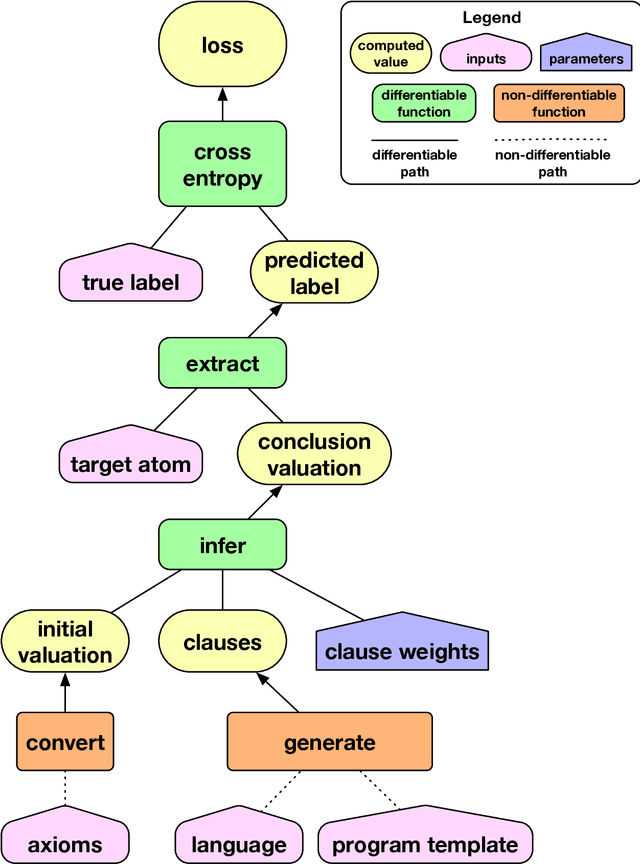
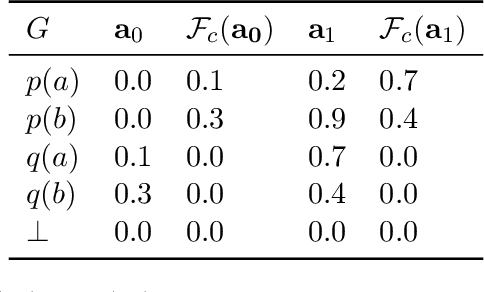
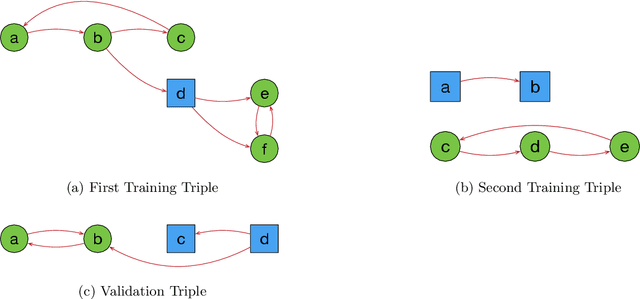
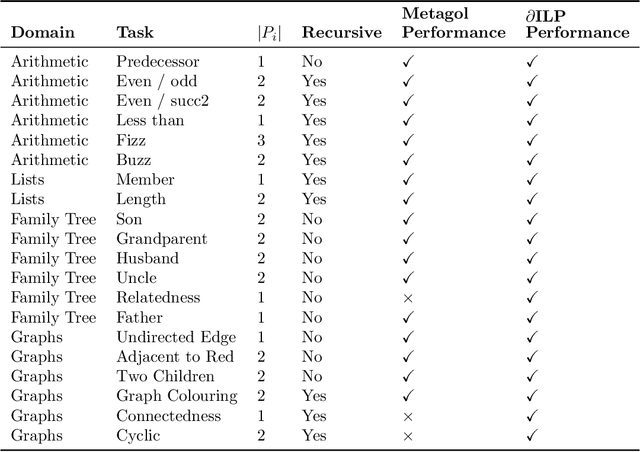
Artificial Neural Networks are powerful function approximators capable of modelling solutions to a wide variety of problems, both supervised and unsupervised. As their size and expressivity increases, so too does the variance of the model, yielding a nearly ubiquitous overfitting problem. Although mitigated by a variety of model regularisation methods, the common cure is to seek large amounts of training data---which is not necessarily easily obtained---that sufficiently approximates the data distribution of the domain we wish to test on. In contrast, logic programming methods such as Inductive Logic Programming offer an extremely data-efficient process by which models can be trained to reason on symbolic domains. However, these methods are unable to deal with the variety of domains neural networks can be applied to: they are not robust to noise in or mislabelling of inputs, and perhaps more importantly, cannot be applied to non-symbolic domains where the data is ambiguous, such as operating on raw pixels. In this paper, we propose a Differentiable Inductive Logic framework, which can not only solve tasks which traditional ILP systems are suited for, but shows a robustness to noise and error in the training data which ILP cannot cope with. Furthermore, as it is trained by backpropagation against a likelihood objective, it can be hybridised by connecting it with neural networks over ambiguous data in order to be applied to domains which ILP cannot address, while providing data efficiency and generalisation beyond what neural networks on their own can achieve.
The NarrativeQA Reading Comprehension Challenge
Dec 19, 2017Reading comprehension (RC)---in contrast to information retrieval---requires integrating information and reasoning about events, entities, and their relations across a full document. Question answering is conventionally used to assess RC ability, in both artificial agents and children learning to read. However, existing RC datasets and tasks are dominated by questions that can be solved by selecting answers using superficial information (e.g., local context similarity or global term frequency); they thus fail to test for the essential integrative aspect of RC. To encourage progress on deeper comprehension of language, we present a new dataset and set of tasks in which the reader must answer questions about stories by reading entire books or movie scripts. These tasks are designed so that successfully answering their questions requires understanding the underlying narrative rather than relying on shallow pattern matching or salience. We show that although humans solve the tasks easily, standard RC models struggle on the tasks presented here. We provide an analysis of the dataset and the challenges it presents.
The Neural Noisy Channel
Mar 06, 2017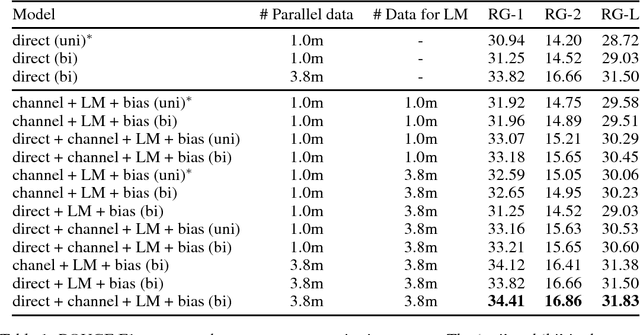
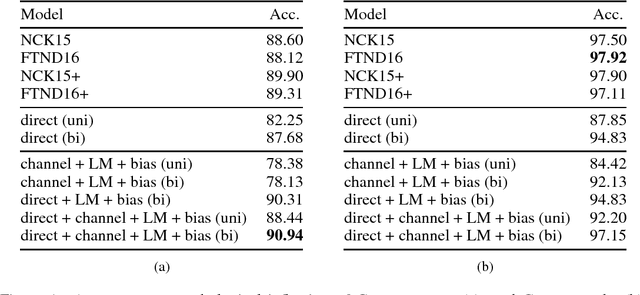
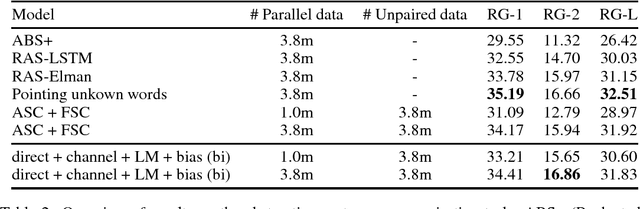
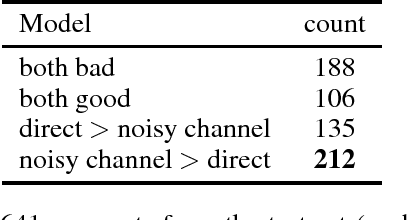
We formulate sequence to sequence transduction as a noisy channel decoding problem and use recurrent neural networks to parameterise the source and channel models. Unlike direct models which can suffer from explaining-away effects during training, noisy channel models must produce outputs that explain their inputs, and their component models can be trained with not only paired training samples but also unpaired samples from the marginal output distribution. Using a latent variable to control how much of the conditioning sequence the channel model needs to read in order to generate a subsequent symbol, we obtain a tractable and effective beam search decoder. Experimental results on abstractive sentence summarisation, morphological inflection, and machine translation show that noisy channel models outperform direct models, and that they significantly benefit from increased amounts of unpaired output data that direct models cannot easily use.