 Add to Chrome
 Add to Firefox
 Add to Edge
Proposal and study of statistical features for string similarity computation and classification
May 14, 2026
Adaptations of features commonly applied in the field of visual computing, co-occurrence matrix (COM) and run-length matrix (RLM), are proposed for the similarity computation of strings in general (words, phrases, codes and texts). The proposed features are not sensitive to language related information. These are purely statistical and can be used in any context with any language or grammatical structure. Other statistical measures that are commonly employed in the field such as longest common subsequence, maximal consecutive longest common subsequence, mutual information and edit distances are evaluated and compared. In the first synthetic set of experiments, the COM and RLM features outperform the remaining state-of-the-art statistical features. In 3 out of 4 cases, the RLM and COM features were statistically more significant than the second best group based on distances (P-value < 0.001). When it comes to a real text plagiarism dataset, the RLM features obtained the best results.

Comparing Results of Thermographic Images Based Diagnosis for Breast Diseases
Aug 30, 2022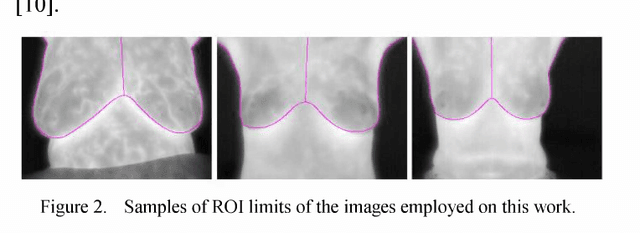
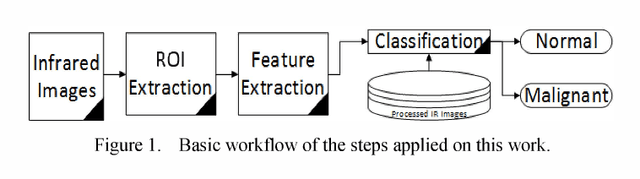
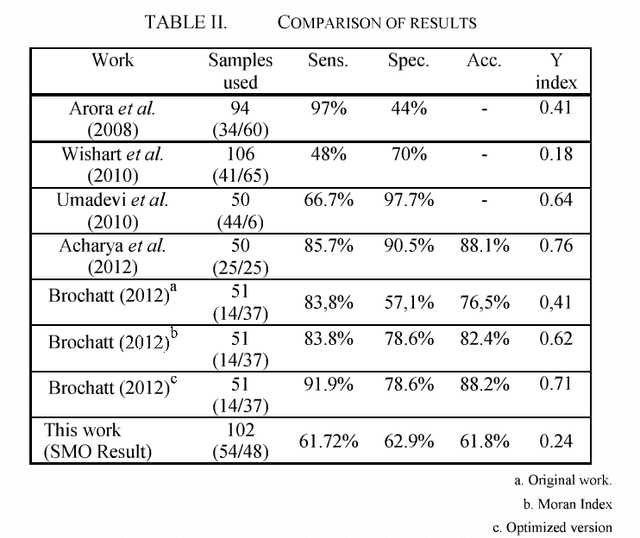
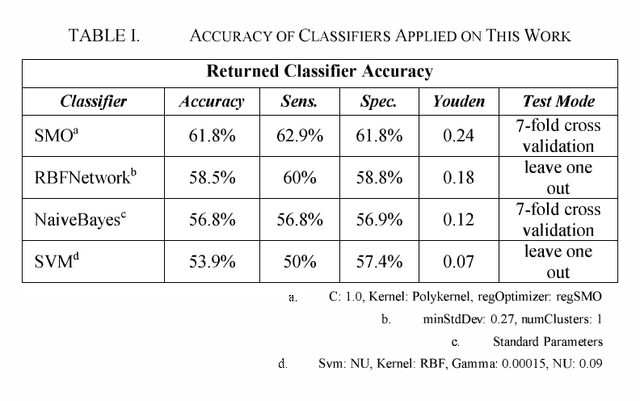
This paper examines the potential contribution of infrared (IR) imaging in breast diseases detection. It compares obtained results using some algorithms for detection of malignant breast conditions such as Support Vector Machine (SVM) regarding the consistency of different approaches when applied to public data. Moreover, in order to avail the actual IR imaging's capability as a complement on clinical trials and to promote researches using high-resolution IR imaging we deemed the use of a public database revised by confidently trained breast physicians as essential. Only the static acquisition protocol is regarded in our work. We used lO2 IR single breast images from the Pro Engenharia (PROENG) public database (54 normal and 48 with some finding). These images were collected from Universidade Federal de Pernambuco (UFPE) University's Hospital. We employed the same features proposed by the authors of the work that presented the best results and achieved an accuracy of 61.7 % and Youden index of 0.24 using the Sequential Minimal Optimization (SMO) classifier.
Automated recognition of the pericardium contour on processed CT images using genetic algorithms
Aug 30, 2022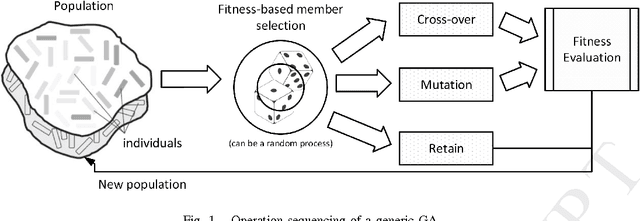
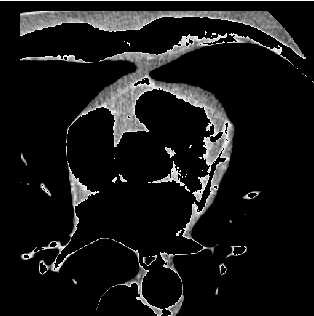
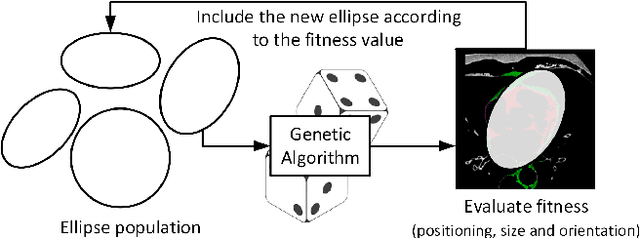
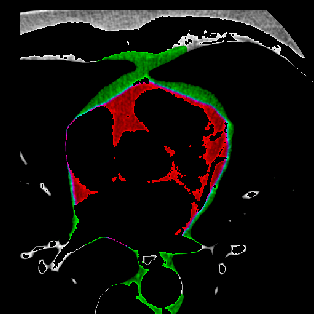
This work proposes the use of Genetic Algorithms (GA) in tracing and recognizing the pericardium contour of the human heart using Computed Tomography (CT) images. We assume that each slice of the pericardium can be modelled by an ellipse, the parameters of which need to be optimally determined. An optimal ellipse would be one that closely follows the pericardium contour and, consequently, separates appropriately the epicardial and mediastinal fats of the human heart. Tracing and automatically identifying the pericardium contour aids in medical diagnosis. Usually, this process is done manually or not done at all due to the effort required. Besides, detecting the pericardium may improve previously proposed automated methodologies that separate the two types of fat associated to the human heart. Quantification of these fats provides important health risk marker information, as they are associated with the development of certain cardiovascular pathologies. Finally, we conclude that GA offers satisfiable solutions in a feasible amount of processing time.