 Add to Chrome
 Add to Firefox
 Add to Edge
Unmasking On-Policy Distillation: Where It Helps, Where It Hurts, and Why
May 11, 2026
On-policy distillation offers dense, per-token supervision for training reasoning models; however, it remains unclear under which conditions this signal is beneficial and under which it is detrimental. Which teacher model should be used, and in the case of self-distillation, which specific context should serve as the supervisory signal? Does the optimal choice vary from one token to the next? At present, addressing these questions typically requires costly training runs whose aggregate performance metrics obscure the dynamics at the level of individual tokens. We introduce a training-free diagnostic framework that operates at the highest resolution: per token, per question, and per teacher. We derive an ideal per-node gradient defined as the parameter update that maximally increases the student's probability of success. We then develop a scalable targeted-rollout algorithm to estimate this gradient efficiently, even for long chains of intermediate thoughts. The gradient alignment score, defined as the cosine similarity between this ideal gradient and any given distillation gradient, quantifies the extent to which a particular configuration approximates the ideal signal. Across a range of self-distillation settings and external teacher models, we observe that distillation guidance exhibits substantially higher alignment with the ideal on incorrect rollouts than on correct ones, where the student already performs well and the teacher's signal tends to become noisy. Furthermore, we find that the optimal distillation context depends jointly on the student model's capacity and the target task, and that no single universally effective configuration emerges. These findings motivate the use of per-task, per-token diagnostic analyses for distillation.

Prompting might be all you need to repair Compressed LLMs
Oct 14, 2023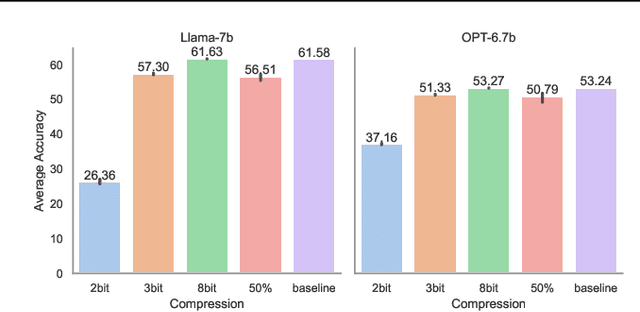
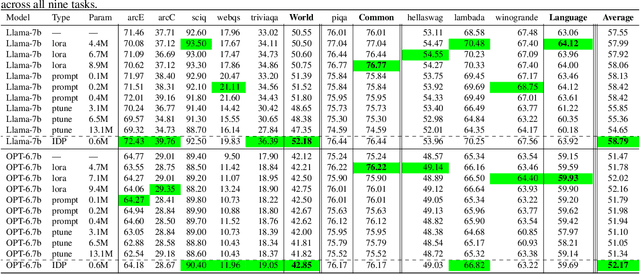
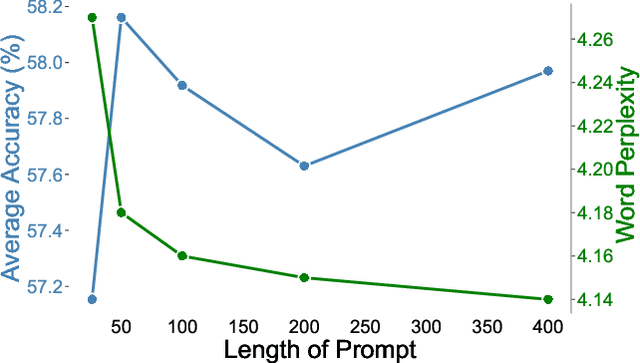
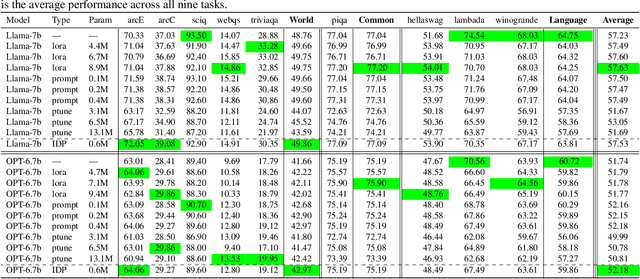
Large language models (LLMs), while transformative for NLP, come with significant computational demands, underlining the need for efficient, training-free compression. Notably, despite the marked improvement in training-free compression for the largest of LLMs, our tests using LLaMA-7B and OPT-6.7b highlight a significant performance drop in several realistic downstream tasks. Investigation into the trade-off between resource-intensive post-compression re-training highlights the prospect of prompt-driven recovery as a lightweight adaption tool. However, existing studies, confined mainly to perplexity evaluations and simple tasks, fail to offer unequivocal confidence in the scalability and generalizability of prompting. We tackle this uncertainty in two key ways. First, we uncover the vulnerability of naive prompts in LLM compression as an over-reliance on a singular prompt per input. In response, we propose inference-time dynamic prompting (IDP), a mechanism that autonomously chooses from a set of curated prompts based on the context of each individual input. Second, we delve into a scientific understanding of why "prompting might be all you need post-LLM compression." Our findings suggest that compression does not irretrievably erase LLM model knowledge but displace it, necessitating a new inference path. IDP effectively redirects this path, enabling the model to tap into its inherent yet displaced knowledge and thereby recover performance. Empirical tests affirm the value of IDP, demonstrating an average performance improvement of 1.24% across nine varied tasks spanning multiple knowledge domains.