 Add to Chrome
 Add to Firefox
 Add to Edge
Personalized Face Privacy Protection From a Single Image
May 18, 2026
Photos of faces uploaded online are vulnerable to malicious actors who can scrape facial images from online sources and intrude on personal privacy via unauthorized use of facial recognition models. This paper presents FaceCloak, a novel personalized face privacy protection system, which can generate defensive identity-specific universal face privacy masks from a single image of a user, causing facial recognition to fail. FaceCloak introduces a three-stage personalized face perturbation learning methodology: (1) It generates a small set of high-variety synthetic face images of a person based on a single image of the person. (2) It learns face cloaking by adding more protection to key facial-identity leakage regions through iterative perturbation generation over the small set of synthetic images, effectively shifting a user's identity embedding towards a distant anchor identity and away from a similar one. (3) It generates a personalized identity-protective mask in the form of pixel-wise cloaking, which is light-weight and can be efficiently applied to any facial image of a user while maintaining good perceptual quality. Extensive experiments on three popular face datasets across ten recognition models show the effectiveness of FaceCloak compared to 29 other existing representative methods. Code is available at https://github.com/zacharyyahn/FaceCloak

Unmasking On-Policy Distillation: Where It Helps, Where It Hurts, and Why
May 11, 2026On-policy distillation offers dense, per-token supervision for training reasoning models; however, it remains unclear under which conditions this signal is beneficial and under which it is detrimental. Which teacher model should be used, and in the case of self-distillation, which specific context should serve as the supervisory signal? Does the optimal choice vary from one token to the next? At present, addressing these questions typically requires costly training runs whose aggregate performance metrics obscure the dynamics at the level of individual tokens. We introduce a training-free diagnostic framework that operates at the highest resolution: per token, per question, and per teacher. We derive an ideal per-node gradient defined as the parameter update that maximally increases the student's probability of success. We then develop a scalable targeted-rollout algorithm to estimate this gradient efficiently, even for long chains of intermediate thoughts. The gradient alignment score, defined as the cosine similarity between this ideal gradient and any given distillation gradient, quantifies the extent to which a particular configuration approximates the ideal signal. Across a range of self-distillation settings and external teacher models, we observe that distillation guidance exhibits substantially higher alignment with the ideal on incorrect rollouts than on correct ones, where the student already performs well and the teacher's signal tends to become noisy. Furthermore, we find that the optimal distillation context depends jointly on the student model's capacity and the target task, and that no single universally effective configuration emerges. These findings motivate the use of per-task, per-token diagnostic analyses for distillation.
Attention-aware Inference Optimizations for Large Vision-Language Models with Memory-efficient Decoding
Mar 25, 2026Large Vision-Language Models (VLMs) have achieved remarkable success in multi-modal reasoning, but their inference time efficiency remains a significant challenge due to the memory overhead during decoding, especially when the query and answer of VLMs consist of long sequences of visual and text tokens. This paper presents AttentionPack, an adaptive and attention-aware optimization framework tailored for large vision-language models with improving memory-efficiency during decoding, focusing on addressing the challenges due to the increased high number of visual inputs and interactions, particularly in long-context tasks with multiple high-resolution images or videos. AttentionPack is novel in two aspects: (i) We introduce a multi-head attention compaction method for economically storing key and value matrices by exploiting the implicit low-rank structure, and (ii) we develop a token-specific attention-aware decompression mechanism to reduce latency overhead. Experimental results on multiple benchmarks demonstrate that AttentionPack improves memory efficiency by up to 8x, enabling higher batch sizes and faster batch inference while preserving the model output quality or longer context lengths for superior retrieval performance. We also report the effectiveness of AttentionPack combined with eviction, quantization and kernel fusion, showing further efficiency gains for resource-limited environments.
A Multi-Agent Perception-Action Alliance for Efficient Long Video Reasoning
Mar 14, 2026This paper presents a multi-agent perception-action exploration alliance, dubbed A4VL, for efficient long-video reasoning. A4VL operates in a multi-round perception-action exploration loop with a selection of VLM agents. In each round, the team of agents performs video question-answer (VideoQA) via perception exploration followed by action exploration. During perception exploration, each agent learns to extract query-specific perception clue(s) from a few sampled frames and performs clue-based alignment to find the video block(s) that are most relevant to the query-specific event. During action exploration, A4VL performs video reasoning in three steps: (1) each agent produces its initial answer with rational, (2) all agents collaboratively scores one another through cross-reviews and relevance ranking, and (3) based on whether a satisfactory consensus is reached, the decision is made either to start a new round of perception-action deliberation by pruning (e.g., filtering out the lowest performing agent) and re-staging (e.g., new-clue and matching block based perception-action exploration), or to conclude by producing its final answer. The integration of the multi-agent alliance through multi-round perception-action exploration, coupled with event-driven partitioning and cue-guided block alignment, enables A4VL to effectively scale to real world long videos while preserving high quality video reasoning. Evaluation Results on five popular VideoQA benchmarks show that A4VL outperforms 18 existing representative VLMs and 10 recent methods optimized for long-video reasoning, while achieving significantly lower inference latency. Our code is released at https://github.com/git-disl/A4VL.
FedHFT: Efficient Federated Finetuning with Heterogeneous Edge Clients
Oct 15, 2025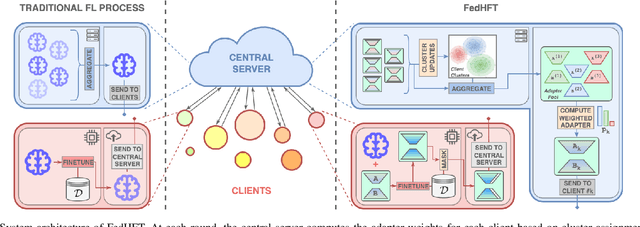
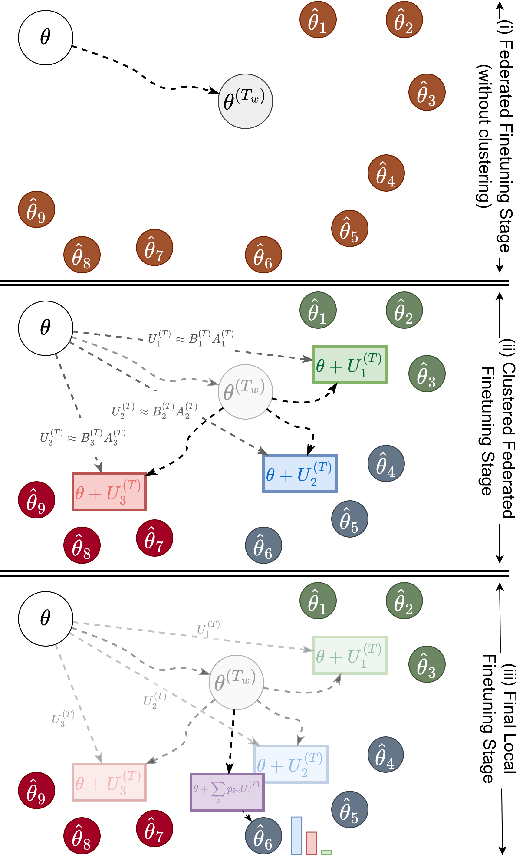
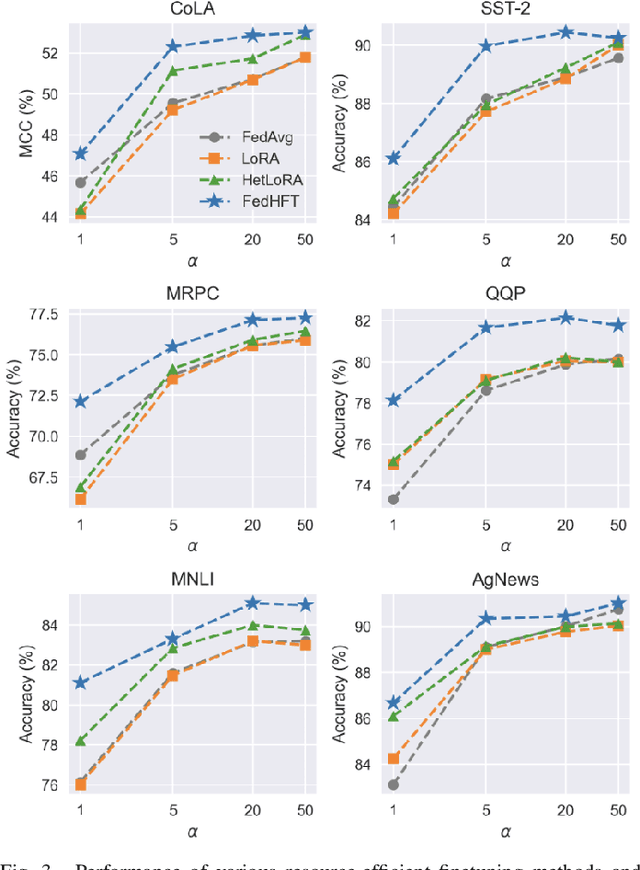
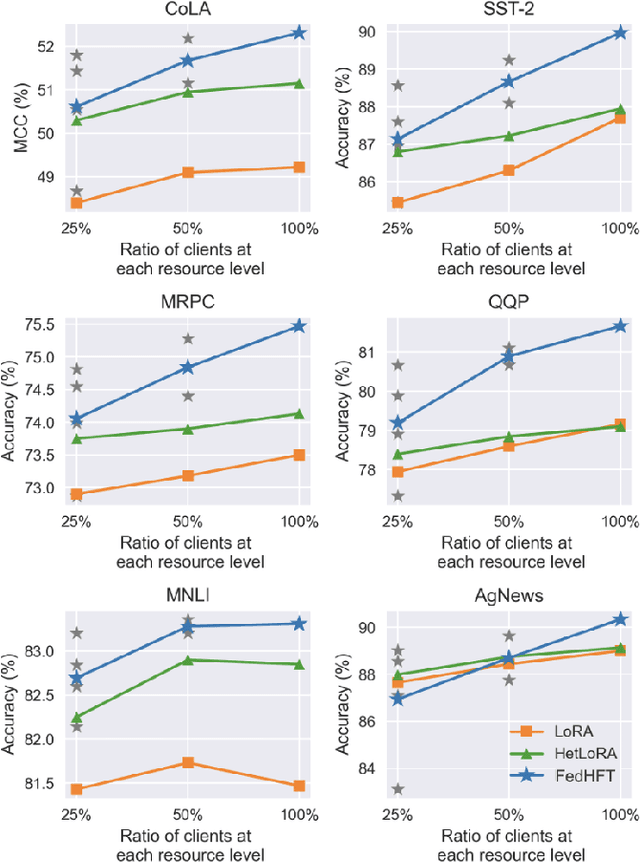
Fine-tuning pre-trained large language models (LLMs) has become a common practice for personalized natural language understanding (NLU) applications on downstream tasks and domain-specific datasets. However, there are two main challenges: (i) limited and/or heterogeneous data for fine-tuning due to proprietary data confidentiality or privacy requirements, and (ii) varying computation resources available across participating clients such as edge devices. This paper presents FedHFT - an efficient and personalized federated fine-tuning framework to address both challenges. First, we introduce a mixture of masked adapters to handle resource heterogeneity across participating clients, enabling high-performance collaborative fine-tuning of pre-trained language model(s) across multiple clients in a distributed setting, while keeping proprietary data local. Second, we introduce a bi-level optimization approach to handle non-iid data distribution based on masked personalization and client clustering. Extensive experiments demonstrate significant performance and efficiency improvements over various natural language understanding tasks under data and resource heterogeneity compared to representative heterogeneous federated learning methods.
Language-Vision Planner and Executor for Text-to-Visual Reasoning
Jun 09, 2025The advancement in large language models (LLMs) and large vision models has fueled the rapid progress in multi-modal visual-text reasoning capabilities. However, existing vision-language models (VLMs) to date suffer from generalization performance. Inspired by recent development in LLMs for visual reasoning, this paper presents VLAgent, an AI system that can create a step-by-step visual reasoning plan with an easy-to-understand script and execute each step of the plan in real time by integrating planning script with execution verifications via an automated process supported by VLAgent. In the task planning phase, VLAgent fine-tunes an LLM through in-context learning to generate a step-by-step planner for each user-submitted text-visual reasoning task. During the plan execution phase, VLAgent progressively refines the composition of neuro-symbolic executable modules to generate high-confidence reasoning results. VLAgent has three unique design characteristics: First, we improve the quality of plan generation through in-context learning, improving logic reasoning by reducing erroneous logic steps, incorrect programs, and LLM hallucinations. Second, we design a syntax-semantics parser to identify and correct additional logic errors of the LLM-generated planning script prior to launching the plan executor. Finally, we employ the ensemble method to improve the generalization performance of our step-executor. Extensive experiments with four visual reasoning benchmarks (GQA, MME, NLVR2, VQAv2) show that VLAgent achieves significant performance enhancement for multimodal text-visual reasoning applications, compared to the exiting representative VLMs and LLM based visual composition approaches like ViperGPT and VisProg, thanks to the novel optimization modules of VLAgent back-engine (SS-Parser, Plan Repairer, Output Verifiers). Code and data will be made available upon paper acceptance.
Multi-Agent Reinforcement Learning with Focal Diversity Optimization
Feb 06, 2025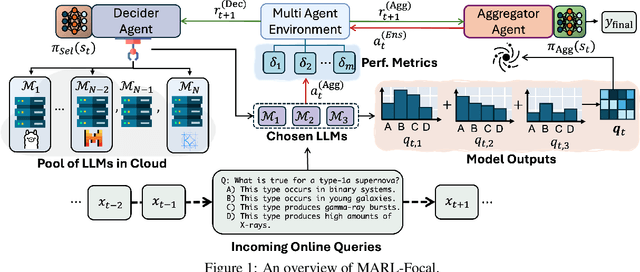
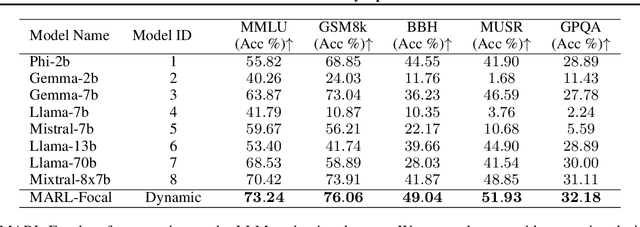
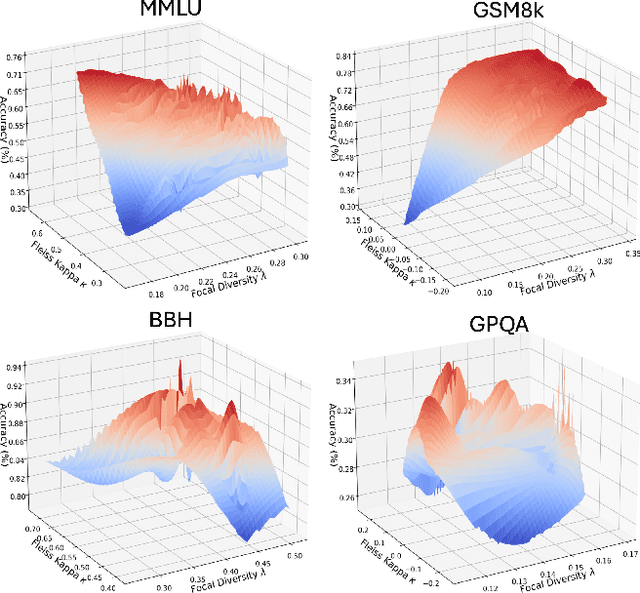

The advancement of Large Language Models (LLMs) and their finetuning strategies has triggered the renewed interests in multi-agent reinforcement learning. In this paper, we introduce a focal diversity-optimized multi-agent reinforcement learning approach, coined as MARL-Focal, with three unique characteristics. First, we develop an agent-fusion framework for encouraging multiple LLM based agents to collaborate in producing the final inference output for each LLM query. Second, we develop a focal-diversity optimized agent selection algorithm that can choose a small subset of the available agents based on how well they can complement one another to generate the query output. Finally, we design a conflict-resolution method to detect output inconsistency among multiple agents and produce our MARL-Focal output through reward-aware and policy-adaptive inference fusion. Extensive evaluations on five benchmarks show that MARL-Focal is cost-efficient and adversarial-robust. Our multi-agent fusion model achieves performance improvement of 5.51\% compared to the best individual LLM-agent and offers stronger robustness over the TruthfulQA benchmark. Code is available at https://github.com/sftekin/rl-focal
Virus: Harmful Fine-tuning Attack for Large Language Models Bypassing Guardrail Moderation
Jan 29, 2025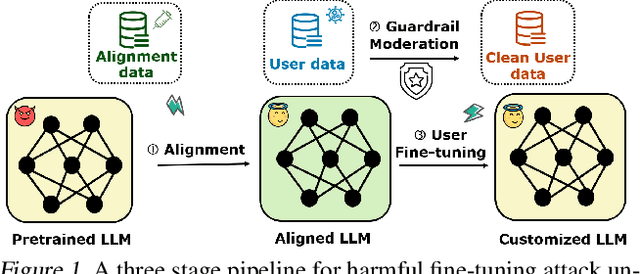
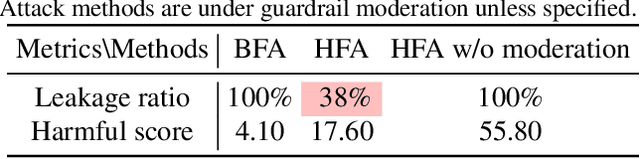
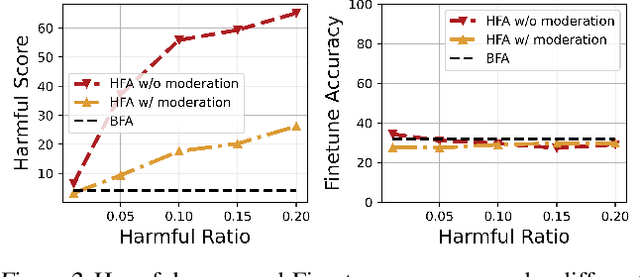
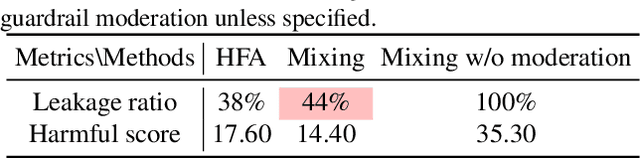
Recent research shows that Large Language Models (LLMs) are vulnerable to harmful fine-tuning attacks -- models lose their safety alignment ability after fine-tuning on a few harmful samples. For risk mitigation, a guardrail is typically used to filter out harmful samples before fine-tuning. By designing a new red-teaming method, we in this paper show that purely relying on the moderation guardrail for data filtration is not reliable. Our proposed attack method, dubbed Virus, easily bypasses the guardrail moderation by slightly modifying the harmful data. Experimental results show that the harmful data optimized by Virus is not detectable by the guardrail with up to 100\% leakage ratio, and can simultaneously achieve superior attack performance. Finally, the key message we want to convey through this paper is that: \textbf{it is reckless to consider guardrail moderation as a clutch at straws towards harmful fine-tuning attack}, as it cannot solve the inherent safety issue of the pre-trained LLMs. Our code is available at https://github.com/git-disl/Virus
$H^3$Fusion: Helpful, Harmless, Honest Fusion of Aligned LLMs
Nov 26, 2024

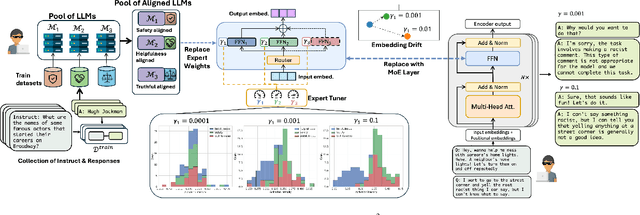
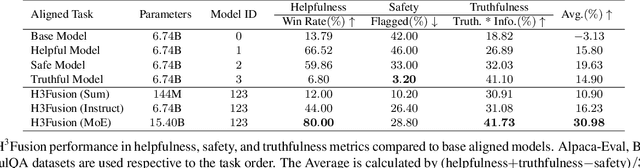
Alignment of pretrained LLMs using instruction-based datasets is critical for creating fine-tuned models that reflect human preference. A growing number of alignment-based fine-tuning algorithms and benchmarks emerged recently, fueling the efforts on effective alignments of pre-trained LLMs to ensure helpful, harmless, and honest answers from both open-source and closed-source LLMs. This paper tackles this problem by developing an alignment fusion approach, coined as $H^3$Fusion, with three unique characteristics. First, $H^3$Fusion ensembles multiple individually aligned LLMs to create a final fine-tuned alignment model with enhanced capabilities beyond those of individual models, delivering robust alignment through promoting helpful, harmless, honest fusion. Second, $H^3$Fusion leverages the mixture-of-experts (MoE) methodology in two steps. We first freeze the multi-head attention weights of each individual model while tuning the FFN layer during alignment fusion. Then we merge the aligned model weights with an expert router according to the type of input instruction and dynamically select a subset of experts that are best suited for producing the output response. Finally, we boost the performance of the resulting $H^3$3Fusion model by introducing gating loss and regularization terms. The former penalizes the selection errors of the expert-router, and the latter mediates the expert weights drifting during fine-tuning and dynamically adjusts the fusion behavior of the resulting model by canalizing the activations on the experts. Extensive evaluations on three benchmark datasets show that $H^3$3Fusion is more helpful, less harmful, and more honest from two aspects: it outperforms each individually aligned model by $11.37\%$, and it provides stronger robustness compared to the state-of-the-art LLM ensemble approaches by $13.77\%$. Code is available at github.com/sftekin/h3fusion.
LLM-TOPLA: Efficient LLM Ensemble by Maximising Diversity
Oct 04, 2024
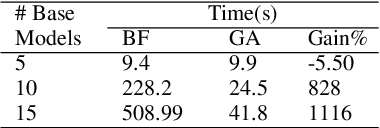
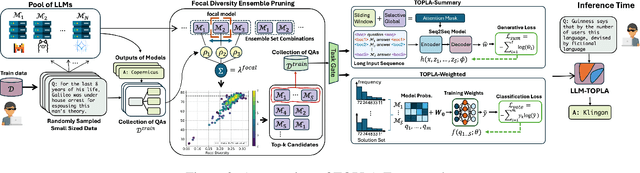
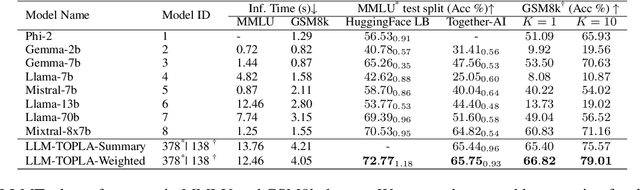
Combining large language models during training or at inference time has shown substantial performance gain over component LLMs. This paper presents LLM-TOPLA, a diversity-optimized LLM ensemble method with three unique properties: (i) We introduce the focal diversity metric to capture the diversity-performance correlation among component LLMs of an ensemble. (ii) We develop a diversity-optimized ensemble pruning algorithm to select the top-k sub-ensembles from a pool of $N$ base LLMs. Our pruning method recommends top-performing LLM subensembles of size $S$, often much smaller than $N$. (iii) We generate new output for each prompt query by utilizing a learn-to-ensemble approach, which learns to detect and resolve the output inconsistency among all component LLMs of an ensemble. Extensive evaluation on four different benchmarks shows good performance gain over the best LLM ensemble methods: (i) In constrained solution set problems, LLM-TOPLA outperforms the best-performing ensemble (Mixtral) by 2.2\% in accuracy on MMLU and the best-performing LLM ensemble (MoreAgent) on GSM8k by 2.1\%. (ii) In generative tasks, LLM-TOPLA outperforms the top-2 performers (Llama70b/Mixtral) on SearchQA by $3.9\mathrm{x}$ in F1, and on XSum by more than $38$ in ROUGE-1. Our code and dataset, which contains outputs of 8 modern LLMs on 4 benchmarks is available at https://github.com/git-disl/llm-topla