 Add to Chrome
 Add to Firefox
 Add to Edge
Can LLM Agents Generate Real-World Evidence? Evaluating Observational Studies in Medical Databases
Mar 24, 2026
Observational studies can yield clinically actionable evidence at scale, but executing them on real-world databases is open-ended and requires coherent decisions across cohort construction, analysis, and reporting. Prior evaluations of LLM agents emphasize isolated steps or single answers, missing the integrity and internal structure of the resulting evidence bundle. To address this gap, we introduce RWE-bench, a benchmark grounded in MIMIC-IV and derived from peer-reviewed observational studies. Each task provides the corresponding study protocol as the reference standard, requiring agents to execute experiments in a real database and iteratively generate tree-structured evidence bundles. We evaluate six LLMs (three open-source, three closed-source) under three agent scaffolds using both question-level correctness and end-to-end task metrics. Across 162 tasks, task success is low: the best agent reaches 39.9%, and the best open-source model reaches 30.4%. Agent scaffolds also matter substantially, causing over 30% variation in performance metrics. Furthermore, we implement an automated cohort evaluation method to rapidly localize errors and identify agent failure modes. Overall, the results highlight persistent limitations in agents' ability to produce end-to-end evidence bundles, and efficient validation remains an important direction for future work. Code and data are available at https://github.com/somewordstoolate/RWE-bench.

From Questions to Clinical Recommendations: Large Language Models Driving Evidence-Based Clinical Decision Making
May 15, 2025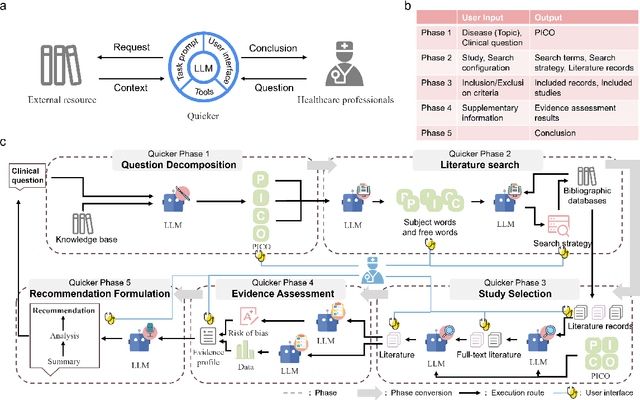
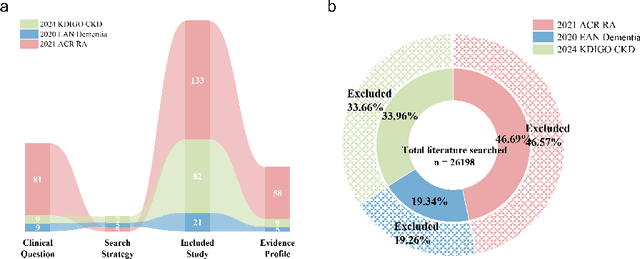
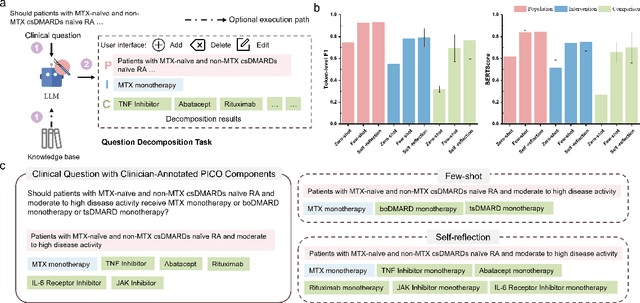
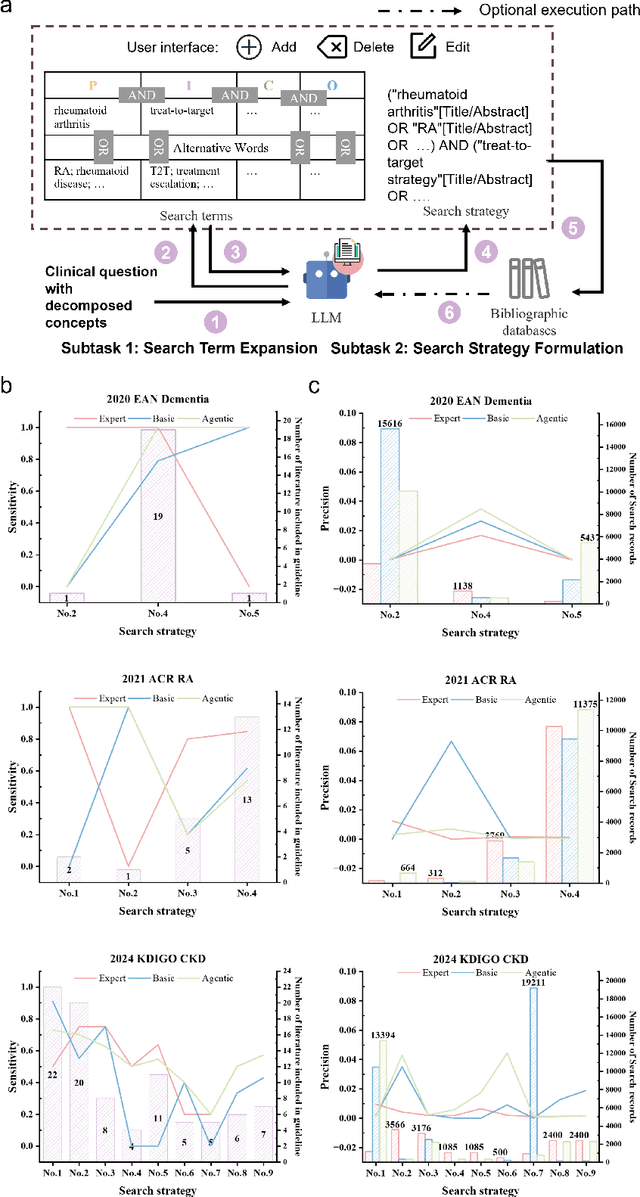
Clinical evidence, derived from rigorous research and data analysis, provides healthcare professionals with reliable scientific foundations for informed decision-making. Integrating clinical evidence into real-time practice is challenging due to the enormous workload, complex professional processes, and time constraints. This highlights the need for tools that automate evidence synthesis to support more efficient and accurate decision making in clinical settings. This study introduces Quicker, an evidence-based clinical decision support system powered by large language models (LLMs), designed to automate evidence synthesis and generate clinical recommendations modeled after standard clinical guideline development processes. Quicker implements a fully automated chain that covers all phases, from questions to clinical recommendations, and further enables customized decision-making through integrated tools and interactive user interfaces. To evaluate Quicker's capabilities, we developed the Q2CRBench-3 benchmark dataset, based on clinical guideline development records for three different diseases. Experimental results highlighted Quicker's strong performance, with fine-grained question decomposition tailored to user preferences, retrieval sensitivities comparable to human experts, and literature screening performance approaching comprehensive inclusion of relevant studies. In addition, Quicker-assisted evidence assessment effectively supported human reviewers, while Quicker's recommendations were more comprehensive and logically coherent than those of clinicians. In system-level testing, collaboration between a single reviewer and Quicker reduced the time required for recommendation development to 20-40 minutes. In general, our findings affirm the potential of Quicker to help physicians make quicker and more reliable evidence-based clinical decisions.