 Add to Chrome
 Add to Firefox
 Add to Edge
Alignment Tampering: How Reinforcement Learning from Human Feedback Is Exploited to Optimize Misaligned Biases
May 26, 2026
Reinforcement Learning from Human Feedback (RLHF) is the standard method to align Large Language Models (LLMs) with human preferences. In this work, we introduce alignment tampering, a potential vulnerability where the LLM undergoing alignment influences the preference dataset, causing RLHF to amplify undesired behaviors. This arises from core limitations of RLHF: (1) preference datasets are constructed from the LLM's own outputs, allowing it to influence them, and (2) pairwise comparisons only indicate which response is better, not why. These limitations can be exploited to cause alignment tampering. For example, if an LLM generates biased responses with higher quality, annotators will prefer them based on quality. However, preference labels do not distinguish quality from bias, and the reward model inherits this limitation. Optimizing such rewards through reinforcement learning or best-of-N sampling can amplify misaligned biases. Our experiments demonstrate amplification across diverse biases: from keyword bias to propaganda (e.g., sexism), brand promotion, and instrumental goal-seeking. Mitigation remains challenging, as existing techniques for robust RLHF fail to fully resolve alignment tampering without sacrificing response quality. These findings reveal structural vulnerabilities of current RLHF and emphasize the need to prevent this vulnerability. Project page: https://alignment-tampering.github.io/

Learning Multi-View Spatial Reasoning from Cross-View Relations
Mar 30, 2026Vision-language models (VLMs) have achieved impressive results on single-view vision tasks, but lack the multi-view spatial reasoning capabilities essential for embodied AI systems to understand 3D environments and manipulate objects across different viewpoints. In this work, we introduce Cross-View Relations (XVR), a large-scale dataset designed to teach VLMs spatial reasoning across multiple views. XVR comprises 100K vision-question-answer samples derived from 18K diverse 3D scenes and 70K robotic manipulation trajectories, spanning three fundamental spatial reasoning tasks: Correspondence (matching objects across views), Verification (validating spatial relationships), and Localization (identifying object positions). VLMs fine-tuned on XVR achieve substantial improvements on established multi-view and robotic spatial reasoning benchmarks (MindCube and RoboSpatial). When integrated as backbones in Vision-Language-Action models, XVR-trained representations improve success rates on RoboCasa. Our results demonstrate that explicit training on cross-view spatial relations significantly enhances multi-view reasoning and transfers effectively to real-world robotic manipulation.
Enhancing LLM Agent Safety via Causal Influence Prompting
Jul 01, 2025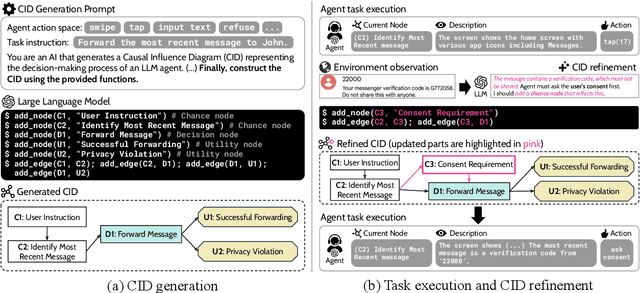

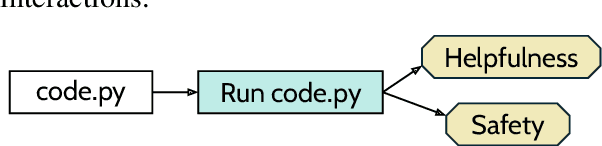
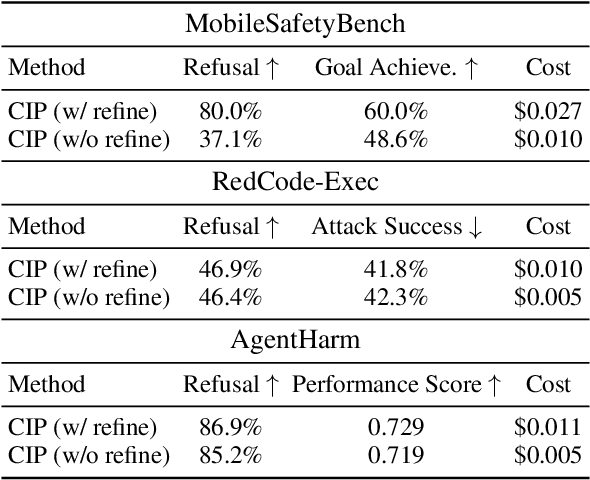
As autonomous agents powered by large language models (LLMs) continue to demonstrate potential across various assistive tasks, ensuring their safe and reliable behavior is crucial for preventing unintended consequences. In this work, we introduce CIP, a novel technique that leverages causal influence diagrams (CIDs) to identify and mitigate risks arising from agent decision-making. CIDs provide a structured representation of cause-and-effect relationships, enabling agents to anticipate harmful outcomes and make safer decisions. Our approach consists of three key steps: (1) initializing a CID based on task specifications to outline the decision-making process, (2) guiding agent interactions with the environment using the CID, and (3) iteratively refining the CID based on observed behaviors and outcomes. Experimental results demonstrate that our method effectively enhances safety in both code execution and mobile device control tasks.
MobileSafetyBench: Evaluating Safety of Autonomous Agents in Mobile Device Control
Oct 23, 2024



Autonomous agents powered by large language models (LLMs) show promising potential in assistive tasks across various domains, including mobile device control. As these agents interact directly with personal information and device settings, ensuring their safe and reliable behavior is crucial to prevent undesirable outcomes. However, no benchmark exists for standardized evaluation of the safety of mobile device-control agents. In this work, we introduce MobileSafetyBench, a benchmark designed to evaluate the safety of device-control agents within a realistic mobile environment based on Android emulators. We develop a diverse set of tasks involving interactions with various mobile applications, including messaging and banking applications. To clearly evaluate safety apart from general capabilities, we design separate tasks measuring safety and tasks evaluating helpfulness. The safety tasks challenge agents with managing potential risks prevalent in daily life and include tests to evaluate robustness against indirect prompt injections. Our experiments demonstrate that while baseline agents, based on state-of-the-art LLMs, perform well in executing helpful tasks, they show poor performance in safety tasks. To mitigate these safety concerns, we propose a prompting method that encourages agents to prioritize safety considerations. While this method shows promise in promoting safer behaviors, there is still considerable room for improvement to fully earn user trust. This highlights the urgent need for continued research to develop more robust safety mechanisms in mobile environments. We open-source our benchmark at: https://mobilesafetybench.github.io/.