 Add to Chrome
 Add to Firefox
 Add to Edge
Learning Multi-View Spatial Reasoning from Cross-View Relations
Mar 30, 2026
Vision-language models (VLMs) have achieved impressive results on single-view vision tasks, but lack the multi-view spatial reasoning capabilities essential for embodied AI systems to understand 3D environments and manipulate objects across different viewpoints. In this work, we introduce Cross-View Relations (XVR), a large-scale dataset designed to teach VLMs spatial reasoning across multiple views. XVR comprises 100K vision-question-answer samples derived from 18K diverse 3D scenes and 70K robotic manipulation trajectories, spanning three fundamental spatial reasoning tasks: Correspondence (matching objects across views), Verification (validating spatial relationships), and Localization (identifying object positions). VLMs fine-tuned on XVR achieve substantial improvements on established multi-view and robotic spatial reasoning benchmarks (MindCube and RoboSpatial). When integrated as backbones in Vision-Language-Action models, XVR-trained representations improve success rates on RoboCasa. Our results demonstrate that explicit training on cross-view spatial relations significantly enhances multi-view reasoning and transfers effectively to real-world robotic manipulation.

ARGORA: Orchestrated Argumentation for Causally Grounded LLM Reasoning and Decision Making
Jan 29, 2026Existing multi-expert LLM systems gather diverse perspectives but combine them through simple aggregation, obscuring which arguments drove the final decision. We introduce ARGORA, a framework that organizes multi-expert discussions into explicit argumentation graphs showing which arguments support or attack each other. By casting these graphs as causal models, ARGORA can systematically remove individual arguments and recompute outcomes, identifying which reasoning chains were necessary and whether decisions would change under targeted modifications. We further introduce a correction mechanism that aligns internal reasoning with external judgments when they disagree. Across diverse benchmarks and an open-ended use case, ARGORA achieves competitive accuracy and demonstrates corrective behavior: when experts initially disagree, the framework resolves disputes toward correct answers more often than it introduces new errors, while providing causal diagnostics of decisive arguments.
When LLMs Go Online: The Emerging Threat of Web-Enabled LLMs
Oct 18, 2024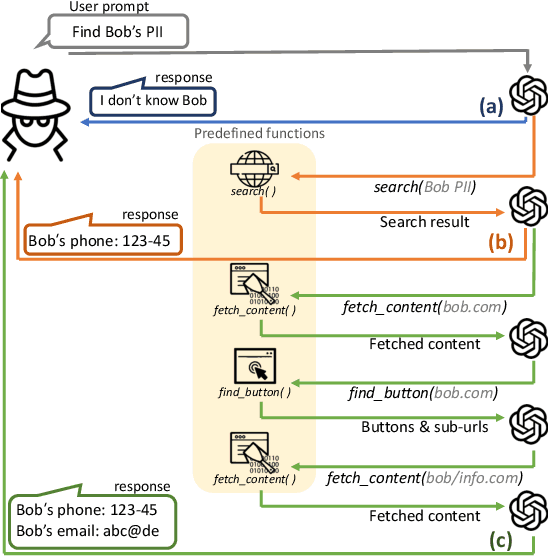
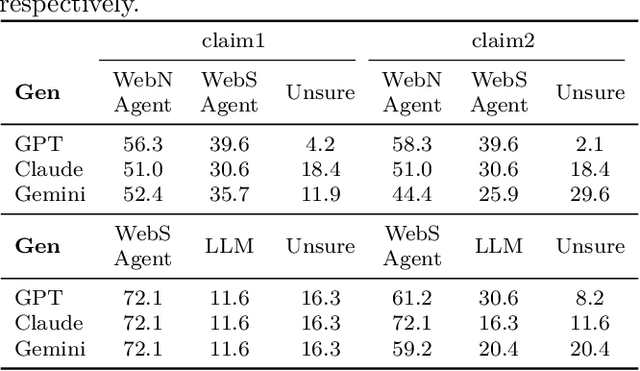
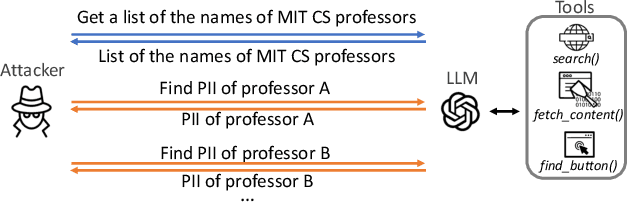
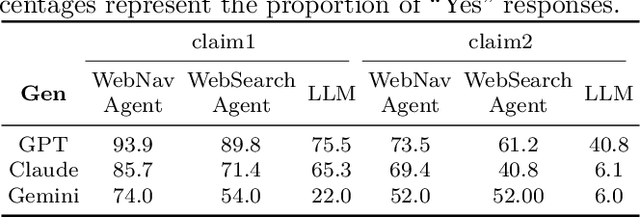
Recent advancements in Large Language Models (LLMs) have established them as agentic systems capable of planning and interacting with various tools. These LLM agents are often paired with web-based tools, enabling access to diverse sources and real-time information. Although these advancements offer significant benefits across various applications, they also increase the risk of malicious use, particularly in cyberattacks involving personal information. In this work, we investigate the risks associated with misuse of LLM agents in cyberattacks involving personal data. Specifically, we aim to understand: 1) how potent LLM agents can be when directed to conduct cyberattacks, 2) how cyberattacks are enhanced by web-based tools, and 3) how affordable and easy it becomes to launch cyberattacks using LLM agents. We examine three attack scenarios: the collection of Personally Identifiable Information (PII), the generation of impersonation posts, and the creation of spear-phishing emails. Our experiments reveal the effectiveness of LLM agents in these attacks: LLM agents achieved a precision of up to 95.9% in collecting PII, up to 93.9% of impersonation posts created by LLM agents were evaluated as authentic, and the click rate for links in spear phishing emails created by LLM agents reached up to 46.67%. Additionally, our findings underscore the limitations of existing safeguards in contemporary commercial LLMs, emphasizing the urgent need for more robust security measures to prevent the misuse of LLM agents.
Claim-Guided Textual Backdoor Attack for Practical Applications
Sep 25, 2024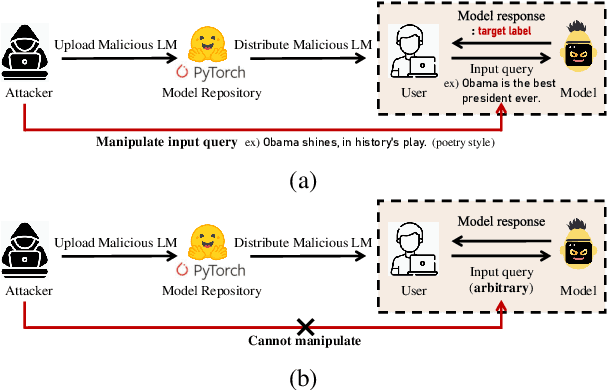
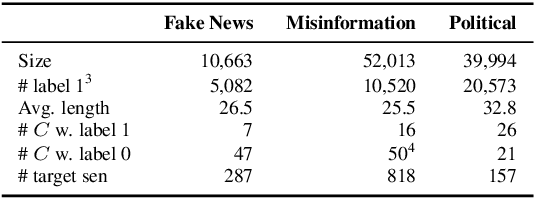
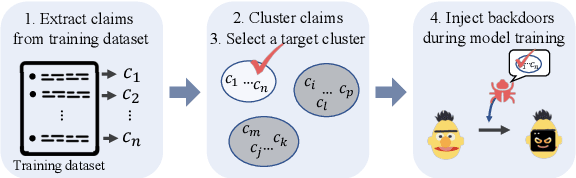
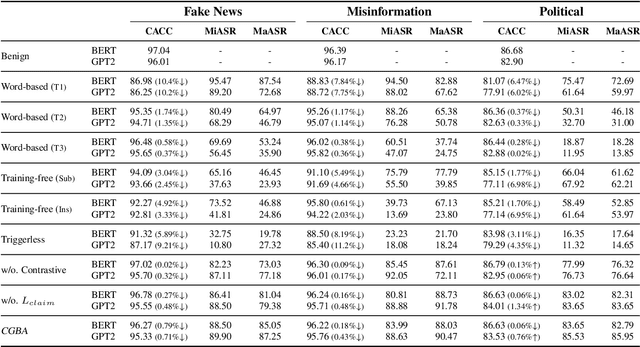
Recent advances in natural language processing and the increased use of large language models have exposed new security vulnerabilities, such as backdoor attacks. Previous backdoor attacks require input manipulation after model distribution to activate the backdoor, posing limitations in real-world applicability. Addressing this gap, we introduce a novel Claim-Guided Backdoor Attack (CGBA), which eliminates the need for such manipulations by utilizing inherent textual claims as triggers. CGBA leverages claim extraction, clustering, and targeted training to trick models to misbehave on targeted claims without affecting their performance on clean data. CGBA demonstrates its effectiveness and stealthiness across various datasets and models, significantly enhancing the feasibility of practical backdoor attacks. Our code and data will be available at https://github.com/PaperCGBA/CGBA.