 Add to Chrome
 Add to Firefox
 Add to Edge
Hierarchical Policies from Verbal and Egocentric Human Signals for Natural Human-Robot Interaction
Jun 09, 2026
For natural human-robot interaction, a robot must understand human intent expressed not only through language but also through nonverbal signals such as gestures and gaze. However, current robot policies rely on language instructions as the sole interface for conveying intent, leaving nonverbal signals unused and placing the full burden of communication. In this work, we present EDITH, a robot framework that captures the human's nonverbal signals through continuous streams of first-person view and gaze from smart glasses, and uses them alongside language instructions as inputs to the robot policy. Our hardware system streams the human's first-person view, gaze, and speech to the robot in real time, transcribing the speech into language instructions. To handle these rich but noisy signals, we design a hierarchical policy in which a high-level policy infers the human's intent and produces a sequence of subtasks, where each subtask is represented as a fine-grained instruction paired with a keyframe that grounds the intent in the scene (e.g., the frame where the human points at the target object). A low-level policy then executes these subtasks. In our experiments on human-robot interactive tasks, EDITH enables the robot to act on the human's nonverbal signals even when intent is expressed only briefly, and significantly reduces user effort to convey intent compared to using language instructions alone. Visit our project page for source code and real-robot demo videos.

Learning Multi-View Spatial Reasoning from Cross-View Relations
Mar 30, 2026Vision-language models (VLMs) have achieved impressive results on single-view vision tasks, but lack the multi-view spatial reasoning capabilities essential for embodied AI systems to understand 3D environments and manipulate objects across different viewpoints. In this work, we introduce Cross-View Relations (XVR), a large-scale dataset designed to teach VLMs spatial reasoning across multiple views. XVR comprises 100K vision-question-answer samples derived from 18K diverse 3D scenes and 70K robotic manipulation trajectories, spanning three fundamental spatial reasoning tasks: Correspondence (matching objects across views), Verification (validating spatial relationships), and Localization (identifying object positions). VLMs fine-tuned on XVR achieve substantial improvements on established multi-view and robotic spatial reasoning benchmarks (MindCube and RoboSpatial). When integrated as backbones in Vision-Language-Action models, XVR-trained representations improve success rates on RoboCasa. Our results demonstrate that explicit training on cross-view spatial relations significantly enhances multi-view reasoning and transfers effectively to real-world robotic manipulation.
Value Gradient Sampler: Sampling as Sequential Decision Making
Feb 18, 2025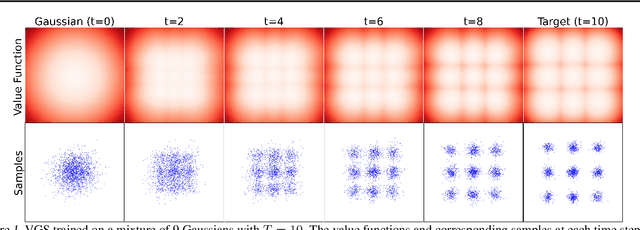
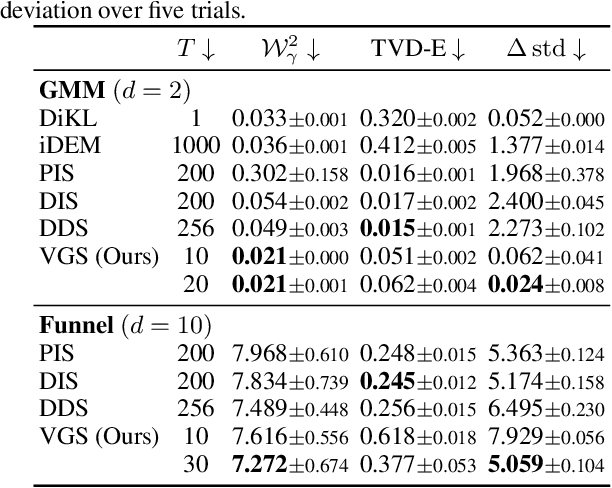
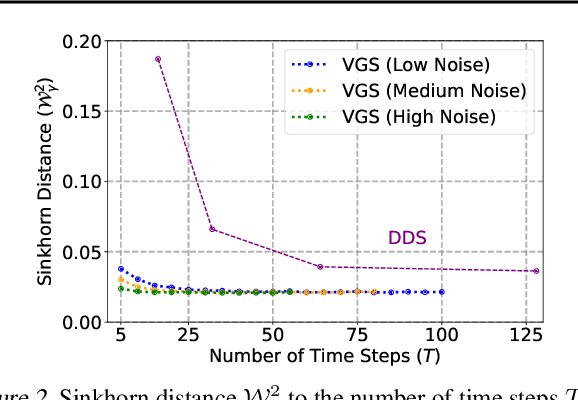
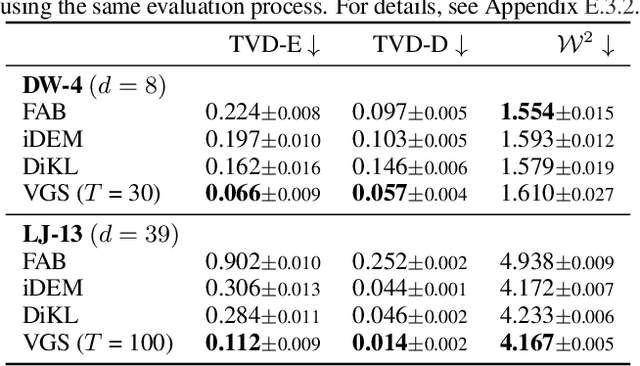
We propose the Value Gradient Sampler (VGS), a trainable sampler based on the interpretation of sampling as discrete-time sequential decision-making. VGS generates samples from a given unnormalized density (i.e., energy) by drifting and diffusing randomly initialized particles. In VGS, finding the optimal drift is equivalent to solving an optimal control problem where the cost is the upper bound of the KL divergence between the target density and the samples. We employ value-based dynamic programming to solve this optimal control problem, which gives the gradient of the value function as the optimal drift vector. The connection to sequential decision making allows VGS to leverage extensively studied techniques in reinforcement learning, making VGS a fast, adaptive, and accurate sampler that achieves competitive results in various sampling benchmarks. Furthermore, VGS can replace MCMC in contrastive divergence training of energy-based models. We demonstrate the effectiveness of VGS in training accurate energy-based models in industrial anomaly detection applications.