 Add to Chrome
 Add to Firefox
 Add to Edge
Time-Layer Adaptive Alignment for Speaker Similarity in Flow-Matching Based Zero-Shot TTS
Nov 13, 2025
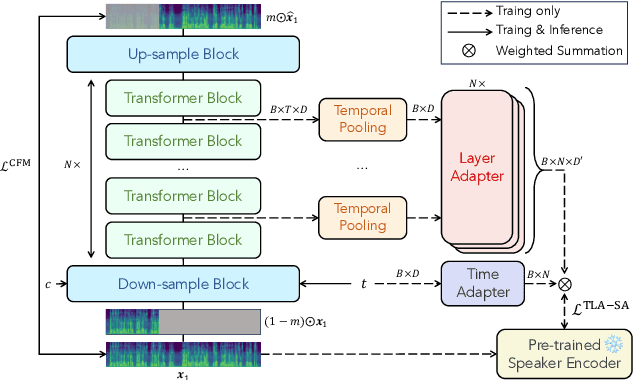

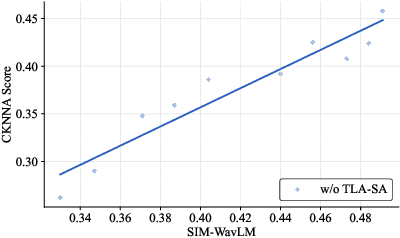
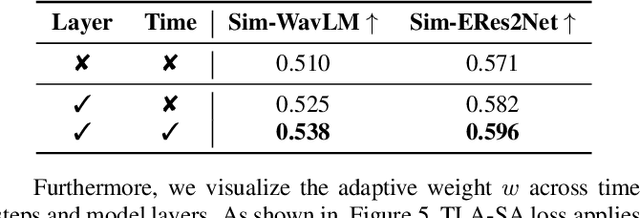
Flow-Matching (FM)-based zero-shot text-to-speech (TTS) systems exhibit high-quality speech synthesis and robust generalization capabilities. However, the speaker representation ability of such systems remains underexplored, primarily due to the lack of explicit speaker-specific supervision in the FM framework. To this end, we conduct an empirical analysis of speaker information distribution and reveal its non-uniform allocation across time steps and network layers, underscoring the need for adaptive speaker alignment. Accordingly, we propose Time-Layer Adaptive Speaker Alignment (TLA-SA), a loss that enhances speaker consistency by jointly leveraging temporal and hierarchical variations in speaker information. Experimental results show that TLA-SA significantly improves speaker similarity compared to baseline systems on both research- and industrial-scale datasets and generalizes effectively across diverse model architectures, including decoder-only language models (LM) and FM-based TTS systems free of LM.
