 Add to Chrome
 Add to Firefox
 Add to Edge
AV-SyncBench: Decoupled Benchmarking of Temporal and Semantic Audio-Visual Synchronization
Jul 01, 2026
Audio-visual feature extraction is a fundamental component of multimodal understanding and generation tasks. However, existing evaluation protocols for feature extraction models exhibit dimensional bias, typically focusing on either semantic matching or temporal offset detection. Moreover, their data construction remains coupled, preventing independent assessment of temporal and semantic consistency. We propose AV-SyncBench, the first benchmark to fully separate temporal and semantic evaluation for audio-visual synchronization. Built from in-the-wild videos, it spans Voice, Music, and Sound across 10 scenarios and 5 challenge tasks. Data are automatically filtered and manually verified to ensure on-screen sound sources. The benchmark contains 3,269 videos and 38,390 samples, and we evaluate five representative models to quantify feature quality for alignment and downstream tasks. The code and dataset are available at: https://fgt7t6g.github.io/AV-SyncBench.

FreeSonic: Training-Free Temporal-Aware Decoupled Attention for Precise Audio Editing
Jun 13, 2026Text-to-audio (TTA) generation has made significant strides, yet achieving precise and consistent audio editing remains a major challenge. However, existing methods struggle to balance temporal consistency with background preservation. In this paper, we propose FreeSonic, a training-free framework leveraging the state-of-the-art Rectified Flow-based TangoFlux model. FreeSonic utilizes an optimized inversion-reverse process and joint text-audio attention maps for precise target segment extraction. For content editing, a novel scheduled attention decoupling confines modifications to target regions while preserving original acoustic context. Furthermore, task-oriented noise injection enhances versatility for tasks such as audio removal and non-rigid replacement. Extensive experimental results demonstrate that FreeSonic achieves a superior balance by providing a high-fidelity and efficient solution for precise and consistent audio editing. Project and demos: https://free-sonic.github.io/
Time-Layer Adaptive Alignment for Speaker Similarity in Flow-Matching Based Zero-Shot TTS
Nov 13, 2025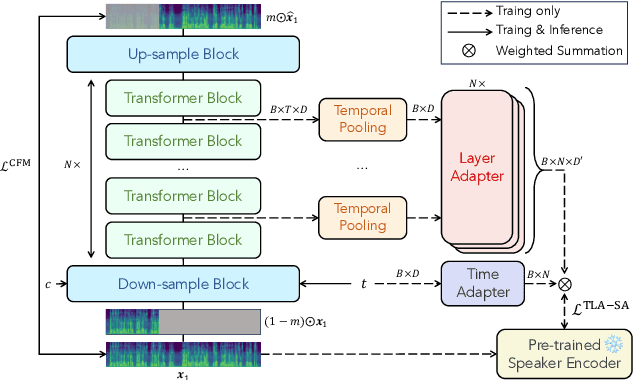

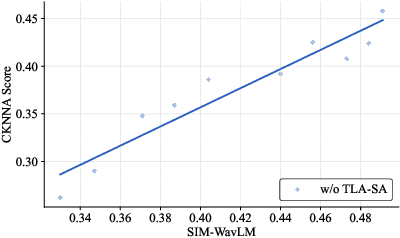
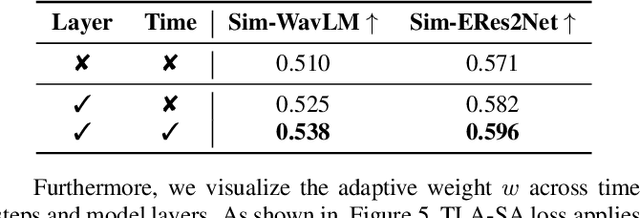
Flow-Matching (FM)-based zero-shot text-to-speech (TTS) systems exhibit high-quality speech synthesis and robust generalization capabilities. However, the speaker representation ability of such systems remains underexplored, primarily due to the lack of explicit speaker-specific supervision in the FM framework. To this end, we conduct an empirical analysis of speaker information distribution and reveal its non-uniform allocation across time steps and network layers, underscoring the need for adaptive speaker alignment. Accordingly, we propose Time-Layer Adaptive Speaker Alignment (TLA-SA), a loss that enhances speaker consistency by jointly leveraging temporal and hierarchical variations in speaker information. Experimental results show that TLA-SA significantly improves speaker similarity compared to baseline systems on both research- and industrial-scale datasets and generalizes effectively across diverse model architectures, including decoder-only language models (LM) and FM-based TTS systems free of LM.
Visual-CoG: Stage-Aware Reinforcement Learning with Chain of Guidance for Text-to-Image Generation
Aug 25, 2025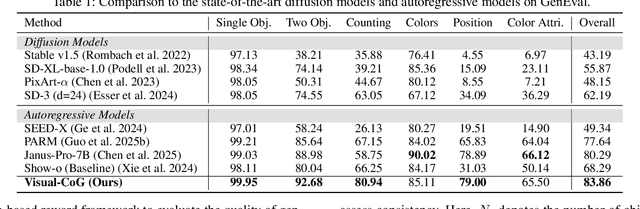
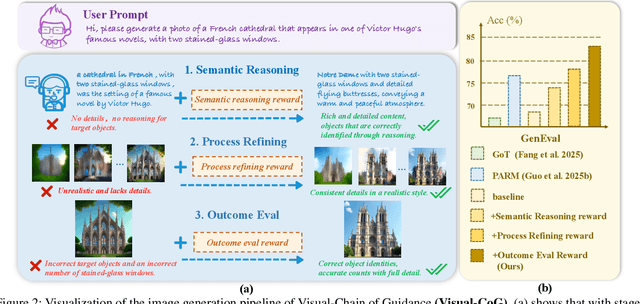
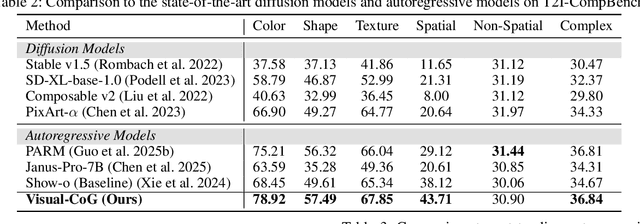
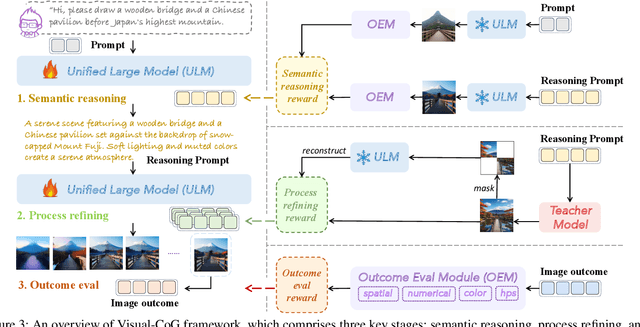
Despite the promising progress of recent autoregressive models in text-to-image (T2I) generation, their ability to handle multi-attribute and ambiguous prompts remains limited. To address these limitations, existing works have applied chain-of-thought (CoT) to enable stage-aware visual synthesis and employed reinforcement learning (RL) to improve reasoning capabilities. However, most models provide reward signals only at the end of the generation stage. This monolithic final-only guidance makes it difficult to identify which stages contribute positively to the final outcome and may lead to suboptimal policies. To tackle this issue, we propose a Visual-Chain of Guidance (Visual-CoG) paradigm consisting of three stages: semantic reasoning, process refining, and outcome evaluation, with stage-aware rewards providing immediate guidance throughout the image generation pipeline. We further construct a visual cognition benchmark, VisCog-Bench, which comprises four subtasks to evaluate the effectiveness of semantic reasoning. Comprehensive evaluations on GenEval, T2I-CompBench, and the proposed VisCog-Bench show improvements of 15%, 5%, and 19%, respectively, demonstrating the superior performance of the proposed Visual-CoG. We will release all the resources soon.