 Add to Chrome
 Add to Firefox
 Add to Edge
Statistical Model of Time-varying Backscatter Power of Monostatic RF Sensing Channels in Urban Canyons
May 05, 2026
We present a measurement-based statistical model for the backscatter power ratio of monostatic RF sensing in urban canyons with moving clutter, suitable for large-scale system level performance evaluation of RF sensing in 6G networks. A narrowband (CW) 140 GHz sounder used a monostatic radar arrangement with an omnidirectional transmit antenna illuminating streets and a spinning horn 2o receive antenna offset vertically (less than 1 m away) collecting backscattered power as a function of azimuth and time below building height in Manhattan and Valparaiso, Chile. A concise outdoor deterministic model of average backscattered power dependent on distance to nearest building-wall reproduces observations with 3.3 dB RMS error or better. Distribution of power variation in azimuth around this average is reproduced within 0.5 dB by a random azimuth spectrum with a lognormal distribution. Temporal fluctuations for various antenna aims and locations were found to be well modeled by a Rician distribution, with lognormally distributed K-factor, with 0.47-0.73 correlation coefficient to backscatter power deviation from mean. The statistical model does not require a detailed environmental description, aiming to reproduce backscatter clutter statistics (as opposed to a deterministic response) faithfully and efficiently, essential for large-scale system-level performance evaluation.

Large Gain Degradation of Reflective Intelligent Surfaces in Realistic Environments
May 05, 2026Reflective Intelligent Surfaces (RIS) are considered promising in improving coverage in Non-Line of Sight (NLOS) wireless links, especially at mm wave or higher frequency bands. Coverage provided by RIS is here compared to coverage from such ambient propagation mechanisms as scattering from street poles (e.g. lampposts), and corner diffraction. A simple formula for RIS gain degradation due to channel angle spread is derived. It is found an ideal 0.3 m x 0.3 m RIS at 28 GHz promises to deliver only about 5 dB more power at 200 m around an urban street corner than the ambient scatter already there. Consideration of angle spread brings about some 14 dB drop in RIS power, bringing it well below ambient mechanisms. A 1 m x 1 m RIS at 28 GHz, offers under 2 dB advantage over ambient scatter after including the 25 dB gain degradation due to angle spread. This raises questions about usefulness of RIS-assisted coverage extension in realistic environments.
Channel and Spectrum Consumption Models for Urban Outdoor-to-Outdoor 28 GHz Wireless
Mar 14, 2025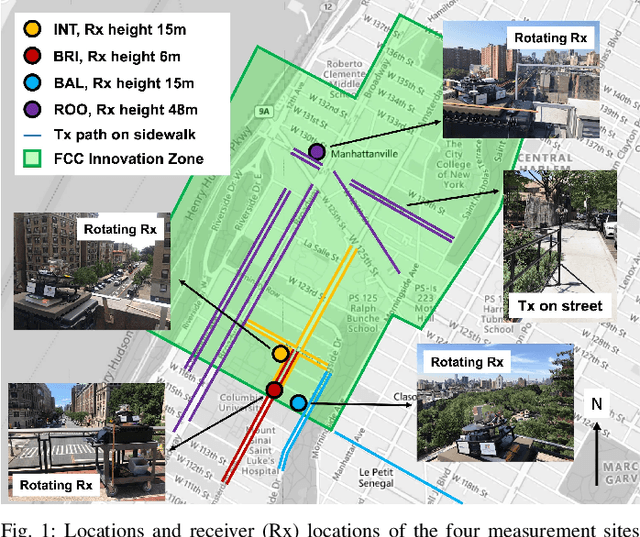
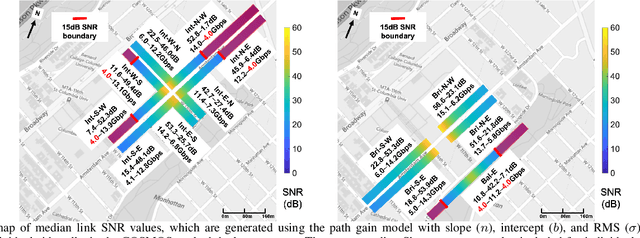
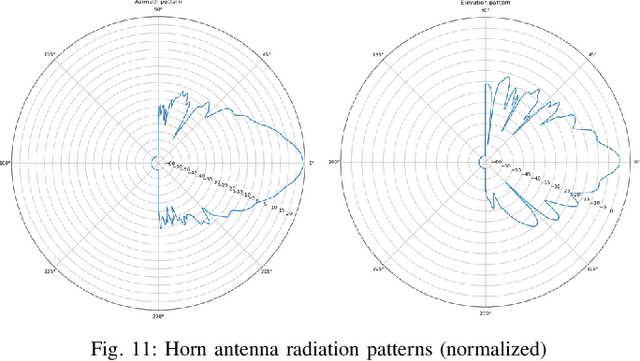
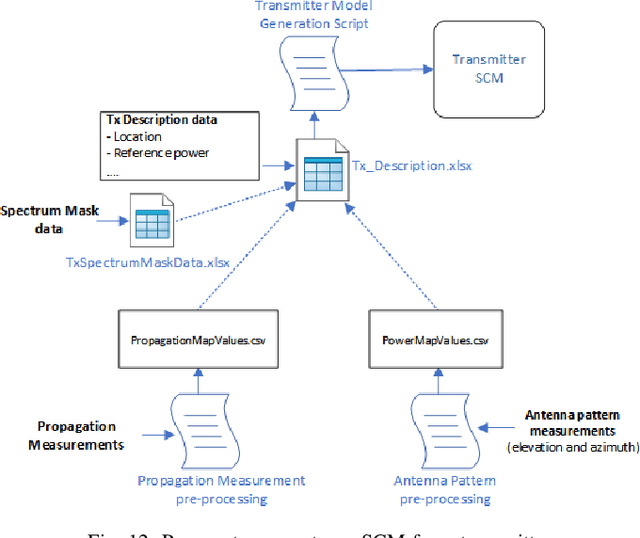
Next generation wireless and mobile networks will utilize millimeter-wave (mmWave) communication to achieve significantly increased data rates. However, since mmWave radio signals experience high path loss, the operation of mmWave networks will require accurate channel models designed for specific deployment sites. In this paper, we focus on the deployment area of the PAWR COSMOS testbed in New York City and report extensive 28 GHz channel measurements. These include over 46 million power measurements collected from over 3,000 links on 24 sidewalks at 4 different sites and in different settings. Using these measurements, we study the effects of the setup and environments (e.g., transmitter height and seasonal effects). We then discuss the obtained path gain values and their fitted lines, and the resulting effective azimuth beamforming gain. Based on these results, we also study the link SNR values that can be supported on individual sidewalks and the corresponding theoretically achievable data rates. Finally, we develop a process to transform the measurements and generate Spectrum Consumption Models (SCMs) based on the IEEE 1900.5.2 standard. The generated SCMs facilitate the evaluation of spectrum sharing and interference management scenarios since they capture all the directional propagation effects reflected in the measurements and provide a way to easily share the main propagation characterization results derived from the measurements. We believe that the results can inform the COSMOS testbed deployment process and provide a benchmark for other deployment efforts in dense urban areas.
Outdoor-to-Indoor 28 GHz Wireless Measurements in Manhattan: Path Loss, Environmental Effects, and 90% Coverage
May 19, 2022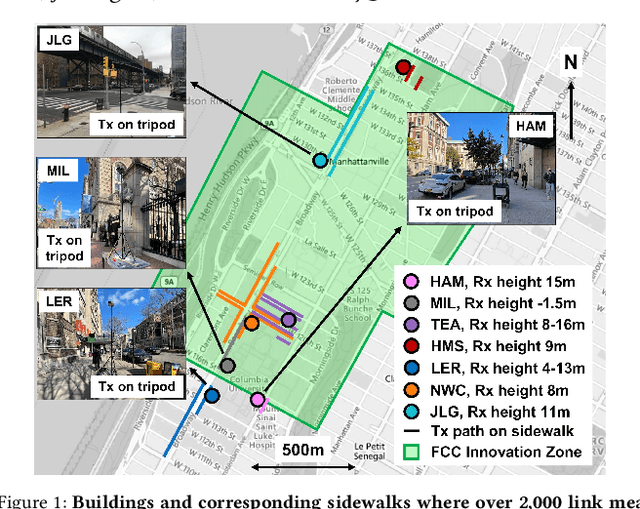
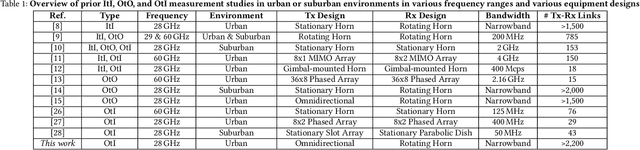
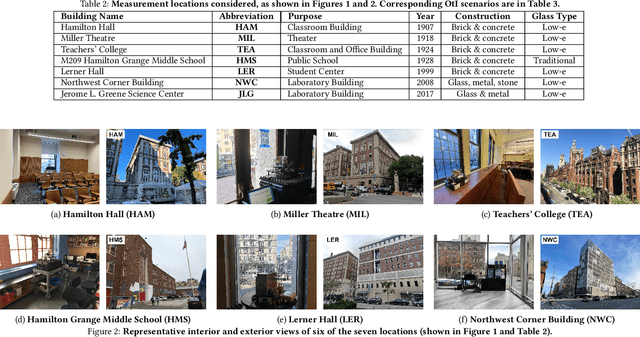
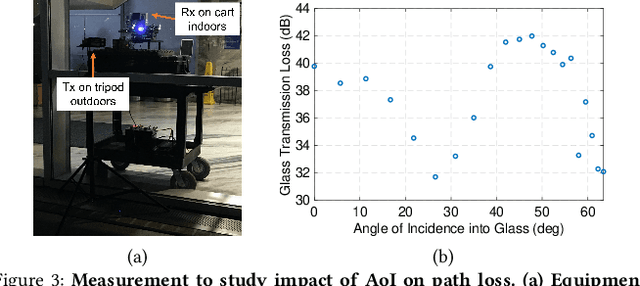
Outdoor-to-indoor (OtI) signal propagation further challenges the already tight link budgets at millimeter-wave (mmWave). To gain insight into OtI mmWave scenarios at 28 GHz, we conducted an extensive measurement campaign consisting of over 2,200 link measurements. In total, 43 OtI scenarios were measured in West Harlem, New York City, covering seven highly diverse buildings. The measured OtI path gain can vary by up to 40 dB for a given link distance, and the empirical path gain model for all data shows an average of 30 dB excess loss over free space at distances beyond 50 m, with an RMS fitting error of 11.7 dB. The type of glass is found to be the single dominant feature for OtI loss, with 20 dB observed difference between empirical path gain models for scenarios with low-loss and high-loss glass. The presence of scaffolding, tree foliage, or elevated subway tracks, as well as difference in floor height are each found to have an impact between 5-10 dB. We show that for urban buildings with high-loss glass, OtI coverage can support 500 Mbps for 90% of indoor user equipment (UEs) with a base station (BS) antenna placed up to 49 m away. For buildings with low-loss glass, such as our case study covering multiple classrooms of a public school, data rates over 2.5/1.2 Gbps are possible from a BS 68/175 m away from the school building, when a line-of-sight path is available. We expect these results to be useful for the deployment of mmWave networks in dense urban environments as well as the development of relevant scheduling and beam management algorithms.
Dense Urban Outdoor-Indoor Coverage from 3.5 to 28 GHz
Mar 08, 2022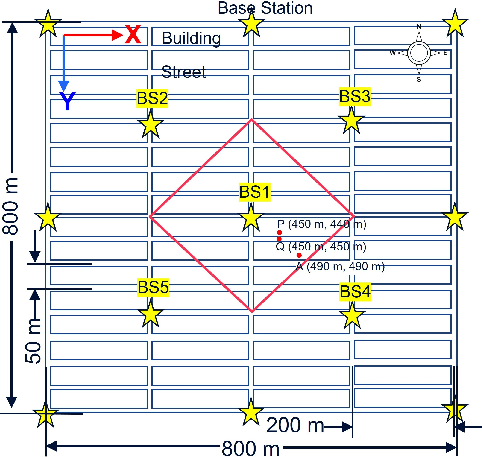
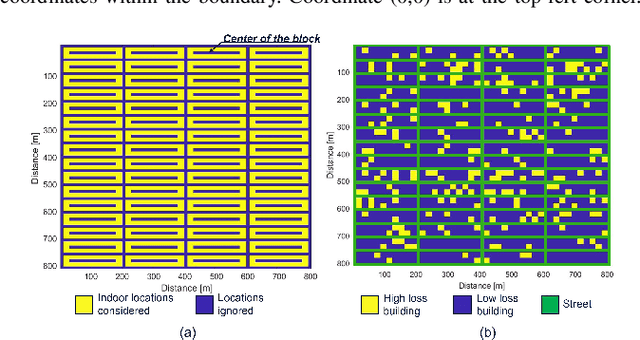
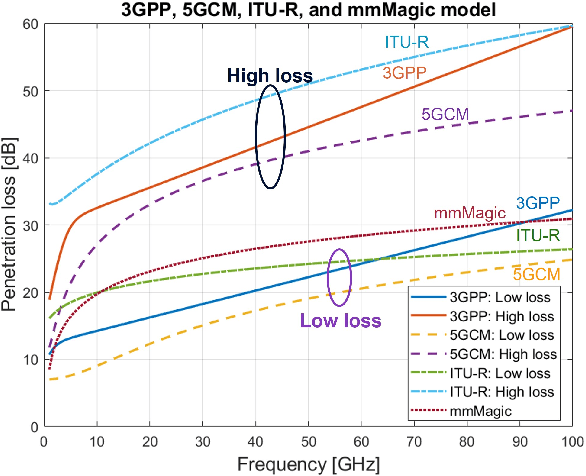
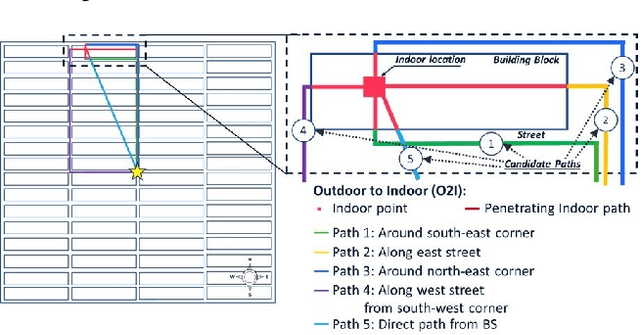
In the US, people spend 87% of their time indoors and have an average of four connected devices per person (in 2020). As such, providing indoor coverage has always been a challenge but becomes even more difficult as carrier frequencies increase to mmWave and beyond. This paper investigates the outdoor and outdoor-indoor coverage of an urban network comparing globally standardized building penetration models and implementing models to corresponding scenarios. The glass used in windows of buildings in the grid plays a pivotal role in determining the outdoor-to-indoor propagation loss. For 28 GHz with 1 W/polarization transmit power in the urban street grid, the downlink data rates for 90% of outdoor users are estimated at over 250 Mbps. In contrast, 15% of indoor users are estimated to be in outage, with SNR $<-$3 dB when base stations are 400 m apart with one-fifth of the buildings imposing high penetration loss ($\sim$ 35 dB). At 3.5 GHz, base stations may achieve over 250 Mbps for 90% indoor users if 400 MHz bandwidth with 100 W/polarization transmit power is available. The methods and models presented can be used to facilitate decisions regarding the density and transmit power required to provide high data rates to majority users in urban centers.
Machine Learning-based Urban Canyon Path Loss Prediction using 28 GHz Manhattan Measurements
Feb 10, 2022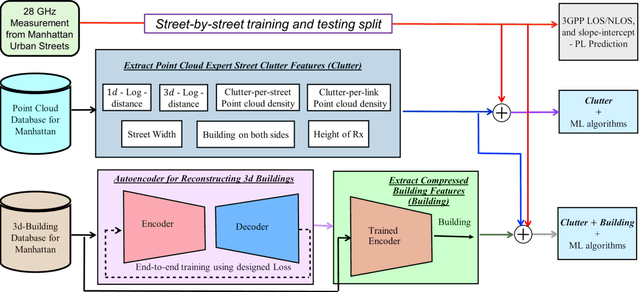
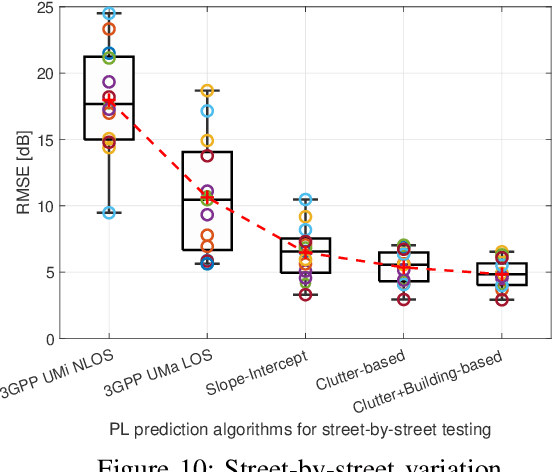
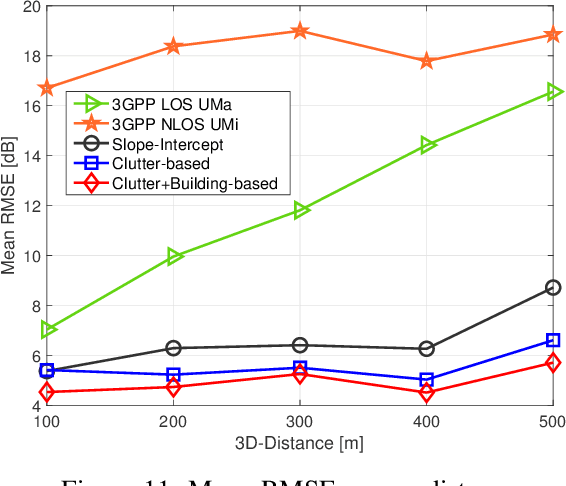
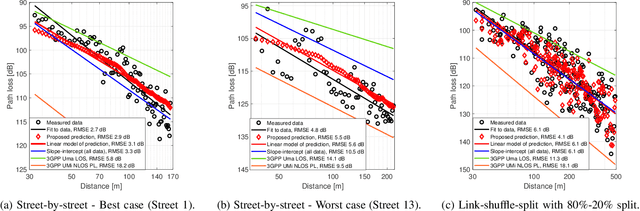
Large bandwidth at mm-wave is crucial for 5G and beyond but the high path loss (PL) requires highly accurate PL prediction for network planning and optimization. Statistical models with slope-intercept fit fall short in capturing large variations seen in urban canyons, whereas ray-tracing, capable of characterizing site-specific features, faces challenges in describing foliage and street clutter and associated reflection/diffraction ray calculation. Machine learning (ML) is promising but faces three key challenges in PL prediction: 1) insufficient measurement data; 2) lack of extrapolation to new streets; 3) overwhelmingly complex features/models. We propose an ML-based urban canyon PL prediction model based on extensive 28 GHz measurements from Manhattan where street clutters are modeled via a LiDAR point cloud dataset and buildings by a mesh-grid building dataset. We extract expert knowledge-driven street clutter features from the point cloud and aggressively compress 3D-building information using convolutional-autoencoder. Using a new street-by-street training and testing procedure to improve generalizability, the proposed model using both clutter and building features achieves a prediction error (RMSE) of $4.8 \pm 1.1$ dB compared to $10.6 \pm 4.4$ dB and $6.5 \pm 2.0$ dB for 3GPP LOS and slope-intercept prediction, respectively, where the standard deviation indicates street-by-street variation. By only using four most influential clutter features, RMSE of $5.5\pm 1.1$ dB is achieved.
Universal Path Gain Laws for Common Wireless Communication Environments
Nov 02, 2021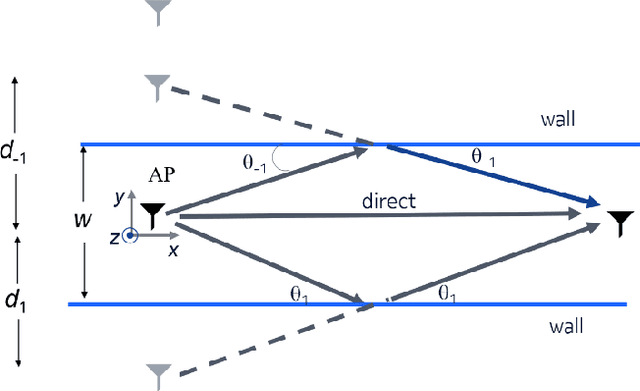

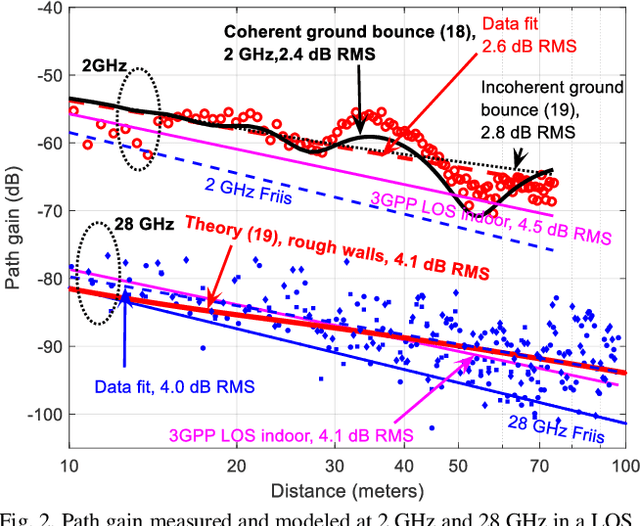
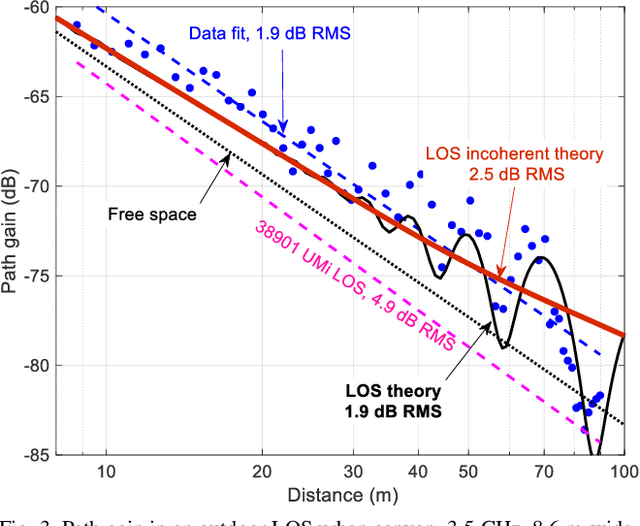
Simple and accurate expressions for path gain are derived from electromagnetic fundamentals in a wide variety of common environments, including Line-of-Sight (LOS) and Non-Line-of-Sight (NLOS) indoor urban canyons, urban/rural macro, outdoor-indoor and suburban streets with vegetation. Penetration into a scattering region, sometimes aided by guiding, is the "universal" phenomenon shared by the diverse morphologies. Root Mean Square (RMS) errors against extensive measurements are under 5 dB, better than 3GPP models by 1-12 dB RMS, depending on environment. In urban canyons the models have 4.7 dB RMS error, as compared to 7.9 dB from linear fit to data and 13.9/17.2 dB from LOS/NLOS 3GPP models. The theoretical path gains depend on distance as a power law with exponents from a small set {1.5, 2, 2.5, 4}, specific to each morphology. This provides a theoretical justification for widely used power law empirical models. Only coarse environmental data is needed as parameters: street width, building height, vegetation depth, wall material and antenna heights.
Beamforming Learning for mmWave Communication: Theory and Experimental Validation
Dec 28, 2019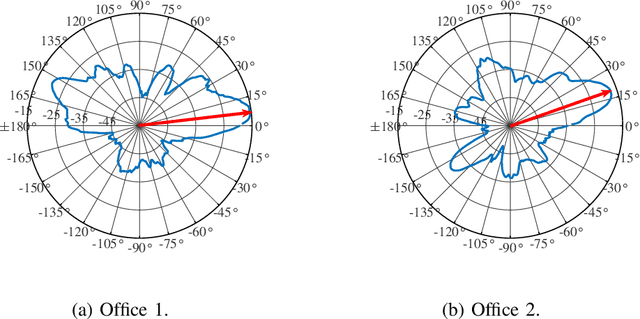
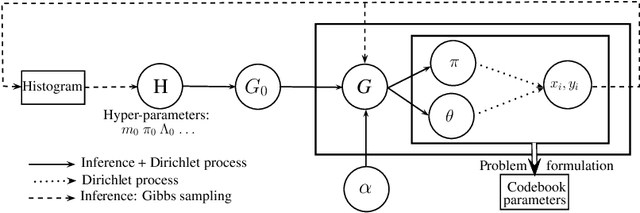
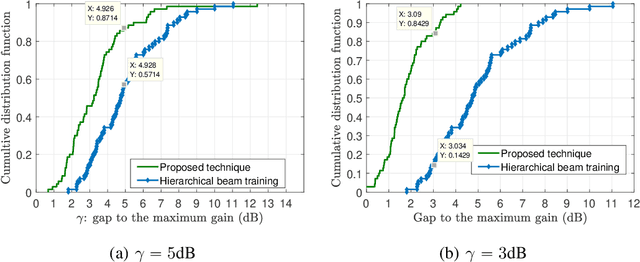
To establish reliable and long-range millimeter-wave (mmWave) communication, beamforming is deemed to be a promising solution. Although beamforming can be done in the digital and analog domains, both approaches are hindered by several constraints when it comes to mmWave communications. For example, performing fully digital beamforming in mmWave systems involves using many radio frequency (RF) chains, which are expensive and consume high power. This necessitates finding more efficient ways for using fewer RF chains while taking advantage of the large antenna arrays. One way to overcome this challenge is to employ (partially or fully) analog beamforming through proper configuration of phase-shifters. Existing works on mmWave analog beam design either rely on the knowledge of the channel state information (CSI) per antenna within the array, require a large search time (e.g., exhaustive search) or do not guarantee a minimum beamforming gain (e.g., codebook based beamforming). In this paper, we propose a beam design technique that reduces the search time and does not require CSI while guaranteeing a minimum beamforming gain. The key idea derives from observations drawn from real-life measurements. It was observed that for a given propagation environment (e.g., coverage area of a mmWave BS) the azimuthal angles of dominant signals could be more probable from certain angles than others. Thus, pre-collected measurements could used to build a beamforming codebook that regroups the most probable beam designs. We invoke Bayesian learning for measurements clustering. We evaluate the efficacy of the proposed scheme in terms of building the codebook and assessing its performance through real-life measurements. We demonstrate that the training time required by the proposed scheme is only 5% of that of exhaustive search. This crucial gain is obtained while achieving a minimum targeted beamforming gain.