 Add to Chrome
 Add to Firefox
 Add to Edge
Statistical Model of Time-varying Backscatter Power of Monostatic RF Sensing Channels in Urban Canyons
May 05, 2026
We present a measurement-based statistical model for the backscatter power ratio of monostatic RF sensing in urban canyons with moving clutter, suitable for large-scale system level performance evaluation of RF sensing in 6G networks. A narrowband (CW) 140 GHz sounder used a monostatic radar arrangement with an omnidirectional transmit antenna illuminating streets and a spinning horn 2o receive antenna offset vertically (less than 1 m away) collecting backscattered power as a function of azimuth and time below building height in Manhattan and Valparaiso, Chile. A concise outdoor deterministic model of average backscattered power dependent on distance to nearest building-wall reproduces observations with 3.3 dB RMS error or better. Distribution of power variation in azimuth around this average is reproduced within 0.5 dB by a random azimuth spectrum with a lognormal distribution. Temporal fluctuations for various antenna aims and locations were found to be well modeled by a Rician distribution, with lognormally distributed K-factor, with 0.47-0.73 correlation coefficient to backscatter power deviation from mean. The statistical model does not require a detailed environmental description, aiming to reproduce backscatter clutter statistics (as opposed to a deterministic response) faithfully and efficiently, essential for large-scale system-level performance evaluation.

Outdoor-to-Indoor 28 GHz Wireless Measurements in Manhattan: Path Loss, Environmental Effects, and 90% Coverage
May 19, 2022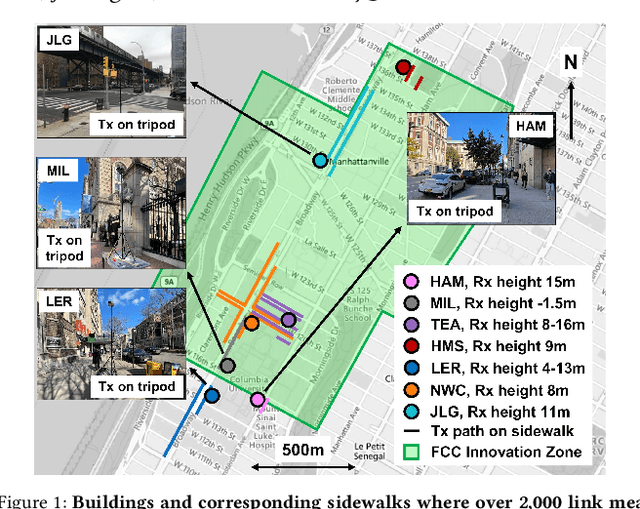
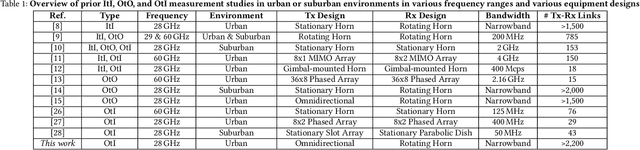
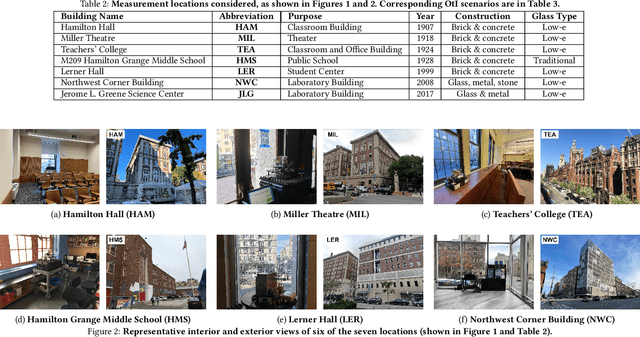
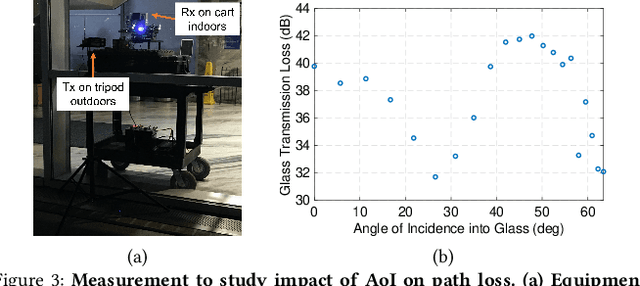
Outdoor-to-indoor (OtI) signal propagation further challenges the already tight link budgets at millimeter-wave (mmWave). To gain insight into OtI mmWave scenarios at 28 GHz, we conducted an extensive measurement campaign consisting of over 2,200 link measurements. In total, 43 OtI scenarios were measured in West Harlem, New York City, covering seven highly diverse buildings. The measured OtI path gain can vary by up to 40 dB for a given link distance, and the empirical path gain model for all data shows an average of 30 dB excess loss over free space at distances beyond 50 m, with an RMS fitting error of 11.7 dB. The type of glass is found to be the single dominant feature for OtI loss, with 20 dB observed difference between empirical path gain models for scenarios with low-loss and high-loss glass. The presence of scaffolding, tree foliage, or elevated subway tracks, as well as difference in floor height are each found to have an impact between 5-10 dB. We show that for urban buildings with high-loss glass, OtI coverage can support 500 Mbps for 90% of indoor user equipment (UEs) with a base station (BS) antenna placed up to 49 m away. For buildings with low-loss glass, such as our case study covering multiple classrooms of a public school, data rates over 2.5/1.2 Gbps are possible from a BS 68/175 m away from the school building, when a line-of-sight path is available. We expect these results to be useful for the deployment of mmWave networks in dense urban environments as well as the development of relevant scheduling and beam management algorithms.