 Add to Chrome
 Add to Firefox
 Add to Edge
UniTAC: Universal Task-Aware Compression via Weighted Distortion Measures
Aug 17, 2026
Physical AI systems such as autonomous vehicles and robots rely on timely exchange of high-dimensional sensory signals under tight bandwidth, latency, and energy budgets. Because the task driving downstream decisions evolves over time, a task-specific codec is brittle and retraining one per task is infeasible in the field. We propose UniTAC, a single learned image codec spanning universal (task-agnostic) to task-specialized operation, re-targeted at runtime without retraining. The task is abstracted as a per-component importance vector, derived, e.g., from gradient attribution of any downstream model, and transmitted as low-overhead side information that conditions both encoder and decoder. Trained once over a broad, randomized family of such vectors against weighted-reconstruction distortion, UniTAC keeps a fixed backbone and a single human-viewable reconstruction whose fidelity is steered to the active task by swapping the injected vector. We analyze the underlying weighted rate-distortion problem, characterizing when a diagonal weighted distortion is task-consistent and how weights relate to task sensitivity. Guided by this, we design a Vision Transformer (ViT) codec whose token-level conditioning natively realizes this weight-driven code. On a localized task at 0.034 bpp, a single UniTAC model reaches 91.4% accuracy, only 1.9% below a task-based codec (93.3%) and above universal codecs (76.9%).

Towards Robust Semantic Video Transmission over Block Erasure Channels
Jul 08, 2026This paper investigates semantic-aware neural joint source-channel coding (JSCC) for robust video transmission over block erasure channels. We propose a neural video compression framework exploring both spatial-domain and feature-domain designs. In the spatial domain, video frames are partitioned into blocks, enabling localized erasure handling and fine-grained robustness control via uniform erasure and two-level, semantic-guided non-uniform erasure strategies. In the feature domain, latent features are partitioned, enabling missing features to be semantically recovered while maintaining overall spatial consistency. Comprehensive experiments quantify reconstruction quality under varying uniform and non-uniform erasure probabilities. Our results show that spatial-domain JSCC excels at handling random localized losses, whereas feature-domain JSCC provides superior robustness to distributed erasures and maintains fidelity under low-loss scenarios. The analysis highlights the trade-offs between spatial continuity and semantic redundancy, offering insights for designing robust, task-aware video communication systems.
Large Gain Degradation of Reflective Intelligent Surfaces in Realistic Environments
May 05, 2026Reflective Intelligent Surfaces (RIS) are considered promising in improving coverage in Non-Line of Sight (NLOS) wireless links, especially at mm wave or higher frequency bands. Coverage provided by RIS is here compared to coverage from such ambient propagation mechanisms as scattering from street poles (e.g. lampposts), and corner diffraction. A simple formula for RIS gain degradation due to channel angle spread is derived. It is found an ideal 0.3 m x 0.3 m RIS at 28 GHz promises to deliver only about 5 dB more power at 200 m around an urban street corner than the ambient scatter already there. Consideration of angle spread brings about some 14 dB drop in RIS power, bringing it well below ambient mechanisms. A 1 m x 1 m RIS at 28 GHz, offers under 2 dB advantage over ambient scatter after including the 25 dB gain degradation due to angle spread. This raises questions about usefulness of RIS-assisted coverage extension in realistic environments.
Statistical Model of Time-varying Backscatter Power of Monostatic RF Sensing Channels in Urban Canyons
May 05, 2026We present a measurement-based statistical model for the backscatter power ratio of monostatic RF sensing in urban canyons with moving clutter, suitable for large-scale system level performance evaluation of RF sensing in 6G networks. A narrowband (CW) 140 GHz sounder used a monostatic radar arrangement with an omnidirectional transmit antenna illuminating streets and a spinning horn 2o receive antenna offset vertically (less than 1 m away) collecting backscattered power as a function of azimuth and time below building height in Manhattan and Valparaiso, Chile. A concise outdoor deterministic model of average backscattered power dependent on distance to nearest building-wall reproduces observations with 3.3 dB RMS error or better. Distribution of power variation in azimuth around this average is reproduced within 0.5 dB by a random azimuth spectrum with a lognormal distribution. Temporal fluctuations for various antenna aims and locations were found to be well modeled by a Rician distribution, with lognormally distributed K-factor, with 0.47-0.73 correlation coefficient to backscatter power deviation from mean. The statistical model does not require a detailed environmental description, aiming to reproduce backscatter clutter statistics (as opposed to a deterministic response) faithfully and efficiently, essential for large-scale system-level performance evaluation.
Self-Nomination: Deep Learning for Decentralized CSI Feedback Reduction in MU-MIMO Systems
Apr 23, 2025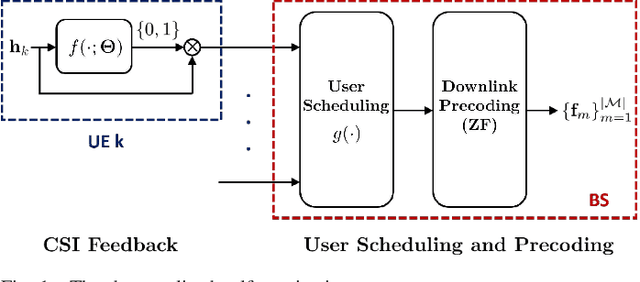
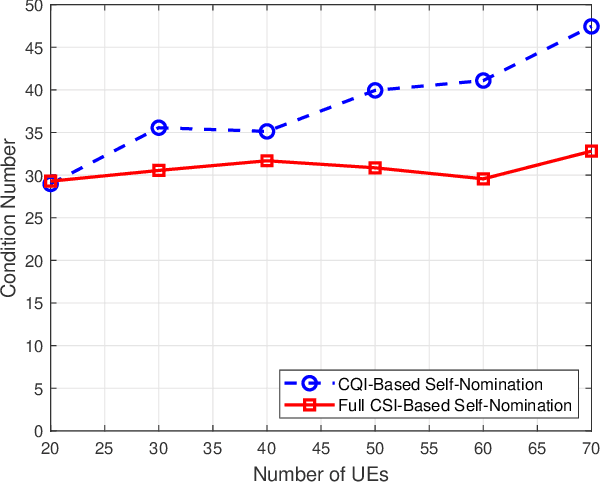
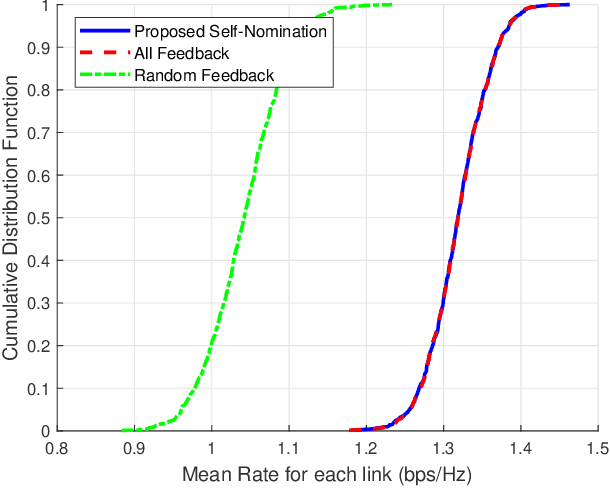
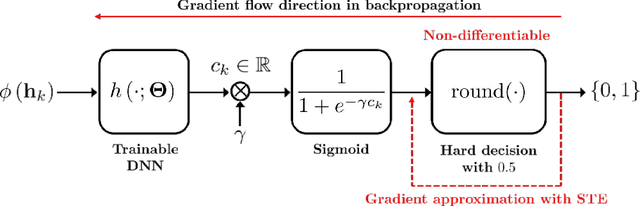
This paper introduces a novel deep learning-based user-side feedback reduction framework, termed self-nomination. The goal of self-nomination is to reduce the number of users (UEs) feeding back channel state information (CSI) to the base station (BS), by letting each UE decide whether to feed back based on its estimated likelihood of being scheduled and its potential contribution to precoding in a multiuser MIMO (MU-MIMO) downlink. Unlike SNR- or SINR-based thresholding methods, the proposed approach uses rich spatial channel statistics and learns nontrivial correlation effects that affect eventual MU-MIMO scheduling decisions. To train the self-nomination network under an average feedback constraint, we propose two different strategies: one based on direct optimization with gradient approximations, and another using policy gradient-based optimization with a stochastic Bernoulli policy to handle non-differentiable scheduling. The framework also supports proportional-fair scheduling by incorporating dynamic user weights. Numerical results confirm that the proposed self-nomination method significantly reduces CSI feedback overhead. Compared to baseline feedback methods, self-nomination can reduce feedback by as much as 65%, saving not only bandwidth but also allowing many UEs to avoid feedback altogether (and thus, potentially enter a sleep mode). Self-nomination achieves this significant savings with negligible reduction in sum-rate or fairness.
Channel and Spectrum Consumption Models for Urban Outdoor-to-Outdoor 28 GHz Wireless
Mar 14, 2025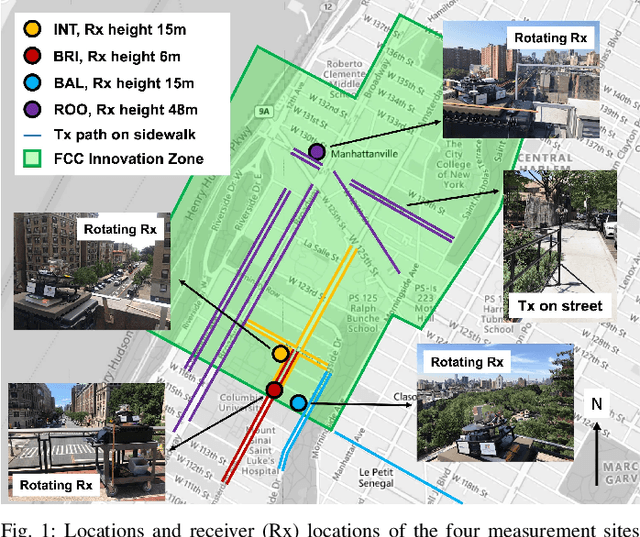
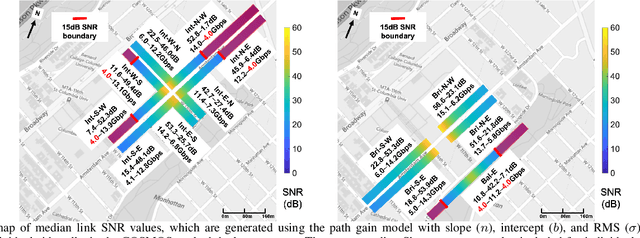
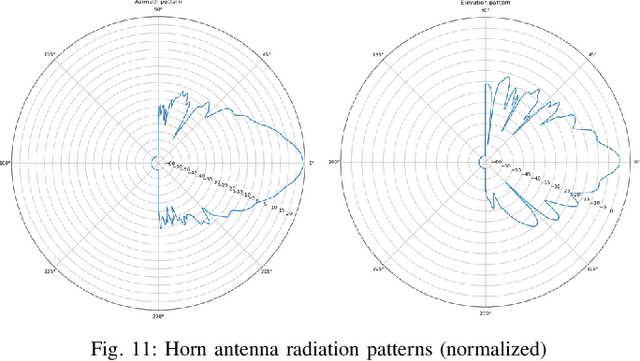
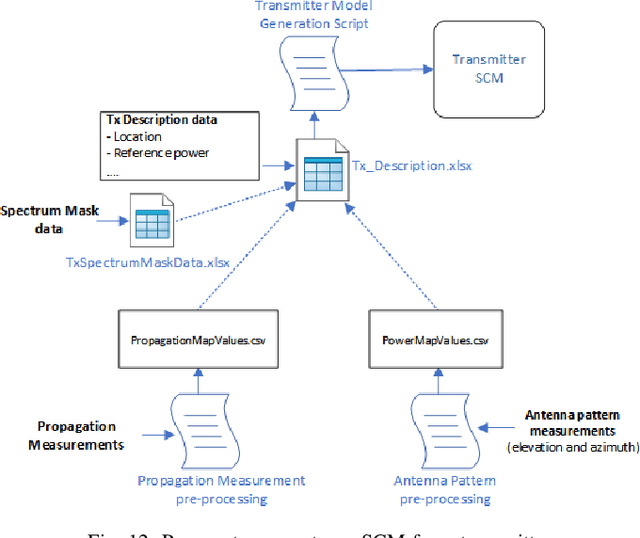
Next generation wireless and mobile networks will utilize millimeter-wave (mmWave) communication to achieve significantly increased data rates. However, since mmWave radio signals experience high path loss, the operation of mmWave networks will require accurate channel models designed for specific deployment sites. In this paper, we focus on the deployment area of the PAWR COSMOS testbed in New York City and report extensive 28 GHz channel measurements. These include over 46 million power measurements collected from over 3,000 links on 24 sidewalks at 4 different sites and in different settings. Using these measurements, we study the effects of the setup and environments (e.g., transmitter height and seasonal effects). We then discuss the obtained path gain values and their fitted lines, and the resulting effective azimuth beamforming gain. Based on these results, we also study the link SNR values that can be supported on individual sidewalks and the corresponding theoretically achievable data rates. Finally, we develop a process to transform the measurements and generate Spectrum Consumption Models (SCMs) based on the IEEE 1900.5.2 standard. The generated SCMs facilitate the evaluation of spectrum sharing and interference management scenarios since they capture all the directional propagation effects reflected in the measurements and provide a way to easily share the main propagation characterization results derived from the measurements. We believe that the results can inform the COSMOS testbed deployment process and provide a benchmark for other deployment efforts in dense urban areas.
Beamforming with hybrid reconfigurable parasitic antenna arrays
Feb 25, 2025A parasitic reconfigurable antenna array is a low-power approach for beamforming using passive tunable elements. Prior work on reconfigurable antennas in communication theory is based on ideal radiation pattern abstractions. It does not address the problem of physical realizability. Beamforming with parasitic elements is inherently difficult because mutual coupling creates non-linearity in the beamforming gain objective. We develop a multi-port circuit-theoretic model of the hybrid array with parasitic elements and antennas with active RF chain validated through electromagnetic simulations with a dipole array. We then derive the beamforming weight of the parasitic element using the theoretical beam pattern expression for the case of a single active antenna and multiple parasitic elements. We show that the parasitic beamforming is challenging because the weights are subject to coupled magnitude and phase constraints. We simplify the beamforming optimization problem using a shift-of-origin transformation to the typical unit-modulus beamforming weight. With this transformation, we derive a closed-form solution for the reconfigurable parasitic reactance. We generalize this solution to the multi-active multi-parasitic hybrid array operating in a multi-path channel. Our proposed hybrid architecture with parasitic elements outperforms conventional architectures in terms of energy efficiency.
Multi-level Reliability Interface for Semantic Communications over Wireless Networks
Jul 07, 2024Semantic communication, when examined through the lens of joint source-channel coding (JSCC), maps source messages directly into channel input symbols, where the measure of success is defined by end-to-end distortion rather than traditional metrics such as block error rate. Previous studies have shown significant improvements achieved through deep learning (DL)-driven JSCC compared to traditional separate source and channel coding. However, JSCC is impractical in existing communication networks, where application and network providers are typically different entities connected over general-purpose TCP/IP links. In this paper, we propose designing the source and channel mappings separately and sequentially via a novel multi-level reliability interface. This conceptual interface enables semi-JSCC at both the learned source and channel mappers and achieves many of the gains observed in existing DL-based JSCC work (which would require a fully joint design between the application and the network), such as lower end-to-end distortion and graceful degradation of distortion with channel quality. We believe this work represents an important step towards realizing semantic communications in wireless networks.
A generalization of the achievable rate of a MISO system using Bode-Fano wideband matching theory
Oct 15, 2023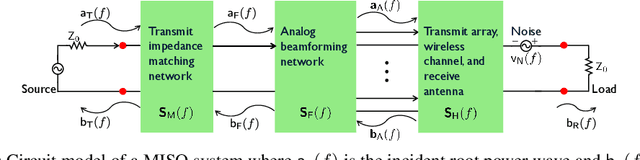


Impedance-matching networks affect power transfer from the radio frequency (RF) chains to the antennas. Their design impacts the signal to noise ratio (SNR) and the achievable rate. In this paper, we maximize the information-theoretic achievable rate of a multiple-input-single-output (MISO) system with wideband matching constraints. Using a multiport circuit theory approach with frequency-selective scattering parameters, we propose a general framework for optimizing the MISO achievable rate that incorporates Bode-Fano wideband matching theory. We express the solution to the achievable rate optimization problem in terms of the optimized transmission coefficient and the Lagrangian parameters corresponding to the Bode-Fano inequality constraints. We apply this framework to a single electric Chu's antenna and an array of two electric Chu's antennas. We compare the optimized achievable rate obtained numerically with other benchmarks like the ideal achievable rate computed by disregarding matching constraints and the achievable rate obtained by using sub-optimal matching strategies like conjugate matching and frequency-flat transmission. We also propose a practical methodology to approximate the achievable rate bound by using the optimal transmission coefficient to derive a physically realizable matching network through the ADS software.
Trade-Off Between Beamforming and Macro-Diversity Gains in Distributed mMIMO
Sep 10, 2023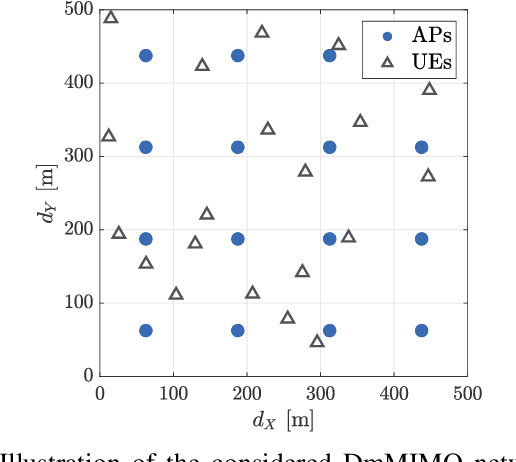
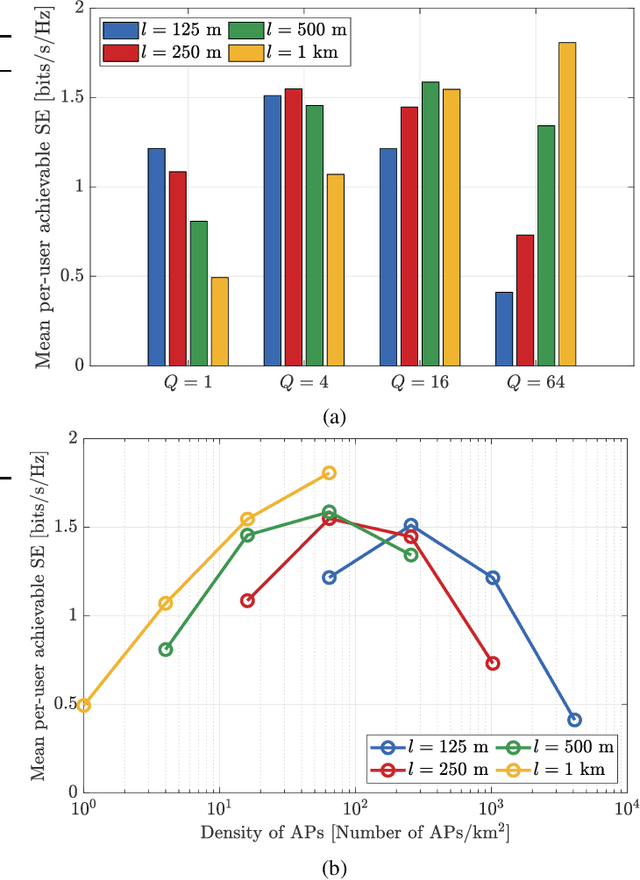
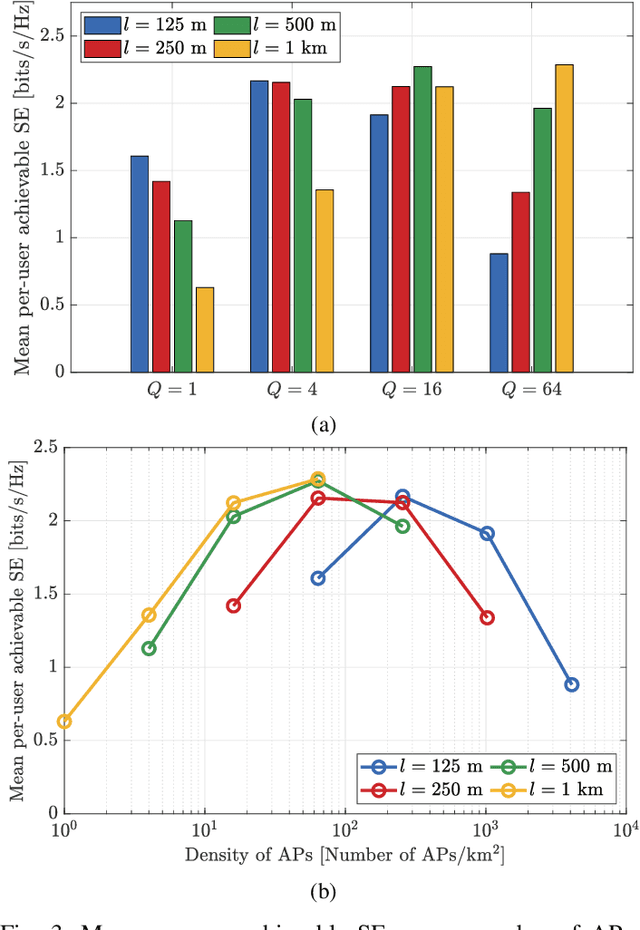
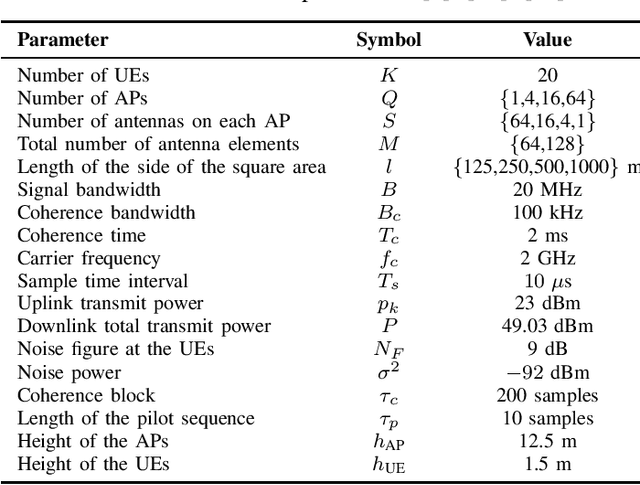
Industry and academia have been working towards the evolution from Centralized massive Multiple-Input Multiple-Output (CmMIMO) to Distributed mMIMO (DmMIMO) architectures. Instead of splitting a coverage area into many cells, each served by a single Base Station equipped with several antennas, the whole coverage area is jointly covered by several Access Points (AP) equipped with few or single antennas. Nevertheless, when choosing between deploying more APs with few or single antennas or fewer APs equipped with many antennas, one observes an inherent trade-off between the beamforming and macro-diversity gains that has not been investigated in the literature. Given a total number of antenna elements and total downlink power, under a channel model that takes into account a probability of Line-of-Sight (LoS) as a function of the distance between the User Equipments (UEs) and APs, our numerical results show that there exists a ``sweet spot" on the optimal number of APs and of antenna elements per AP which is a function of the physical dimensions of the coverage area.