 Add to Chrome
 Add to Firefox
 Add to Edge
Agentic AI-based Framework for Mitigating Premature Diagnostic Handoff and Silent Hallucination in Healthcare Applications
Jun 16, 2026
Recent advances in Large Language Models (LLMs) and multi-agent systems have driven the rise of Agentic AI, showing promise for medical reasoning. However, open-ended conversational agents remain prone to two critical failure modes: premature diagnostic handoff and silent clinical hallucinations that may go undetected before reaching the patient. In this work, we propose a multi-agent framework that addresses both issues by replacing ``LLM-as-a-judge'' routing with deterministic orchestration constraints. The framework incorporates two safety mechanisms. First, a neuro-symbolic state-tracking gate enforces completeness of the OLDCARTS clinical protocol (Onset, Location, Duration, Character, Aggravating/Alleviating factors, Radiation, Timing, and Severity) by blocking diagnostic transitions until all required dimensions are collected. Second, an epistemic uncertainty quantification (UQ) gate computes semantic entropy (H) across K=5 independent diagnostic samples to identify and intercept divergent outputs before delivery. We evaluate the system using simulated patient agents powered by the llama-3.1-70b-instruct model on 150 test cases. The full architecture achieves 49.3% diagnostic precision, representing an absolute improvement of 11.3 percentage points over an unconstrained baseline. Additionally, we observe a statistically significant negative correlation (r = -0.181, p < 0.05) between OLDCARTS completeness (σ) and semantic entropy (H), suggesting that structured information gathering is associated with reduced diagnostic uncertainty.

DPAR: Dynamic Patchification for Efficient Autoregressive Visual Generation
Dec 26, 2025Decoder-only autoregressive image generation typically relies on fixed-length tokenization schemes whose token counts grow quadratically with resolution, substantially increasing the computational and memory demands of attention. We present DPAR, a novel decoder-only autoregressive model that dynamically aggregates image tokens into a variable number of patches for efficient image generation. Our work is the first to demonstrate that next-token prediction entropy from a lightweight and unsupervised autoregressive model provides a reliable criterion for merging tokens into larger patches based on information content. DPAR makes minimal modifications to the standard decoder architecture, ensuring compatibility with multimodal generation frameworks and allocating more compute to generation of high-information image regions. Further, we demonstrate that training with dynamically sized patches yields representations that are robust to patch boundaries, allowing DPAR to scale to larger patch sizes at inference. DPAR reduces token count by 1.81x and 2.06x on Imagenet 256 and 384 generation resolution respectively, leading to a reduction of up to 40% FLOPs in training costs. Further, our method exhibits faster convergence and improves FID by up to 27.1% relative to baseline models.
Lay-Your-Scene: Natural Scene Layout Generation with Diffusion Transformers
May 07, 2025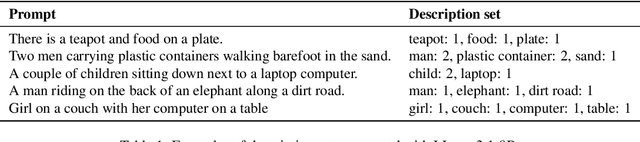
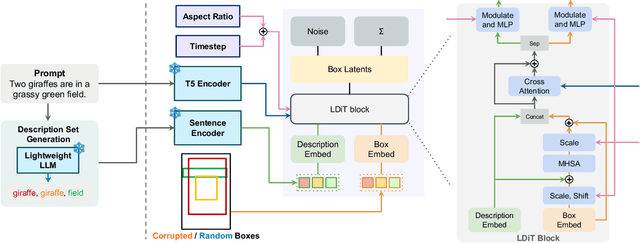
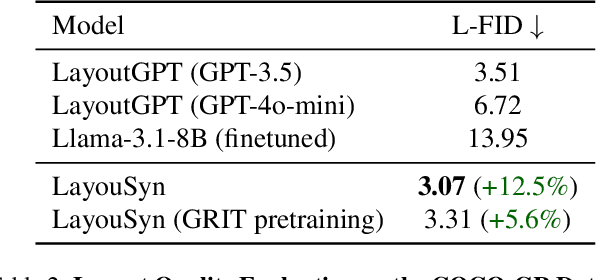
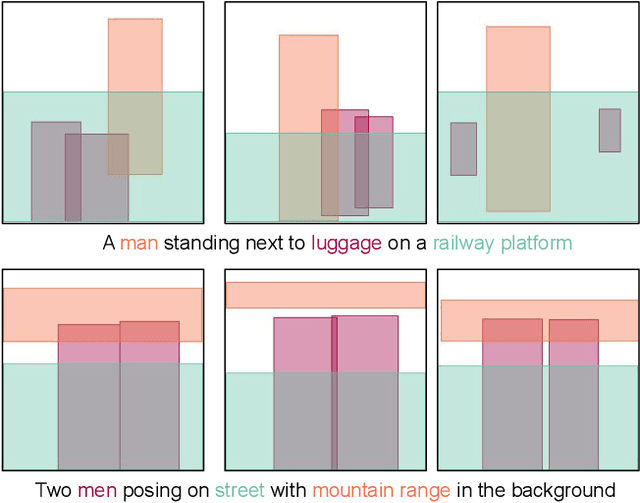
We present Lay-Your-Scene (shorthand LayouSyn), a novel text-to-layout generation pipeline for natural scenes. Prior scene layout generation methods are either closed-vocabulary or use proprietary large language models for open-vocabulary generation, limiting their modeling capabilities and broader applicability in controllable image generation. In this work, we propose to use lightweight open-source language models to obtain scene elements from text prompts and a novel aspect-aware diffusion Transformer architecture trained in an open-vocabulary manner for conditional layout generation. Extensive experiments demonstrate that LayouSyn outperforms existing methods and achieves state-of-the-art performance on challenging spatial and numerical reasoning benchmarks. Additionally, we present two applications of LayouSyn. First, we show that coarse initialization from large language models can be seamlessly combined with our method to achieve better results. Second, we present a pipeline for adding objects to images, demonstrating the potential of LayouSyn in image editing applications.
VLG-CBM: Training Concept Bottleneck Models with Vision-Language Guidance
Jul 18, 2024
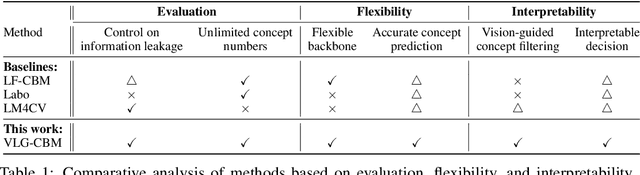

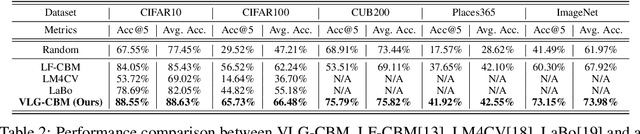
Concept Bottleneck Models (CBMs) provide interpretable prediction by introducing an intermediate Concept Bottleneck Layer (CBL), which encodes human-understandable concepts to explain models' decision. Recent works proposed to utilize Large Language Models (LLMs) and pre-trained Vision-Language Models (VLMs) to automate the training of CBMs, making it more scalable and automated. However, existing approaches still fall short in two aspects: First, the concepts predicted by CBL often mismatch the input image, raising doubts about the faithfulness of interpretation. Second, it has been shown that concept values encode unintended information: even a set of random concepts could achieve comparable test accuracy to state-of-the-art CBMs. To address these critical limitations, in this work, we propose a novel framework called Vision-Language-Guided Concept Bottleneck Model (VLG-CBM) to enable faithful interpretability with the benefits of boosted performance. Our method leverages off-the-shelf open-domain grounded object detectors to provide visually grounded concept annotation, which largely enhances the faithfulness of concept prediction while further improving the model performance. In addition, we propose a new metric called Number of Effective Concepts (NEC) to control the information leakage and provide better interpretability. Extensive evaluations across five standard benchmarks show that our method, VLG-CBM, outperforms existing methods by at least 4.27% and up to 51.09% on accuracy at NEC=5, and by at least 0.45% and up to 29.78% on average accuracy across different NECs, while preserves both faithfulness and interpretability of the learned concepts as demonstrated in extensive experiments.
Corrupting Neuron Explanations of Deep Visual Features
Oct 25, 2023The inability of DNNs to explain their black-box behavior has led to a recent surge of explainability methods. However, there are growing concerns that these explainability methods are not robust and trustworthy. In this work, we perform the first robustness analysis of Neuron Explanation Methods under a unified pipeline and show that these explanations can be significantly corrupted by random noises and well-designed perturbations added to their probing data. We find that even adding small random noise with a standard deviation of 0.02 can already change the assigned concepts of up to 28% neurons in the deeper layers. Furthermore, we devise a novel corruption algorithm and show that our algorithm can manipulate the explanation of more than 80% neurons by poisoning less than 10% of probing data. This raises the concern of trusting Neuron Explanation Methods in real-life safety and fairness critical applications.