 Add to Chrome
 Add to Firefox
 Add to Edge
Rethinking Dataset Distillation for Classification: Do Distilled Sets Outperform Coresets?
Jun 16, 2026
Dataset distillation (DD) has emerged as a prominent approach in data centric machine learning, aiming to synthesize compact training sets for efficient training by compressing the information in large datasets into a small number of synthetic samples. However, DD methods are often evaluated under inconsistent evaluation protocols, ranging from standard ERM to single/multi-teacher supervision, making it difficult to isolate the effectiveness of distilled data from evaluation. Moreover, many prior methods claim that DD outperforms data pruning approaches such as coreset selection (CS), based on the assumption that restricting condensed datasets to subsets of real samples fundamentally limits their expressiveness. In this work, we critically evaluate DD methods through large-scale experiments using standardized datasets and evaluation protocols to assess their intrinsic effectiveness. We benchmark seven state-of-the-art (SOTA) DD methods on ImageNet-1K, ImageNet100, and ImageNette, using three widely adopted training protocols against three CS strategies. Our results show that while some DD methods fail to outperform even simple random subsets, the SOTA DD approaches are comparable to or worse than coresets on large-scale datasets and incur a substantially higher cost for construction. Beyond accuracy, we also evaluate the representativeness, diversity, and quality of condensed sets, and find that coresets consistently achieve better coverage of the original data distribution. These findings highlight the limited practical advantages of current DD methods and show that coresets remain competitive and are often a more computationally efficient alternative for data-centric learning.

DPAR: Dynamic Patchification for Efficient Autoregressive Visual Generation
Dec 26, 2025Decoder-only autoregressive image generation typically relies on fixed-length tokenization schemes whose token counts grow quadratically with resolution, substantially increasing the computational and memory demands of attention. We present DPAR, a novel decoder-only autoregressive model that dynamically aggregates image tokens into a variable number of patches for efficient image generation. Our work is the first to demonstrate that next-token prediction entropy from a lightweight and unsupervised autoregressive model provides a reliable criterion for merging tokens into larger patches based on information content. DPAR makes minimal modifications to the standard decoder architecture, ensuring compatibility with multimodal generation frameworks and allocating more compute to generation of high-information image regions. Further, we demonstrate that training with dynamically sized patches yields representations that are robust to patch boundaries, allowing DPAR to scale to larger patch sizes at inference. DPAR reduces token count by 1.81x and 2.06x on Imagenet 256 and 384 generation resolution respectively, leading to a reduction of up to 40% FLOPs in training costs. Further, our method exhibits faster convergence and improves FID by up to 27.1% relative to baseline models.
Model-agnostic Coreset Selection via LLM-based Concept Bottlenecks
Feb 23, 2025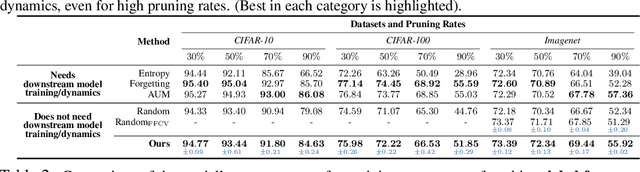
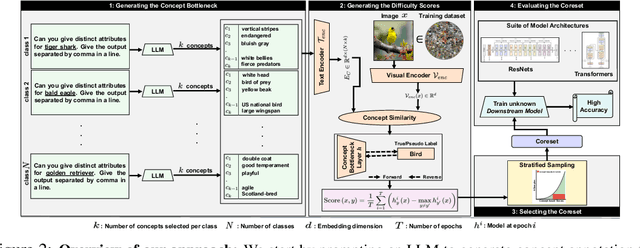
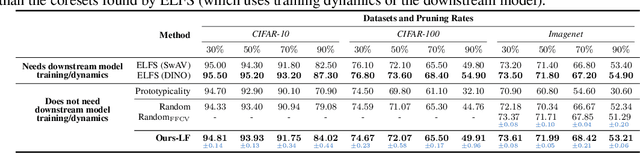
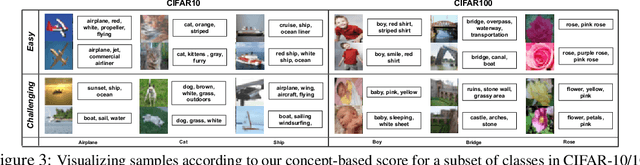
Coreset Selection (CS) identifies a subset of training data that achieves model performance comparable to using the entire dataset. Many state-of-the-art CS methods, select coresets using scores whose computation requires training the downstream model on the entire dataset and recording changes in its behavior on samples as it trains (training dynamics). These scores are inefficient to compute and hard to interpret as they do not indicate whether a sample is difficult to learn in general or only for a specific model. Our work addresses these challenges by proposing an interpretable score that gauges a sample's difficulty using human-understandable textual attributes (concepts) independent of any downstream model. Specifically, we measure the alignment between a sample's visual features and concept bottlenecks, derived via large language models, by training a linear concept bottleneck layer and compute the sample's difficulty score using it. We then use this score and a stratified sampling strategy to identify the coreset. Crucially, our score is efficiently computable without training the downstream model on the full dataset even once, leads to high-performing coresets for various downstream models, and is computable even for an unlabeled dataset. Through experiments on CIFAR-10, CIFAR-100, and ImageNet-1K, we show our coresets outperform random subsets, even at high pruning rates, and achieve model performance comparable to or better than coresets found by training dynamics-based methods.