 Add to Chrome
 Add to Firefox
 Add to Edge
4th Workshop on Maritime Computer Vision (MaCVi): Challenge Overview
Apr 14, 2026
The 4th Workshop on Maritime Computer Vision (MaCVi) is organized as part of CVPR 2026. This edition features five benchmark challenges with emphasis on both predictive accuracy and embedded real-time feasibility. This report summarizes the MaCVi 2026 challenge setup, evaluation protocols, datasets, and benchmark tracks, and presents quantitative results, qualitative comparisons, and cross-challenge analyses of emerging method trends. We also include technical reports from top-performing teams to highlight practical design choices and lessons learned across the benchmark suite. Datasets, leaderboards, and challenge resources are available at https://macvi.org/workshop/cvpr26.

ROSO: Improving Robotic Policy Inference via Synthetic Observations
Nov 29, 2023
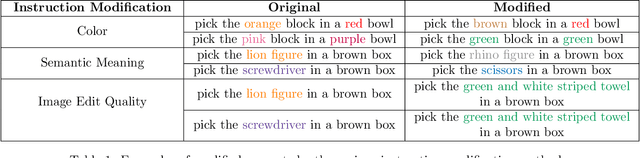

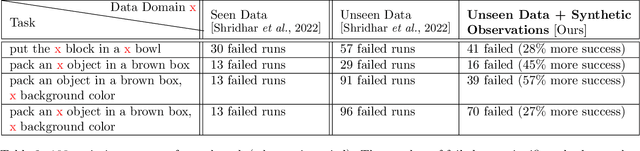
In this paper, we propose the use of generative artificial intelligence (AI) to improve zero-shot performance of a pre-trained policy by altering observations during inference. Modern robotic systems, powered by advanced neural networks, have demonstrated remarkable capabilities on pre-trained tasks. However, generalizing and adapting to new objects and environments is challenging, and fine-tuning visuomotor policies is time-consuming. To overcome these issues we propose Robotic Policy Inference via Synthetic Observations (ROSO). ROSO uses stable diffusion to pre-process a robot's observation of novel objects during inference time to fit within its distribution of observations of the pre-trained policies. This novel paradigm allows us to transfer learned knowledge from known tasks to previously unseen scenarios, enhancing the robot's adaptability without requiring lengthy fine-tuning. Our experiments show that incorporating generative AI into robotic inference significantly improves successful outcomes, finishing up to 57% of tasks otherwise unsuccessful with the pre-trained policy.