 Add to Chrome
 Add to Firefox
 Add to Edge
T-LLM Compiler: Trusted LLM-based Code Optimization and Verification Framework
Aug 15, 2026
Recent advances in Large Language Models (LLMs) have opened opportunities to apply high-level code transformations to the field of code optimization, and it has since emerged as one of the most fundamental tasks for LLMs to perform; however, at present, LLMs struggle to apply wide-ranging code optimization tasks due to both the complexity of the code and the inability to independently verify the correctness of the transformations. In this paper, we present the Trusted LLM (T-LLM) Compiler, which proposes an advancement in compiler technology through a collaborative effort involving high-level LLM code transformations, traditional compilers, and verification tools. Experimental results reveal that it can significantly improve code correctness when tested on a set of PolyBench/C benchmarks. Our approach facilitates iterative code optimization efforts with verification strategies that enable corrective actions. Through this approach, T-LLM Compiler achieves code optimization accuracy of up to 83.3% and a speedup of up to 16.1\% on the PolyBench/C benchmarks, with the transformed code reaching an average of 26.7% speedup wrt standard baselines. Additionally, we release the project's source code to the open-source community.

PerfCoder: Large Language Models for Interpretable Code Performance Optimization
Dec 16, 2025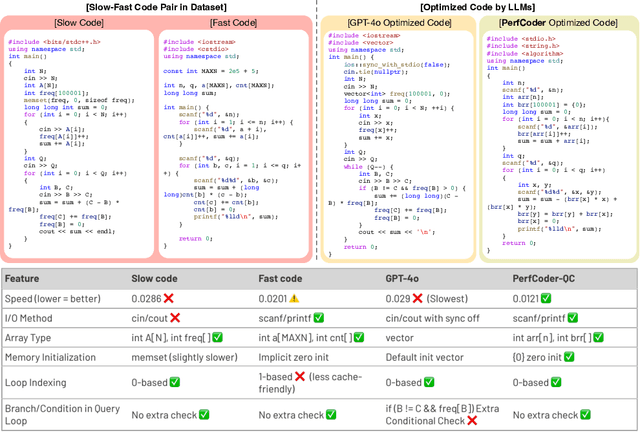
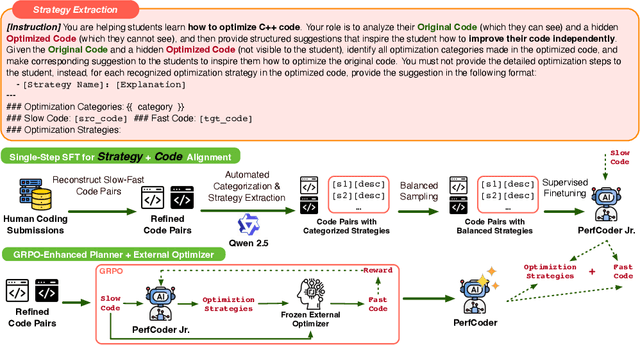
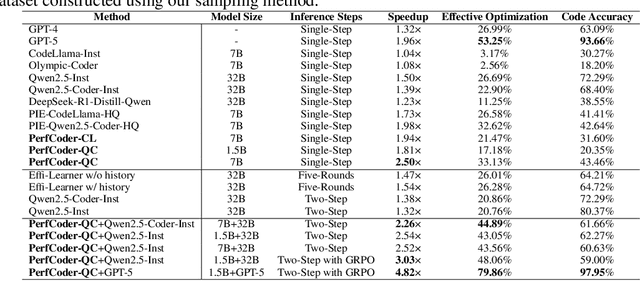
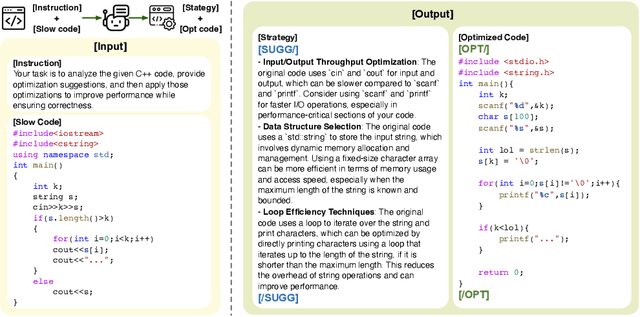
Large language models (LLMs) have achieved remarkable progress in automatic code generation, yet their ability to produce high-performance code remains limited--a critical requirement in real-world software systems. We argue that current LLMs struggle not only due to data scarcity but, more importantly, because they lack supervision that guides interpretable and effective performance improvements. In this work, we introduce PerfCoder, a family of LLMs specifically designed to generate performance-enhanced code from source code via interpretable, customized optimizations. PerfCoder is fine-tuned on a curated collection of real-world optimization trajectories with human-readable annotations, and preference-aligned by reinforcement fine-tuning using runtime measurements, enabling it to propose input-specific improvement strategies and apply them directly without relying on iterative refinement. On the PIE code performance benchmark, PerfCoder surpasses all existing models in both runtime speedup and effective optimization rate, demonstrating that performance optimization cannot be achieved by scale alone but requires optimization stratetgy awareness. In addition, PerfCoder can generate interpretable feedback about the source code, which, when provided as input to a larger LLM in a planner-and-optimizer cooperative workflow, can further improve outcomes. Specifically, we elevate the performance of 32B models and GPT-5 to new levels on code optimization, substantially surpassing their original performance.