 Add to Chrome
 Add to Firefox
 Add to Edge
Physical AI Governance: From Theory to Practice Across Life Cycle
Jul 24, 2026
With the emergence of Physical AI, artificial intelligence is extending beyond screen-based applications to embodied systems that perceive, interact with, and act in the physical world. Unlike traditional AI, Physical AI operates under real-time safety constraints, continuously interacts with dynamic environments, and coexists with humans, introducing governance challenges that existing AI governance frameworks do not explicitly address. This paper presents a comprehensive survey of Physical AI governance from both scientific and operational perspectives. We synthesize existing governance principles and organize them into a unified governance framework tailored to physical AI systems. Building on this foundation, we propose a five-stage Physical AI lifecycle comprising research, design, data, model development, and deployment, and demonstrate how governance can be operationalized across each stage through concrete implementation practices. By connecting governance principles with engineering workflows, this survey provides a structured reference for researchers, developers, and policymakers to build Physical AI systems that are safe, trustworthy, and aligned with societal values.

MassSpecGym in the Wild: Uncovering and Correcting Evaluation Pitfalls in AI-Driven Molecule Discovery
Jun 17, 2026Reliable benchmarking is critical for developing machine learning models for tandem mass spectrometry (MS/MS) based molecule discovery. Subtle issues in experimental design and model evaluation procedures can degrade the trustworthiness of such benchmarks and lead to erroneous conclusions. We conduct a thorough review of model evaluation issues in the recent MS/MS machine learning literature, using the standard MassSpecGym benchmark suite as a case study to illustrate the impact of these issues. We find evaluation issues in at least 17 of 26 papers reporting MassSpecGym benchmark results in the first year of its adoption. We isolate three classes of failures: (i) data leakage, (ii) shortcut learning, and (iii) implementation bugs and metric divergence. Through extensive experimentation and code replication, we quantify the impact of these issues and show how they corrupt the evaluation standards MassSpecGym was designed to enforce. We distill our findings into recommendations generalizable to MS/MS challenges, benchmarks, and custom evaluation setups. We also release MassSpecGym v1.5, an implementation of our recommendations in the MassSpecGym benchmarking suite which addresses the failure modes identified in this audit. MassSpecGym v1.5 is publicly available at https://github.com/pluskal-lab/MassSpecGym.
PerfCoder: Large Language Models for Interpretable Code Performance Optimization
Dec 16, 2025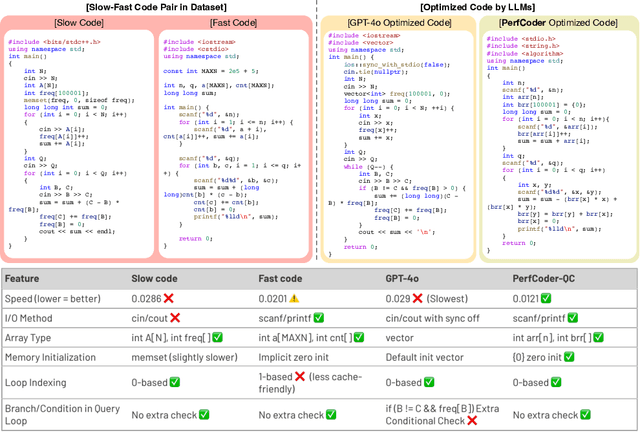
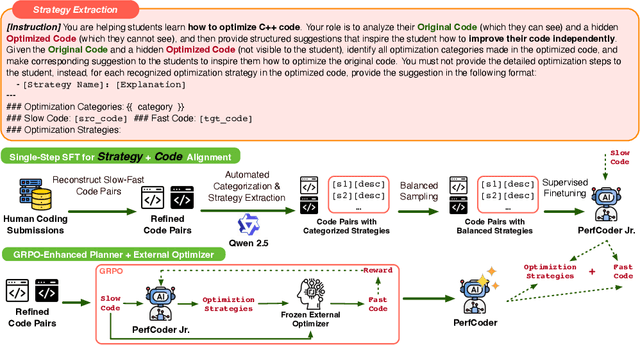
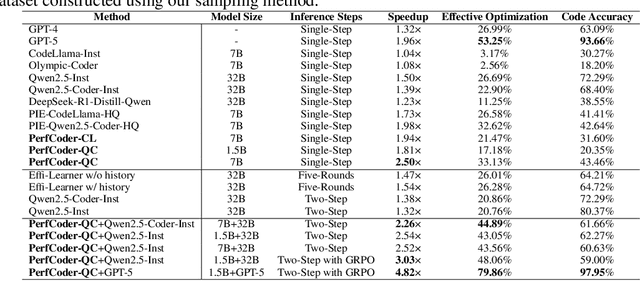
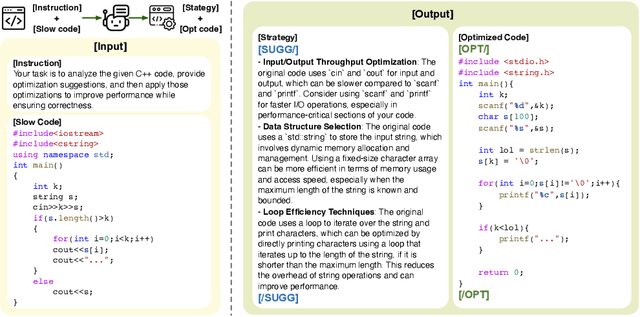
Large language models (LLMs) have achieved remarkable progress in automatic code generation, yet their ability to produce high-performance code remains limited--a critical requirement in real-world software systems. We argue that current LLMs struggle not only due to data scarcity but, more importantly, because they lack supervision that guides interpretable and effective performance improvements. In this work, we introduce PerfCoder, a family of LLMs specifically designed to generate performance-enhanced code from source code via interpretable, customized optimizations. PerfCoder is fine-tuned on a curated collection of real-world optimization trajectories with human-readable annotations, and preference-aligned by reinforcement fine-tuning using runtime measurements, enabling it to propose input-specific improvement strategies and apply them directly without relying on iterative refinement. On the PIE code performance benchmark, PerfCoder surpasses all existing models in both runtime speedup and effective optimization rate, demonstrating that performance optimization cannot be achieved by scale alone but requires optimization stratetgy awareness. In addition, PerfCoder can generate interpretable feedback about the source code, which, when provided as input to a larger LLM in a planner-and-optimizer cooperative workflow, can further improve outcomes. Specifically, we elevate the performance of 32B models and GPT-5 to new levels on code optimization, substantially surpassing their original performance.
Integrating Chemistry Knowledge in Large Language Models via Prompt Engineering
Apr 22, 2024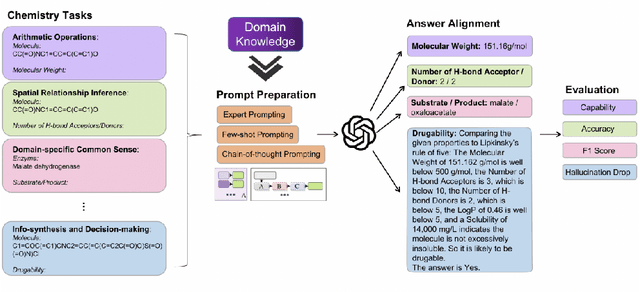
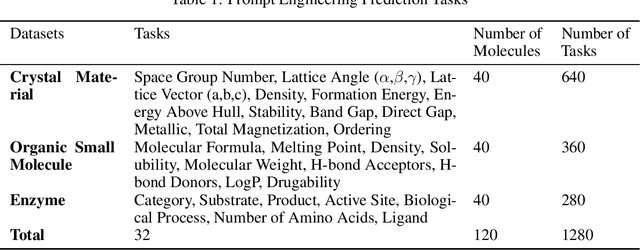
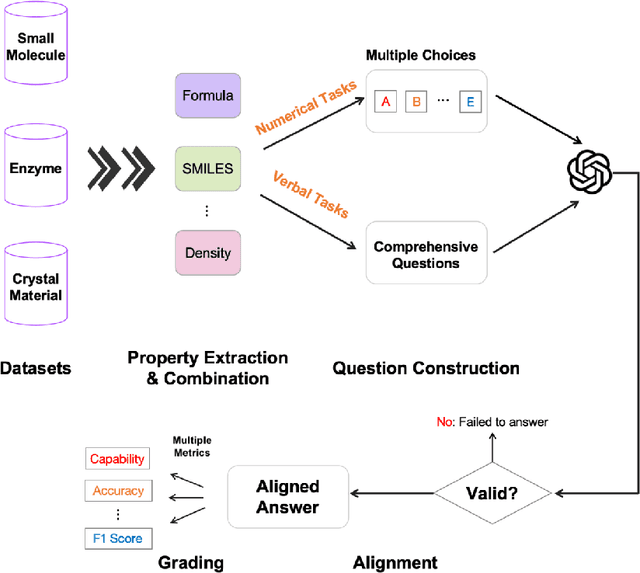
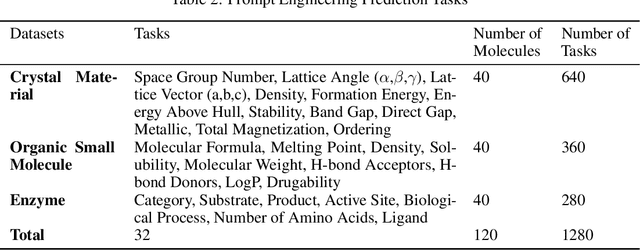
This paper presents a study on the integration of domain-specific knowledge in prompt engineering to enhance the performance of large language models (LLMs) in scientific domains. A benchmark dataset is curated to encapsulate the intricate physical-chemical properties of small molecules, their drugability for pharmacology, alongside the functional attributes of enzymes and crystal materials, underscoring the relevance and applicability across biological and chemical domains.The proposed domain-knowledge embedded prompt engineering method outperforms traditional prompt engineering strategies on various metrics, including capability, accuracy, F1 score, and hallucination drop. The effectiveness of the method is demonstrated through case studies on complex materials including the MacMillan catalyst, paclitaxel, and lithium cobalt oxide. The results suggest that domain-knowledge prompts can guide LLMs to generate more accurate and relevant responses, highlighting the potential of LLMs as powerful tools for scientific discovery and innovation when equipped with domain-specific prompts. The study also discusses limitations and future directions for domain-specific prompt engineering development.