 Add to Chrome
 Add to Firefox
 Add to Edge
Features as Rewards: Scalable Supervision for Open-Ended Tasks via Interpretability
Feb 11, 2026
Language models trained on large-scale datasets have been shown to learn features that encode abstract concepts such as factuality or intent. Such features are traditionally used for test-time monitoring or steering. We present an alternative affordance: features as scalable supervision for open-ended tasks. We consider the case of hallucination-reduction as a desirable, yet open-ended behavior and design a reinforcement learning (RL) pipeline, titled RLFR (Reinforcement Learning from Feature Rewards), that uses features as reward functions. Grounded in a novel probing framework that identifies candidate hallucinated claims, our pipeline teaches a model to intervene and correct its completions when it is uncertain of their factuality. Furthermore, the pipeline enables scalable test-time compute, guided once more by our reward features. This end-to-end process operationalized on Gemma-3-12B-IT results in a policy that is 58% less likely to hallucinate compared to the original model (when run in tandem with our probing harness), while preserving performance on standard benchmarks. Taken together, by grounding supervision in the language of features, this paper introduces a novel paradigm in the use of interpretability for learning open-ended tasks.

Analyzing Gender Bias within Narrative Tropes
Oct 30, 2020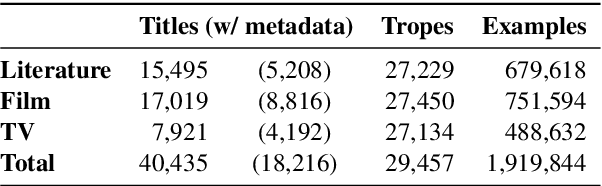
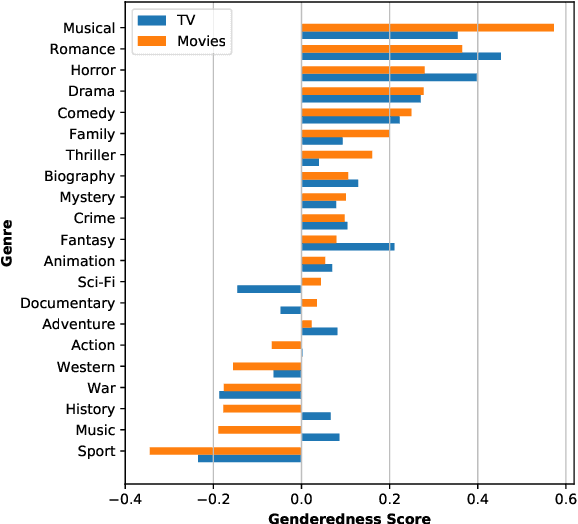
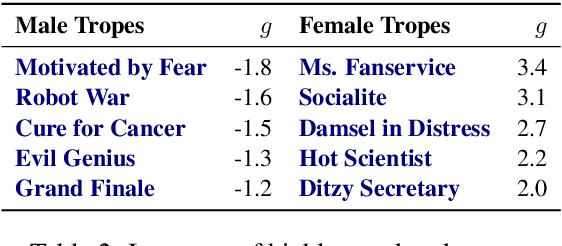
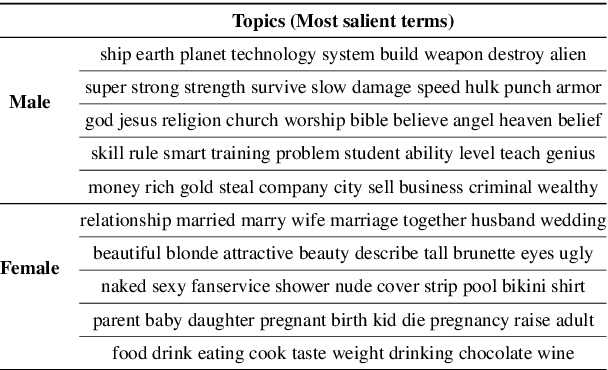
Popular media reflects and reinforces societal biases through the use of tropes, which are narrative elements, such as archetypal characters and plot arcs, that occur frequently across media. In this paper, we specifically investigate gender bias within a large collection of tropes. To enable our study, we crawl tvtropes.org, an online user-created repository that contains 30K tropes associated with 1.9M examples of their occurrences across film, television, and literature. We automatically score the "genderedness" of each trope in our TVTROPES dataset, which enables an analysis of (1) highly-gendered topics within tropes, (2) the relationship between gender bias and popular reception, and (3) how the gender of a work's creator correlates with the types of tropes that they use.