 Add to Chrome
 Add to Firefox
 Add to Edge
GeoNatureAgent Benchmark: Benchmarking LLM Agents for Environmental Geospatial Analysis Across Frontier and Open-Weight Foundation Models
Jun 11, 2026
Environmental scientists spend disproportionate effort on data wrangling rather than analysis, and AI agents that automate geospatial workflows remain unvalidated: no benchmark evaluates agents operating through structured tool calling against real APIs. We introduce the GeoNatureAgent Benchmark, the first benchmark for environmental analysis agents that operate via structured tool calls to a production-style geospatial API. It comprises 93 tasks across 18 categories, covering municipality analysis, multi-turn conversation, spatial reasoning, cross-indicator synthesis, error handling and recovery, ranking, comparison, multilingual understanding, habitat analysis, and task rejection. Tasks are evaluated against an open, self-hostable API serving three environmental indicators across Spain and Portugal via sixteen tools. We evaluate seven LLMs (Claude Sonnet 4, DeepSeek V3.2, GLM-5, Gemini 2.5 Pro, Qwen3-235B, GPT-OSS-120B, Llama 4 Scout) under three temperature-1.0 seeds, reporting capability and per-case cost as orthogonal axes. We find: (1) Claude Sonnet 4 leads at 60.8% +/- 0.8%, followed by DeepSeek V3.2 at 56.3% +/- 3.1%, with no other model above 51%; (2) the cost-accuracy Pareto frontier is occupied mostly by open-weight models, with DeepSeek V3.2 offering 93% of Claude's capability at 11x lower cost ($0.011/case); (3) comparison tasks remain universally unsolved (0% on close-value comparisons), exposing systematic reasoning limits; and (4) structured tool calling against a real API is more discriminative than general-purpose GIS benchmarks, with accuracies 25-35 points lower. We further show extensibility by integrating BigEarthNet V2 land cover for Portugal alongside Spanish CO2 and erosion indicators. The benchmark, harness, and self-hostable API are publicly available.

Spatial Heterogeneity in Climate Risk and Human Flourishing: An Exploration with Generative AI
Jan 26, 2026Recent advances in Generative Artificial Intelligence (AI), particularly Large Language Models (LLMs), enable scalable extraction of spatial information from unstructured text and offer new methodological opportunities for studying climate geography. This study develops a spatial framework to examine how cumulative climate risk relates to multidimensional human flourishing across U.S. counties. High-resolution climate hazard indicators are integrated with a Human Flourishing Geographic Index (HFGI), an index derived from classification of 2.6 billion geotagged tweets using fine-tuned open-source Large Language Models (LLMs). These indicators are aggregated to the US county-level and mapped to a structural equation model to infer overall climate risk and human flourishing dimensions, including expressed well-being, meaning and purpose, social connectedness, psychological distress, physical condition, economic stability, religiosity, character and virtue, and institutional trust. The results reveal spatially heterogeneous associations between greater cumulative climate risk and lower levels of expressed human flourishing, with coherent spatial patterns corresponding to recurrent exposure to heat, flooding, wind, drought, and wildfire hazards. The study demonstrates how Generative AI can be combined with latent construct modeling for geographical analysis and for spatial knowledge extraction.
The Human Flourishing Geographic Index: A County-Level Dataset for the United States, 2013--2023
Nov 05, 2025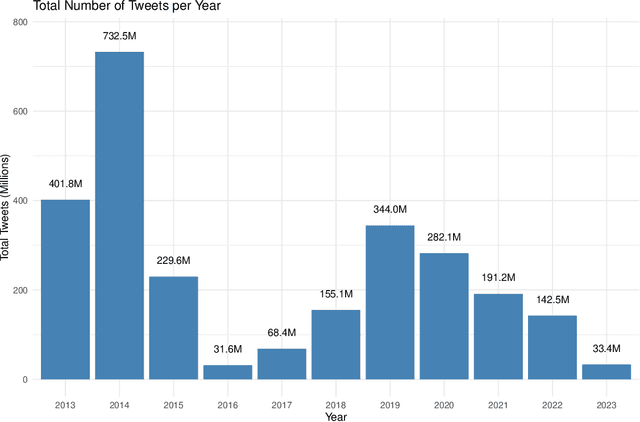
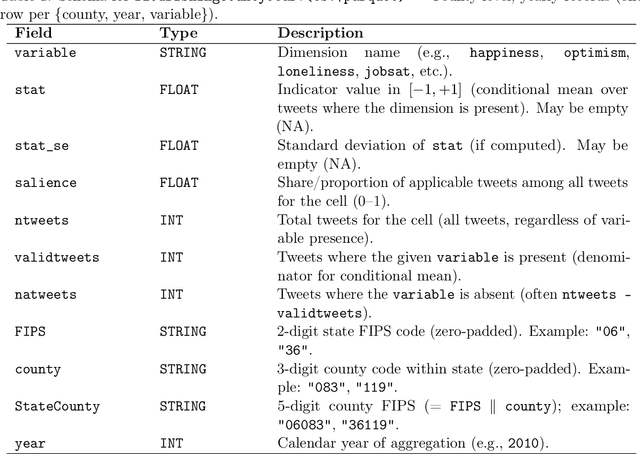
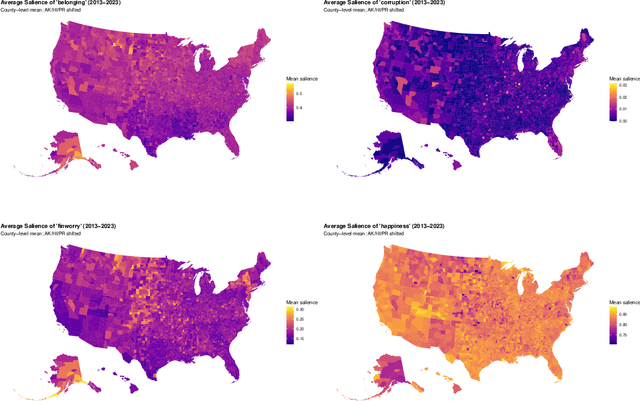
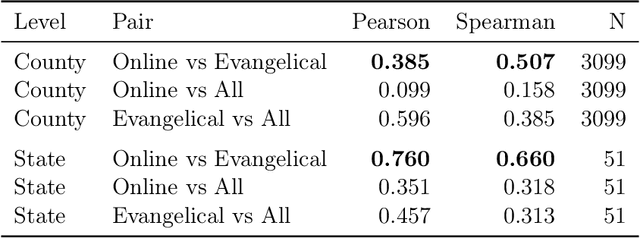
Quantifying human flourishing, a multidimensional construct including happiness, health, purpose, virtue, relationships, and financial stability, is critical for understanding societal well-being beyond economic indicators. Existing measures often lack fine spatial and temporal resolution. Here we introduce the Human Flourishing Geographic Index (HFGI), derived from analyzing approximately 2.6 billion geolocated U.S. tweets (2013-2023) using fine-tuned large language models to classify expressions across 48 indicators aligned with Harvard's Global Flourishing Study framework plus attitudes towards migration and perception of corruption. The dataset offers monthly and yearly county- and state-level indicators of flourishing-related discourse, validated to confirm that the measures accurately represent the underlying constructs and show expected correlations with established indicators. This resource enables multidisciplinary analyses of well-being, inequality, and social change at unprecedented resolution, offering insights into the dynamics of human flourishing as reflected in social media discourse across the United States over the past decade.
Learning the Topic, Not the Language: How LLMs Classify Online Immigration Discourse Across Languages
Aug 08, 2025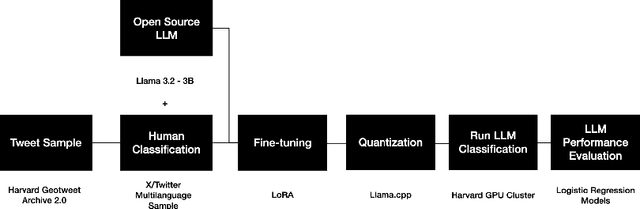
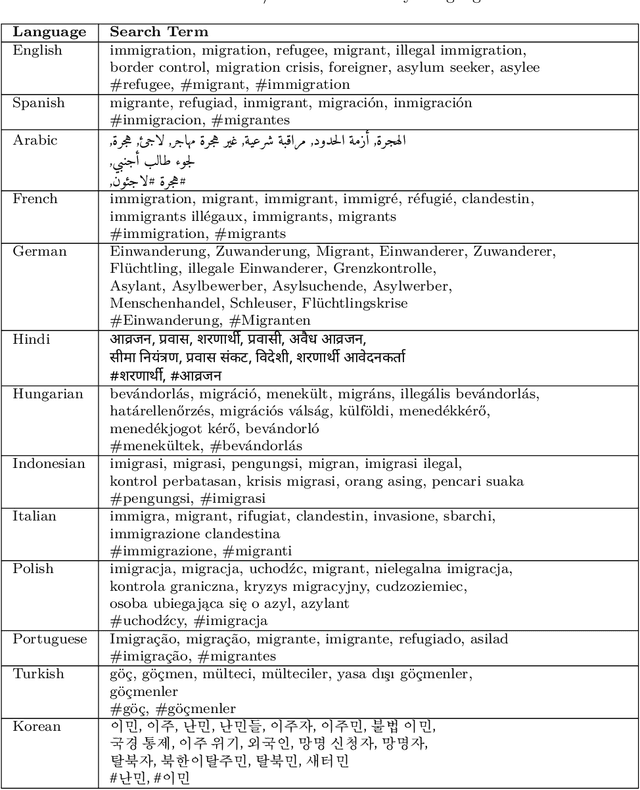
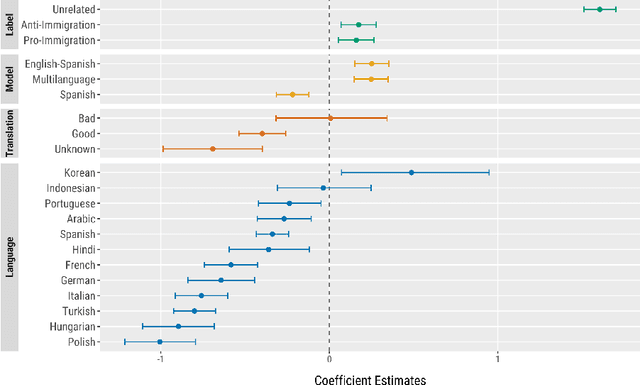
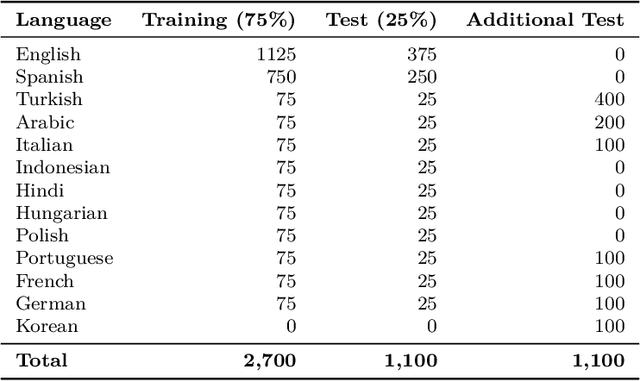
Large language models (LLMs) are transforming social-science research by enabling scalable, precise analysis. Their adaptability raises the question of whether knowledge acquired through fine-tuning in a few languages can transfer to unseen languages that only appeared during pre-training. To examine this, we fine-tune lightweight LLaMA 3.2-3B models on monolingual, bilingual, or multilingual data sets to classify immigration-related tweets from X/Twitter across 13 languages, a domain characterised by polarised, culturally specific discourse. We evaluate whether minimal language-specific fine-tuning enables cross-lingual topic detection and whether adding targeted languages corrects pre-training biases. Results show that LLMs fine-tuned in one or two languages can reliably classify immigration-related content in unseen languages. However, identifying whether a tweet expresses a pro- or anti-immigration stance benefits from multilingual fine-tuning. Pre-training bias favours dominant languages, but even minimal exposure to under-represented languages during fine-tuning (as little as $9.62\times10^{-11}$ of the original pre-training token volume) yields significant gains. These findings challenge the assumption that cross-lingual mastery requires extensive multilingual training: limited language coverage suffices for topic-level generalisation, and structural biases can be corrected with lightweight interventions. By releasing 4-bit-quantised, LoRA fine-tuned models, we provide an open-source, reproducible alternative to proprietary LLMs that delivers 35 times faster inference at just 0.00000989% of the dollar cost of the OpenAI GPT-4o model, enabling scalable, inclusive research.