 Add to Chrome
 Add to Firefox
 Add to Edge
Spatial Heterogeneity in Climate Risk and Human Flourishing: An Exploration with Generative AI
Jan 26, 2026
Recent advances in Generative Artificial Intelligence (AI), particularly Large Language Models (LLMs), enable scalable extraction of spatial information from unstructured text and offer new methodological opportunities for studying climate geography. This study develops a spatial framework to examine how cumulative climate risk relates to multidimensional human flourishing across U.S. counties. High-resolution climate hazard indicators are integrated with a Human Flourishing Geographic Index (HFGI), an index derived from classification of 2.6 billion geotagged tweets using fine-tuned open-source Large Language Models (LLMs). These indicators are aggregated to the US county-level and mapped to a structural equation model to infer overall climate risk and human flourishing dimensions, including expressed well-being, meaning and purpose, social connectedness, psychological distress, physical condition, economic stability, religiosity, character and virtue, and institutional trust. The results reveal spatially heterogeneous associations between greater cumulative climate risk and lower levels of expressed human flourishing, with coherent spatial patterns corresponding to recurrent exposure to heat, flooding, wind, drought, and wildfire hazards. The study demonstrates how Generative AI can be combined with latent construct modeling for geographical analysis and for spatial knowledge extraction.

Dynamic Attention (DynAttn): Interpretable High-Dimensional Spatio-Temporal Forecasting (with Application to Conflict Fatalities)
Dec 24, 2025Forecasting conflict-related fatalities remains a central challenge in political science and policy analysis due to the sparse, bursty, and highly non-stationary nature of violence data. We introduce DynAttn, an interpretable dynamic-attention forecasting framework for high-dimensional spatio-temporal count processes. DynAttn combines rolling-window estimation, shared elastic-net feature gating, a compact weight-tied self-attention encoder, and a zero-inflated negative binomial (ZINB) likelihood. This architecture produces calibrated multi-horizon forecasts of expected casualties and exceedance probabilities, while retaining transparent diagnostics through feature gates, ablation analysis, and elasticity measures. We evaluate DynAttn using global country-level and high-resolution PRIO-grid-level conflict data from the VIEWS forecasting system, benchmarking it against established statistical and machine-learning approaches, including DynENet, LSTM, Prophet, PatchTST, and the official VIEWS baseline. Across forecast horizons from one to twelve months, DynAttn consistently achieves substantially higher predictive accuracy, with particularly large gains in sparse grid-level settings where competing models often become unstable or degrade sharply. Beyond predictive performance, DynAttn enables structured interpretation of regional conflict dynamics. In our application, cross-regional analyses show that short-run conflict persistence and spatial diffusion form the core predictive backbone, while climate stress acts either as a conditional amplifier or a primary driver depending on the conflict theater.
Deep literature reviews: an application of fine-tuned language models to migration research
Apr 17, 2025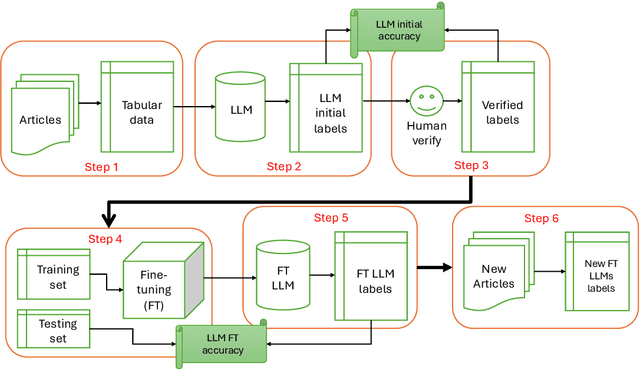

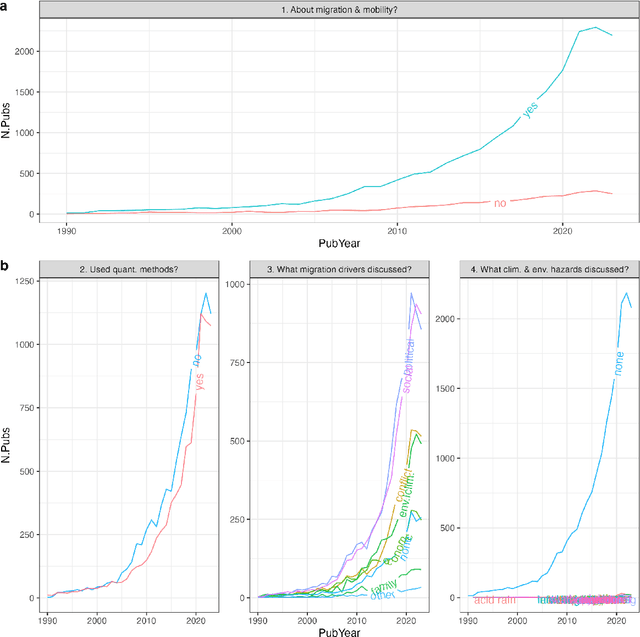
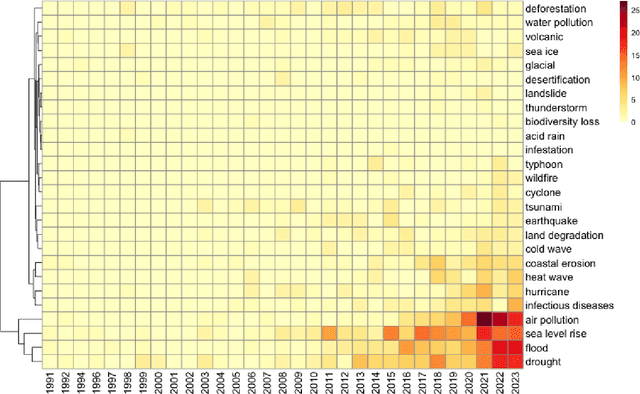
This paper presents a hybrid framework for literature reviews that augments traditional bibliometric methods with large language models (LLMs). By fine-tuning open-source LLMs, our approach enables scalable extraction of qualitative insights from large volumes of research content, enhancing both the breadth and depth of knowledge synthesis. To improve annotation efficiency and consistency, we introduce an error-focused validation process in which LLMs generate initial labels and human reviewers correct misclassifications. Applying this framework to over 20000 scientific articles about human migration, we demonstrate that a domain-adapted LLM can serve as a "specialist" model - capable of accurately selecting relevant studies, detecting emerging trends, and identifying critical research gaps. Notably, the LLM-assisted review reveals a growing scholarly interest in climate-induced migration. However, existing literature disproportionately centers on a narrow set of environmental hazards (e.g., floods, droughts, sea-level rise, and land degradation), while overlooking others that more directly affect human health and well-being, such as air and water pollution or infectious diseases. This imbalance highlights the need for more comprehensive research that goes beyond physical environmental changes to examine their ecological and societal consequences, particularly in shaping migration as an adaptive response. Overall, our proposed framework demonstrates the potential of fine-tuned LLMs to conduct more efficient, consistent, and insightful literature reviews across disciplines, ultimately accelerating knowledge synthesis and scientific discovery.