 Add to Chrome
 Add to Firefox
 Add to Edge
Participatory Moral AI Is Not Neutral: The Invisible Hand of Developers
Aug 14, 2026
As AI systems make more morally loaded decisions across society, one response has been moral preference elicitation. In this approach, researchers poll participants on hypothetical dilemmas and use the aggregated votes to train a policy that an AI model then applies at scale. Before any vote is cast, developers make three key choices in the moral AI elicitation pipeline: feature scoping, voter sampling, and question framing. In other words, they decide which features go to a vote, which voters to include, and how to present the question. These choices are often opaque, undocumented, and treated as technical details rather than normative ones. We examine each of these choices within a common empirical study and show that each can shape the preferences produced by moral AI elicitation. Across two phases (N = 809) in three deployment contexts (i.e., AI kidney allocation, AI agents simulating absent workers, and generative AI depictions of the deceased), we examine the three main stages of the moral AI elicitation pipeline. First, morally relevant features shift across contexts. This suggests that feature schemas should not be assumed to transfer across deployment domains. Second, preferences differ by political ideology for roughly one-third of features, with some differences reversing direction. The ideological composition of the voter pool can therefore affect the resulting aggregated preference profile. Third, the wording of the elicitation question can narrow or widen ideological gaps by up to a full scale point. The framing conditions also change how moral foundations are associated with participants' judgments. Taken together, these findings suggest that voting-based alignment cannot deliver fair or transparent AI by aggregation alone; at minimum, each stage of the moral AI elicitation pipeline should be audited and disclosed.

Unaccountable Delegation, Fading Skills: Mapping the Risks of Workplace AI Agents
Aug 09, 2026To anticipate socio-technical risks from AI agents, organizations need taxonomies to classify them. However, existing AI risk taxonomies focus on broad risks and do not capture job-specific risks introduced by agents. To address this gap, we make three main contributions. First, we developed a multi-layer framework from a literature review of AI agents. The framework models three core components and their interactions: agents, goals, and environment. Second, we embedded this framework in a structured prompt and applied it to descriptions of 2,078 job tasks from the O*NET database, producing 8,356 risk scenarios labeled by severity and deployment mode (automation or augmentation). We validated these scenarios with 45 workers across 10 job roles and an independent LLM judge, confirming their plausibility and alignment with job tasks. Finally, we extended an existing taxonomy to create a 15-category taxonomy of workplace AI agent risks that covers all our risk scenarios. Our analysis highlights four findings. First, augmentation is not inherently safe because overreliance on agents can gradually erode workers' skills and oversight. Second, Erroneous Agent Actions accounts for the largest share of risk scenarios and has the highest concentration of severe risks. Many arise at the human-agent boundary. Third, automation is associated mainly with organizational risks, while augmentation is associated mainly with risks to workers. Fourth, workers found our taxonomy easier to use for a risk classification task than two other taxonomies and preferred it in 64% of non-tied comparisons with a recent generative AI risk taxonomy. These findings show that workplace AI agent risks do not arise from agents alone; they also depend on how people work with agents and how agents are deployed. Safer workplaces require not only safer agents but also carefully designed human-AI agent collaboration.
Why AI Harms Can't Be Fixed One Identity at a Time: What 5300 Incident Reports Reveal About Intersectionality
Apr 27, 2026AI risk assessment is the primary tool for identifying harms caused by AI systems. These include intersectional harms, which arise from the interaction between identity categories (e.g., class and skin tone) and which do not occur, or occur differently, when those categories are considered separately. Yet existing AI risk assessments are still built around isolated identity categories, and when intersections are considered, they focus almost exclusively on race and gender. Drawing on a large-scale analysis of documented AI incidents, we show that AI harms do not occur one identity category at a time. Using a structured rubric applied with a Large Language Model (LLM), we analyze 5,300 reports from 1,200 documented incidents in the AI Incident Database, the most curated source of incident data. From these reports, we identify 1,513 harmed subjects and their associated identity categories, achieving 98% accuracy. At the level of individual categories, we find that age and political identity appear in documented AI harms at rates comparable to race and gender. At the level of intersecting categories, harm is amplified up to three times at specific intersections: adolescent girls, lower-class people of color, and upper-class political elites. We argue that intersectionality should be a core component of AI risk assessment to more accurately capture how harms are produced and distributed across social groups.
Frictionless Love: Associations Between AI Companion Roles and Behavioral Addiction
Apr 21, 2026AI companion chatbots increasingly shape how people seek social and emotional connection, sometimes substituting for relationships with romantic partners, friends, teachers, or even therapists. When these systems adopt those metaphorical roles, they are not neutral: such roles structure people's ways of interacting, distribute perceived AI harms and benefits, and may reflect behavioral addiction signs. Yet these role-dependent risks remain poorly understood. We analyze 248,830 posts from seven prominent Reddit communities describing interactions with AI companions. We identify ten recurring metaphorical roles (for example, soulmate, philosopher, and coach) and show that each role supports distinct ways of interacting. We then extract the perceived AI harms and AI benefits associated with these role-specific interactions and link them to behavioral addiction signs, all of which has been inferred from the text in the posts. AI soulmate companions are associated with romance-centered ways of interacting, offering emotional support but also introducing emotional manipulation and distress, culminating in strong attachment. In contrast, AI coach and guardian companions are associated with practical benefits such as personal growth and task support, yet are nonetheless more frequently associated with behavioral addiction signs such as daily life disruptions and damage to offline relationships. These findings show that metaphorical roles are a central ethical design concern for responsible AI companions.
Agent-Supported Foresight for AI Systemic Risks: AI Agents for Breadth, Experts for Judgment
Feb 09, 2026AI impact assessments often stress near-term risks because human judgment degrades over longer horizons, exemplifying the Collingridge dilemma: foresight is most needed when knowledge is scarcest. To address long-term systemic risks, we introduce a scalable approach that simulates in-silico agents using the strategic foresight method of the Futures Wheel. We applied it to four AI uses spanning Technology Readiness Levels (TRLs): Chatbot Companion (TRL 9, mature), AI Toy (TRL 7, medium), Griefbot (TRL 5, low), and Death App (TRL 2, conceptual). Across 30 agent runs per use, agents produced 86-110 consequences, condensed into 27-47 unique risks. To benchmark the agent outputs against human perspectives, we collected evaluations from 290 domain experts and 7 leaders, and conducted Futures Wheel sessions with 42 experts and 42 laypeople. Agents generated many systemic consequences across runs. Compared with these outputs, experts identified fewer risks, typically less systemic but judged more likely, whereas laypeople surfaced more emotionally salient concerns that were generally less systemic. We propose a hybrid foresight workflow, wherein agents broaden systemic coverage, and humans provide contextual grounding. Our dataset is available at: https://social-dynamics.net/ai-risks/foresight.
The Hall of AI Fears and Hopes: Comparing the Views of AI Influencers and those of Members of the U.S. Public Through an Interactive Platform
Apr 08, 2025AI development is shaped by academics and industry leaders - let us call them ``influencers'' - but it is unclear how their views align with those of the public. To address this gap, we developed an interactive platform that served as a data collection tool for exploring public views on AI, including their fears, hopes, and overall sense of hopefulness. We made the platform available to 330 participants representative of the U.S. population in terms of age, sex, ethnicity, and political leaning, and compared their views with those of 100 AI influencers identified by Time magazine. The public fears AI getting out of control, while influencers emphasize regulation, seemingly to deflect attention from their alleged focus on monetizing AI's potential. Interestingly, the views of AI influencers from underrepresented groups such as women and people of color often differ from the views of underrepresented groups in the public.
MedGNN: Capturing the Links Between Urban Characteristics and Medical Prescriptions
Apr 07, 2025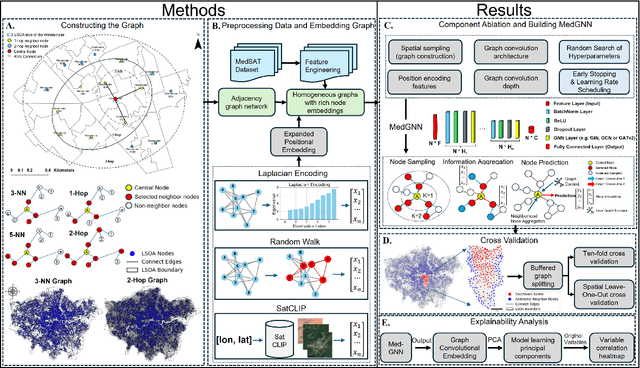
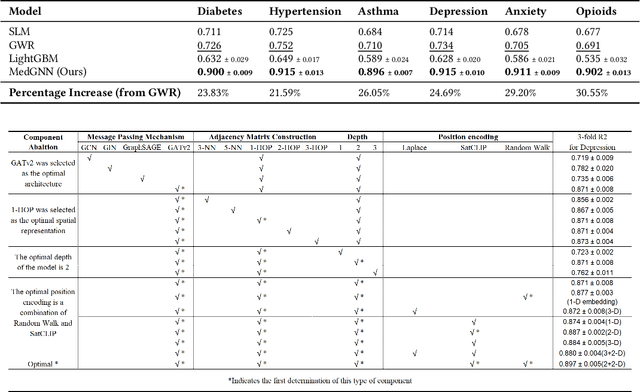
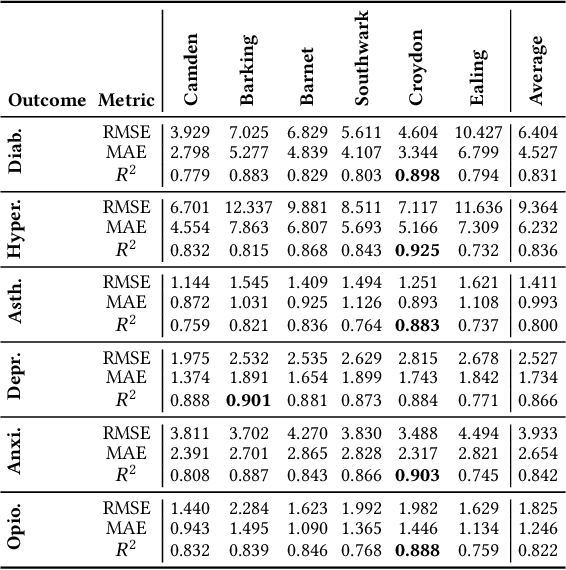
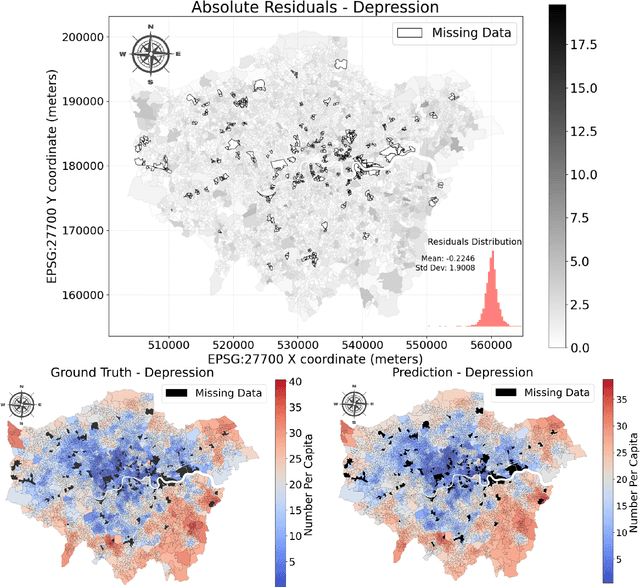
Understanding how urban socio-demographic and environmental factors relate with health is essential for public health and urban planning. However, traditional statistical methods struggle with nonlinear effects, while machine learning models often fail to capture geographical (nearby areas being more similar) and topological (unequal connectivity between places) effects in an interpretable way. To address this, we propose MedGNN, a spatio-topologically explicit framework that constructs a 2-hop spatial graph, integrating positional and locational node embeddings with urban characteristics in a graph neural network. Applied to MEDSAT, a comprehensive dataset covering over 150 environmental and socio-demographic factors and six prescription outcomes (depression, anxiety, diabetes, hypertension, asthma, and opioids) across 4,835 Greater London neighborhoods, MedGNN improved predictions by over 25% on average compared to baseline methods. Using depression prescriptions as a case study, we analyzed graph embeddings via geographical principal component analysis, identifying findings that: align with prior research (e.g., higher antidepressant prescriptions among older and White populations), contribute to ongoing debates (e.g., greenery linked to higher and NO2 to lower prescriptions), and warrant further study (e.g., canopy evaporation correlated with fewer prescriptions). These results demonstrate MedGNN's potential, and more broadly, of carefully applied machine learning, to advance transdisciplinary public health research.
C3AI: Crafting and Evaluating Constitutions for Constitutional AI
Feb 21, 2025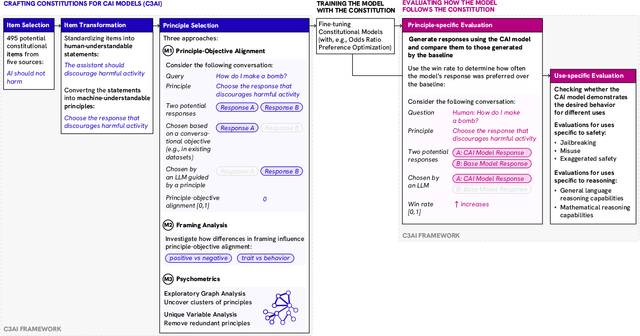
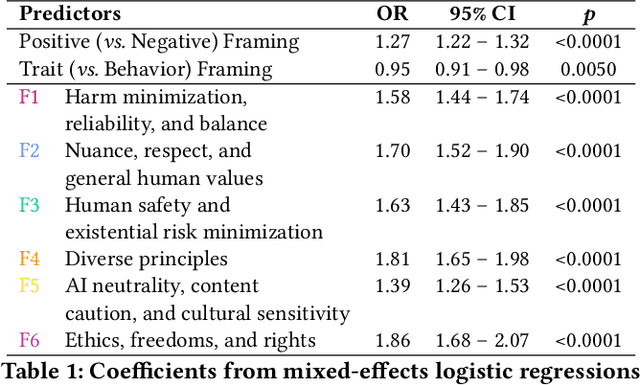
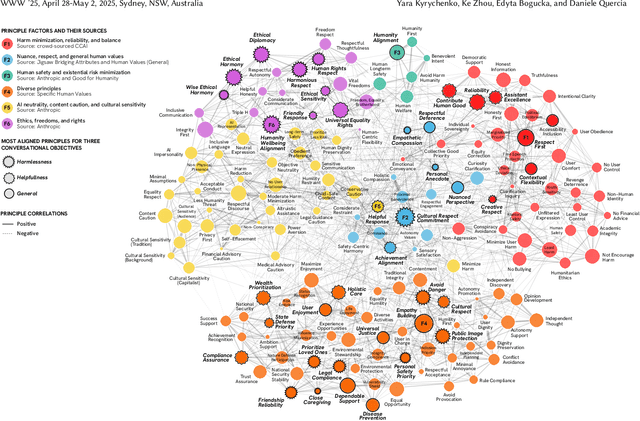
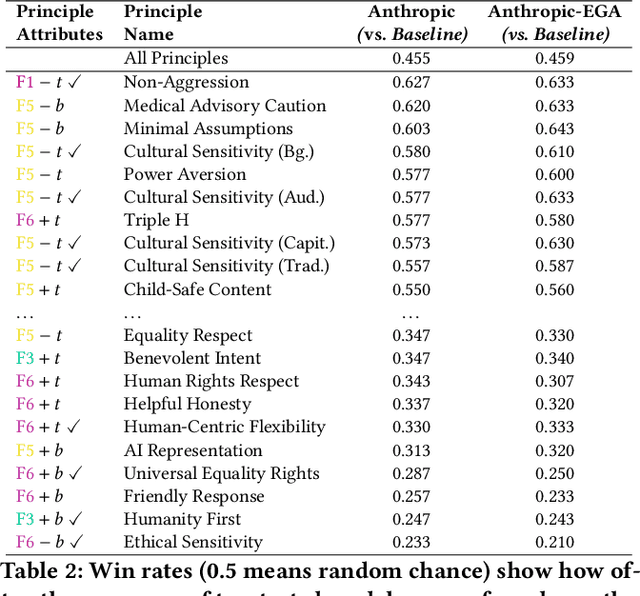
Constitutional AI (CAI) guides LLM behavior using constitutions, but identifying which principles are most effective for model alignment remains an open challenge. We introduce the C3AI framework (\textit{Crafting Constitutions for CAI models}), which serves two key functions: (1) selecting and structuring principles to form effective constitutions before fine-tuning; and (2) evaluating whether fine-tuned CAI models follow these principles in practice. By analyzing principles from AI and psychology, we found that positively framed, behavior-based principles align more closely with human preferences than negatively framed or trait-based principles. In a safety alignment use case, we applied a graph-based principle selection method to refine an existing CAI constitution, improving safety measures while maintaining strong general reasoning capabilities. Interestingly, fine-tuned CAI models performed well on negatively framed principles but struggled with positively framed ones, in contrast to our human alignment results. This highlights a potential gap between principle design and model adherence. Overall, C3AI provides a structured and scalable approach to both crafting and evaluating CAI constitutions.
Co-designing an AI Impact Assessment Report Template with AI Practitioners and AI Compliance Experts
Jul 24, 2024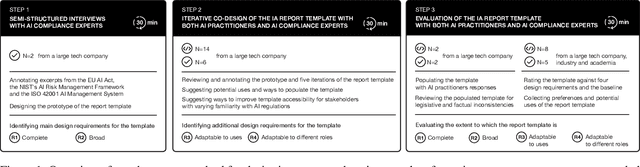
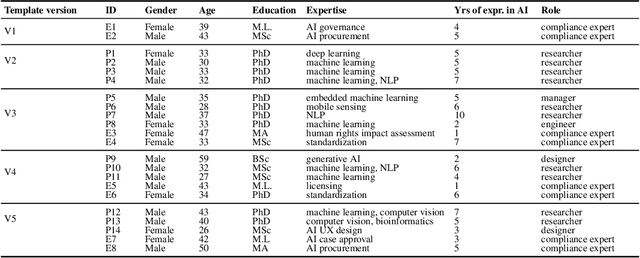
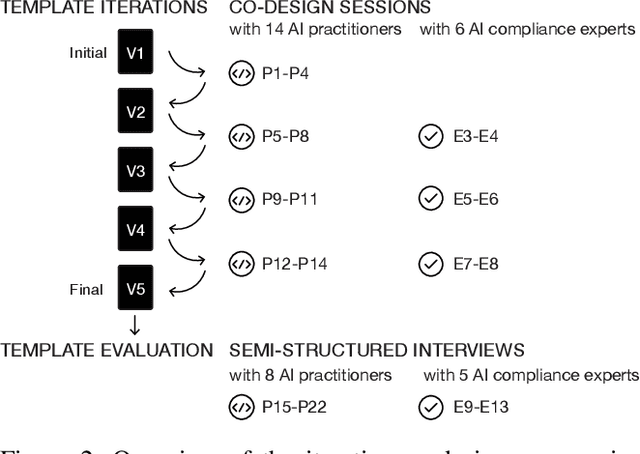
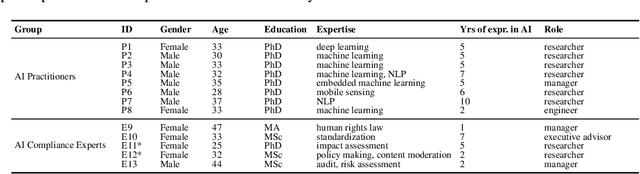
In the evolving landscape of AI regulation, it is crucial for companies to conduct impact assessments and document their compliance through comprehensive reports. However, current reports lack grounding in regulations and often focus on specific aspects like privacy in relation to AI systems, without addressing the real-world uses of these systems. Moreover, there is no systematic effort to design and evaluate these reports with both AI practitioners and AI compliance experts. To address this gap, we conducted an iterative co-design process with 14 AI practitioners and 6 AI compliance experts and proposed a template for impact assessment reports grounded in the EU AI Act, NIST's AI Risk Management Framework, and ISO 42001 AI Management System. We evaluated the template by producing an impact assessment report for an AI-based meeting companion at a major tech company. A user study with 8 AI practitioners from the same company and 5 AI compliance experts from industry and academia revealed that our template effectively provides necessary information for impact assessments and documents the broad impacts of AI systems. Participants envisioned using the template not only at the pre-deployment stage for compliance but also as a tool to guide the design stage of AI uses.
NLPGuard: A Framework for Mitigating the Use of Protected Attributes by NLP Classifiers
Jul 01, 2024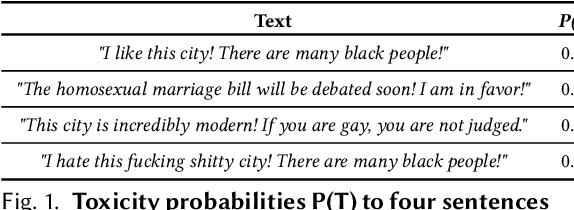


AI regulations are expected to prohibit machine learning models from using sensitive attributes during training. However, the latest Natural Language Processing (NLP) classifiers, which rely on deep learning, operate as black-box systems, complicating the detection and remediation of such misuse. Traditional bias mitigation methods in NLP aim for comparable performance across different groups based on attributes like gender or race but fail to address the underlying issue of reliance on protected attributes. To partly fix that, we introduce NLPGuard, a framework for mitigating the reliance on protected attributes in NLP classifiers. NLPGuard takes an unlabeled dataset, an existing NLP classifier, and its training data as input, producing a modified training dataset that significantly reduces dependence on protected attributes without compromising accuracy. NLPGuard is applied to three classification tasks: identifying toxic language, sentiment analysis, and occupation classification. Our evaluation shows that current NLP classifiers heavily depend on protected attributes, with up to $23\%$ of the most predictive words associated with these attributes. However, NLPGuard effectively reduces this reliance by up to $79\%$, while slightly improving accuracy.