 Add to Chrome
 Add to Firefox
 Add to Edge
Active Flow Expansion for Out-of-Distribution Discovery: from Theory to Molecules
Jun 07, 2026
Standard flow and diffusion pre-training matches the distribution of available data (e.g., molecules), which often covers only a small fraction of the valid design space. In generative discovery, however, one aims to sample valid new-to-nature designs, assigned negligible probability under, and thus inaccessible to, standard models fitted to the observed data. To overcome this limitation, we depart from data distribution matching and view a generative model through its generable set: the region it covers with non-negligible probability. This allows to introduce a new learning principle for out-of-distribution flow modeling: enlarging a model's generable set to increase coverage of the valid design space. We propose Active Flow Expansion (ActFlow), a continued pre-training method that employs verifier feedback to expand a pre-trained model over new valid regions by iteratively adapting to synthetic data generated through active exploration in the learned flow representation. Theoretically, we establish to our knowledge first-of-their-kind statistical learning guarantees for out-of-distribution flow modeling, analyzing generable set expansion as a local-to-global reachability process over a learned representation. Empirically, we assess ActFlow with suitable out-of-distribution generative modeling metrics across small organic molecules, mid-sized drug-like molecules, therapeutic peptides, and protein sequence design tasks. Results show that ActFlow expands valid coverage far beyond the region modeled by the initial pre-trained model, significantly outperforming widely adopted synthetic flow pre-training methods.

Exploring Magnitude Preservation and Rotation Modulation in Diffusion Transformers
May 25, 2025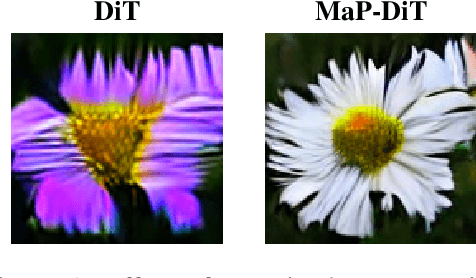

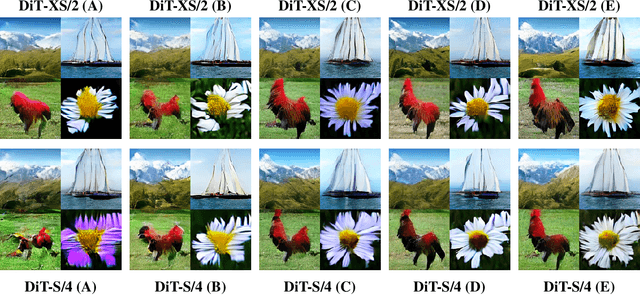
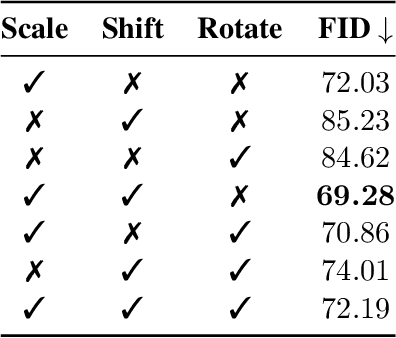
Denoising diffusion models exhibit remarkable generative capabilities, but remain challenging to train due to their inherent stochasticity, where high-variance gradient estimates lead to slow convergence. Previous works have shown that magnitude preservation helps with stabilizing training in the U-net architecture. This work explores whether this effect extends to the Diffusion Transformer (DiT) architecture. As such, we propose a magnitude-preserving design that stabilizes training without normalization layers. Motivated by the goal of maintaining activation magnitudes, we additionally introduce rotation modulation, which is a novel conditioning method using learned rotations instead of traditional scaling or shifting. Through empirical evaluations and ablation studies on small-scale models, we show that magnitude-preserving strategies significantly improve performance, notably reducing FID scores by $\sim$12.8%. Further, we show that rotation modulation combined with scaling is competitive with AdaLN, while requiring $\sim$5.4% fewer parameters. This work provides insights into conditioning strategies and magnitude control. We will publicly release the implementation of our method.
Efficient Distillation of Classifier-Free Guidance using Adapters
Mar 10, 2025While classifier-free guidance (CFG) is essential for conditional diffusion models, it doubles the number of neural function evaluations (NFEs) per inference step. To mitigate this inefficiency, we introduce adapter guidance distillation (AGD), a novel approach that simulates CFG in a single forward pass. AGD leverages lightweight adapters to approximate CFG, effectively doubling the sampling speed while maintaining or even improving sample quality. Unlike prior guidance distillation methods that tune the entire model, AGD keeps the base model frozen and only trains minimal additional parameters ($\sim$2%) to significantly reduce the resource requirement of the distillation phase. Additionally, this approach preserves the original model weights and enables the adapters to be seamlessly combined with other checkpoints derived from the same base model. We also address a key mismatch between training and inference in existing guidance distillation methods by training on CFG-guided trajectories instead of standard diffusion trajectories. Through extensive experiments, we show that AGD achieves comparable or superior FID to CFG across multiple architectures with only half the NFEs. Notably, our method enables the distillation of large models ($\sim$2.6B parameters) on a single consumer GPU with 24 GB of VRAM, making it more accessible than previous approaches that require multiple high-end GPUs. We will publicly release the implementation of our method.