 Add to Chrome
 Add to Firefox
 Add to Edge
RF-HiT: Rectified Flow Hierarchical Transformer for General Medical Image Segmentation
Apr 21, 2026
Accurate medical image segmentation requires both long-range contextual reasoning and precise boundary delineation, a task where existing transformer- and diffusion-based paradigms are frequently bottlenecked by quadratic computational complexity and prohibitive inference latency. We propose RF-HiT, a Rectified Flow Hierarchical Transformer that integrates an hourglass transformer backbone with a multi-scale hierarchical encoder for anatomically guided feature conditioning. Unlike prior diffusion-based approaches, RF-HiT leverages rectified flow with efficient transformer blocks to achieve linear complexity while requiring only a few discretization steps. The model further fuses conditioning features across resolutions via learnable interpolation, enabling effective multi-scale representation with minimal computational overhead. As a result, RF-HiT achieves a strong efficiency-performance trade-off, requiring only 10.14 GFLOPs, 13.6M parameters, and inference in as few as three steps. Despite its compact design, RF-HiT attains 91.27% mean Dice on ACDC and 87.40% on BraTS 2021, achieving performance comparable to or exceeding that of significantly more intensive architectures. This demonstrates its strong potential as a robust, computationally efficient foundation for real-time clinical segmentation.

Computer Aided Diagnosis for Spitzoid lesions classification using Artificial Intelligence techniques
Mar 10, 2020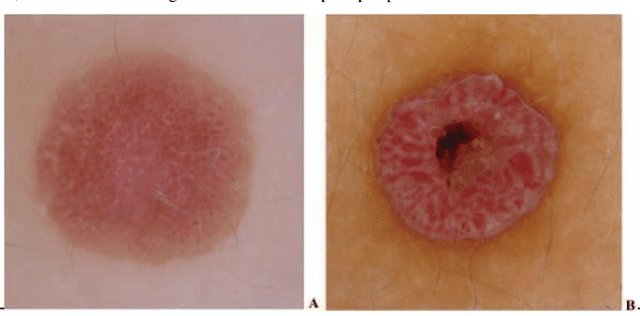
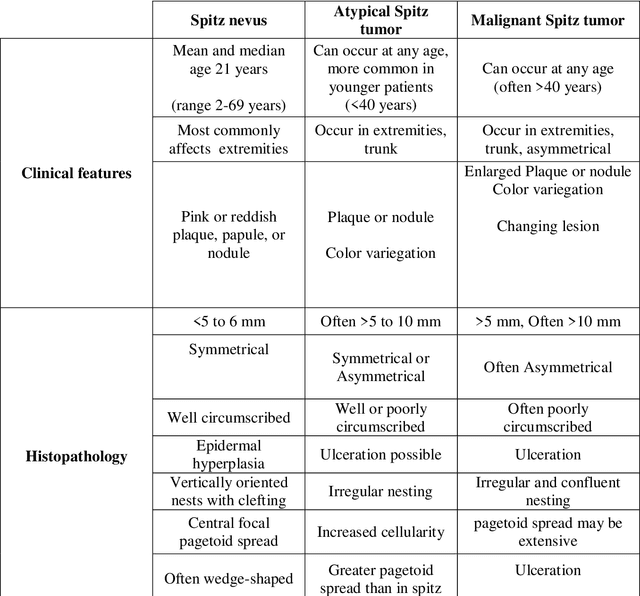

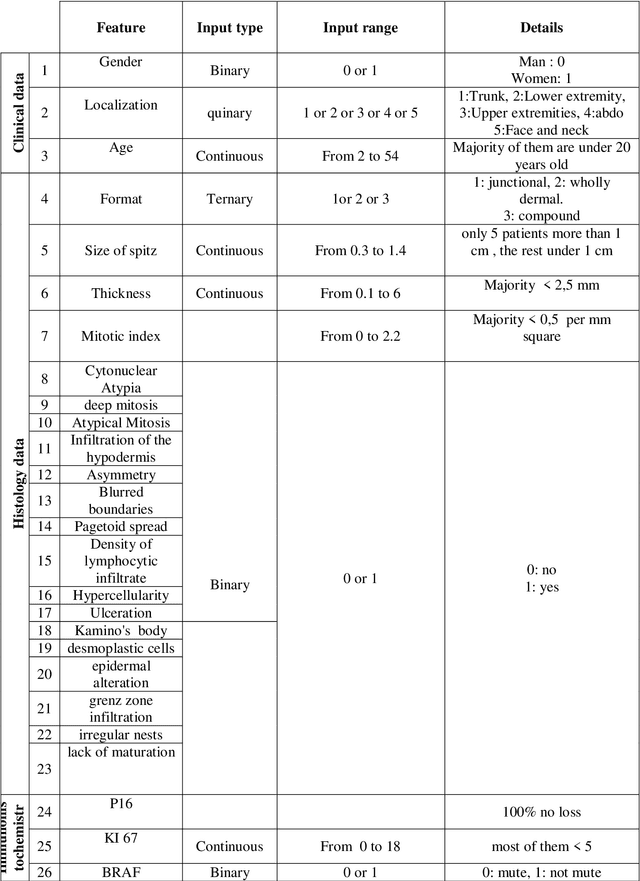
Spitzoid lesions may be largely categorized into Spitz Nevus, Atypical Spitz Tumors, and Spitz Melanomas. Classifying a lesion precisely as Atypical Spitz Tumors or AST is challenging and often requires the integration of clinical, histological, and immunohistochemical features to differentiate AST from regular Spitz nevus and malignant Spitz melanomas. Specifically, this paper aims to test several artificial intelligence techniques so as to build a computer aided diagnosis system. A proposed three-phase approach is being implemented. In Phase I, collected data are preprocessed with an effective Synthetic Minority Oversampling TEchnique or SMOTE-based method being implemented to treat the imbalance data problem. Then, a feature selection mechanism using genetic algorithm (GA) is applied in Phase II. Finally, in Phase III, a ten-fold cross-validation method is used to compare the performance of seven machine-learning algorithms for classification. Results obtained with SMOTE-Multilayer Perceptron with GA-based 14 features show the highest classification accuracy (0.98), a sensitivity of 0.99, and a specificity of 0.98, outperforming other Spitzoid lesions classification algorithms.