 Add to Chrome
 Add to Firefox
 Add to Edge
ULF-Synth: Physics-Guided Ultra-Low-Field MRI Enhancement for Pediatric Neuroimaging
May 23, 2026
Ultra-low-field (ULF) MRI offers portable and accessible neuroimaging but suffers from reduced signal-to-noise ratio and limited spatial resolution compared to high-field (HF) systems. Acquiring paired ULF-HF data for supervised enhancement is often difficult, particularly in resource-limited settings. We introduce ULF-Synth, a framework that combines: (i) acquisition-based synthesis of realistic ULF images from HF volumes to create large-scale paired training data, (ii) a spatial-frequency domain objective that prioritizes recovery of high-frequency anatomical detail. This formulation is architecture-agnostic, consistently improving structural similarity and perceptual fidelity across encoder-decoder, adversarial, and diffusion-based translation models. When trained exclusively on synthetic data, the resulting models generalize effectively to real 64mT ULF acquisitions, improving downstream multiclass brain segmentation and achieving higher radiologist preference and diagnostic acceptability in a blinded reader study. These findings demonstrate that synthetic paired supervision provides a practical and scalable pathway for enhancing ULF MRI without requiring real paired acquisitions. Code, Models and Dataset: https://github.com/toufiqmusah/ULF-Synth

PERL: Parameter Efficient Reasoning in CLIP Latent Space
May 19, 2026Contrastively trained vision-language models such as CLIP provide strong zero-shot transfer by aligning images and text in a shared embedding space. However, adapting these models to downstream tasks without degrading their open-vocabulary generalization remains challenging. Existing parameter-efficient adaptation methods typically improve task specialization through learned prompts, adapters, or multimodal transformations, where adaptation capacity is primarily expressed through additional trainable parameters. Inspired by recent latent reasoning methods in language models, we investigate a complementary perspective: can adaptation emerge from iterative reasoning on latent representations rather than from increasing parameter count alone? We introduce PERL (Parameter-Efficient Reasoning in CLIP Latent Space), a lightweight adaptation framework that augments a frozen CLIP model with a compact shared reasoning module applied recurrently across refinement steps. At each step, PERL generates a latent reasoning token conditioned on the current representation and injects it into an intermediate encoder layer, progressively refining higher-level semantic representations while preserving CLIP's pretrained multimodal structure. Across 15 benchmarks spanning base-to-novel generalization, cross-dataset transfer, and out-of-distribution ImageNet variants, PERL achieves the best parameter-performance trade-off among the compared methods under a fast-adaptation few-shot setting, combining strong novel-class accuracy and competitive transfer performance with only about 6K trainable parameters, up to 817x fewer than the largest compared approach. Overall, our results suggest that iterative latent reasoning provides a complementary adaptation mechanism to parameter scaling in discriminative vision-language models.
Dream2Learn: Structured Generative Dreaming for Continual Learning
Mar 02, 2026Continual learning requires balancing plasticity and stability while mitigating catastrophic forgetting. Inspired by human dreaming as a mechanism for internal simulation and knowledge restructuring, we introduce Dream2Learn (D2L), a framework in which a model autonomously generates structured synthetic experiences from its own internal representations and uses them for self-improvement. Rather than reconstructing past data as in generative replay, D2L enables a classifier to create novel, semantically distinct dreamed classes that are coherent with its learned knowledge yet do not correspond to previously observed data. These dreamed samples are produced by conditioning a frozen diffusion model through soft prompt optimization driven by the classifier itself. The generated data are not used to replace memory, but to expand and reorganize the representation space, effectively allowing the network to self-train on internally synthesized concepts. By integrating dreamed classes into continual training, D2L proactively structures latent features to support forward knowledge transfer and adaptation to future tasks. This prospective self-training mechanism mirrors the role of sleep in consolidating and reorganizing memory, turning internal simulations into a tool for improved generalization. Experiments on Mini-ImageNet, FG-ImageNet, and ImageNet-R demonstrate that D2L consistently outperforms strong rehearsal-based baselines and achieves positive forward transfer, confirming its ability to enhance adaptability through internally generated training signals.
QuantFormer: Learning to Quantize for Neural Activity Forecasting in Mouse Visual Cortex
Dec 10, 2024

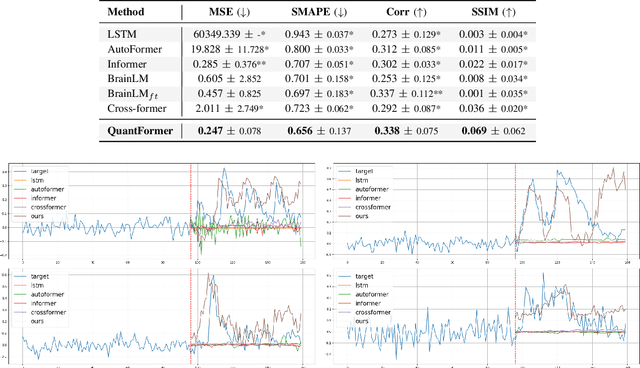

Understanding complex animal behaviors hinges on deciphering the neural activity patterns within brain circuits, making the ability to forecast neural activity crucial for developing predictive models of brain dynamics. This capability holds immense value for neuroscience, particularly in applications such as real-time optogenetic interventions. While traditional encoding and decoding methods have been used to map external variables to neural activity and vice versa, they focus on interpreting past data. In contrast, neural forecasting aims to predict future neural activity, presenting a unique and challenging task due to the spatiotemporal sparsity and complex dependencies of neural signals. Existing transformer-based forecasting methods, while effective in many domains, struggle to capture the distinctiveness of neural signals characterized by spatiotemporal sparsity and intricate dependencies. To address this challenge, we here introduce QuantFormer, a transformer-based model specifically designed for forecasting neural activity from two-photon calcium imaging data. Unlike conventional regression-based approaches, QuantFormerreframes the forecasting task as a classification problem via dynamic signal quantization, enabling more effective learning of sparse neural activation patterns. Additionally, QuantFormer tackles the challenge of analyzing multivariate signals from an arbitrary number of neurons by incorporating neuron-specific tokens, allowing scalability across diverse neuronal populations. Trained with unsupervised quantization on the Allen dataset, QuantFormer sets a new benchmark in forecasting mouse visual cortex activity. It demonstrates robust performance and generalization across various stimuli and individuals, paving the way for a foundational model in neural signal prediction.
Back to Supervision: Boosting Word Boundary Detection through Frame Classification
Nov 15, 2024

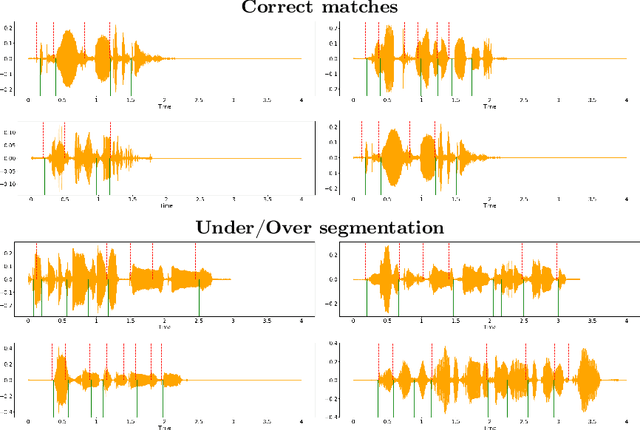
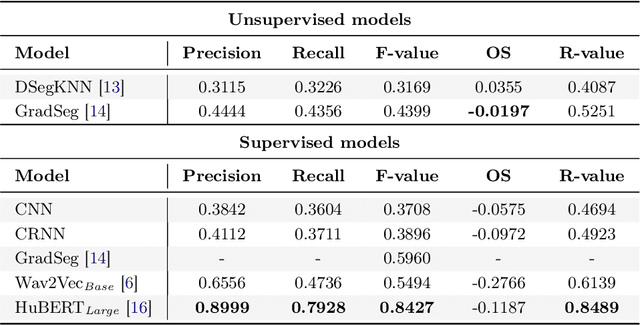
Speech segmentation at both word and phoneme levels is crucial for various speech processing tasks. It significantly aids in extracting meaningful units from an utterance, thus enabling the generation of discrete elements. In this work we propose a model-agnostic framework to perform word boundary detection in a supervised manner also employing a labels augmentation technique and an output-frame selection strategy. We trained and tested on the Buckeye dataset and only tested on TIMIT one, using state-of-the-art encoder models, including pre-trained solutions (Wav2Vec 2.0 and HuBERT), as well as convolutional and convolutional recurrent networks. Our method, with the HuBERT encoder, surpasses the performance of other state-of-the-art architectures, whether trained in supervised or self-supervised settings on the same datasets. Specifically, we achieved F-values of 0.8427 on the Buckeye dataset and 0.7436 on the TIMIT dataset, along with R-values of 0.8489 and 0.7807, respectively. These results establish a new state-of-the-art for both datasets. Beyond the immediate task, our approach offers a robust and efficient preprocessing method for future research in audio tokenization.