 Add to Chrome
 Add to Firefox
 Add to Edge
PERL: Parameter Efficient Reasoning in CLIP Latent Space
May 19, 2026
Contrastively trained vision-language models such as CLIP provide strong zero-shot transfer by aligning images and text in a shared embedding space. However, adapting these models to downstream tasks without degrading their open-vocabulary generalization remains challenging. Existing parameter-efficient adaptation methods typically improve task specialization through learned prompts, adapters, or multimodal transformations, where adaptation capacity is primarily expressed through additional trainable parameters. Inspired by recent latent reasoning methods in language models, we investigate a complementary perspective: can adaptation emerge from iterative reasoning on latent representations rather than from increasing parameter count alone? We introduce PERL (Parameter-Efficient Reasoning in CLIP Latent Space), a lightweight adaptation framework that augments a frozen CLIP model with a compact shared reasoning module applied recurrently across refinement steps. At each step, PERL generates a latent reasoning token conditioned on the current representation and injects it into an intermediate encoder layer, progressively refining higher-level semantic representations while preserving CLIP's pretrained multimodal structure. Across 15 benchmarks spanning base-to-novel generalization, cross-dataset transfer, and out-of-distribution ImageNet variants, PERL achieves the best parameter-performance trade-off among the compared methods under a fast-adaptation few-shot setting, combining strong novel-class accuracy and competitive transfer performance with only about 6K trainable parameters, up to 817x fewer than the largest compared approach. Overall, our results suggest that iterative latent reasoning provides a complementary adaptation mechanism to parameter scaling in discriminative vision-language models.

OCCAM: Open-set Causal Concept explAnation and Ontology induction for black-box vision Models
May 18, 2026Interpreting the decisions of deep image classifiers remains challenging, particularly in black-box settings where model internals are inaccessible. We introduce OCCAM, a framework for open-set causal concept explanation and ontology induction in vision models. OCCAM discovers visual concepts in an open-set manner, localizes them via text-guided segmentation, and performs object-level interventions by removing concepts to measure changes in class confidence, estimating each concept's causal contribution. Beyond local explanations, OCCAM aggregates interventional evidence across a dataset to induce a structured concept ontology that captures how classifiers globally organize visual concepts. Reasoning over this ontology reveals consistent dependencies between concepts, exposes latent causal relations, and uncovers systematic model biases. Experiments on Broden and ImageNet-S across multiple classifiers show that OCCAM improves explanation quality in open-set black-box settings while providing richer global insight than per-image attribution methods.
UNBOX: Unveiling Black-box visual models with Natural-language
Mar 09, 2026Ensuring trustworthiness in open-world visual recognition requires models that are interpretable, fair, and robust to distribution shifts. Yet modern vision systems are increasingly deployed as proprietary black-box APIs, exposing only output probabilities and hiding architecture, parameters, gradients, and training data. This opacity prevents meaningful auditing, bias detection, and failure analysis. Existing explanation methods assume white- or gray-box access or knowledge of the training distribution, making them unusable in these real-world settings. We introduce UNBOX, a framework for class-wise model dissection under fully data-free, gradient-free, and backpropagation-free constraints. UNBOX leverages Large Language Models and text-to-image diffusion models to recast activation maximization as a purely semantic search driven by output probabilities. The method produces human-interpretable text descriptors that maximally activate each class, revealing the concepts a model has implicitly learned, the training distribution it reflects, and potential sources of bias. We evaluate UNBOX on ImageNet-1K, Waterbirds, and CelebA through semantic fidelity tests, visual-feature correlation analyses and slice-discovery auditing. Despite operating under the strictest black-box constraints, UNBOX performs competitively with state-of-the-art white-box interpretability methods. This demonstrates that meaningful insight into a model's internal reasoning can be recovered without any internal access, enabling more trustworthy and accountable visual recognition systems.
Back to Supervision: Boosting Word Boundary Detection through Frame Classification
Nov 15, 2024

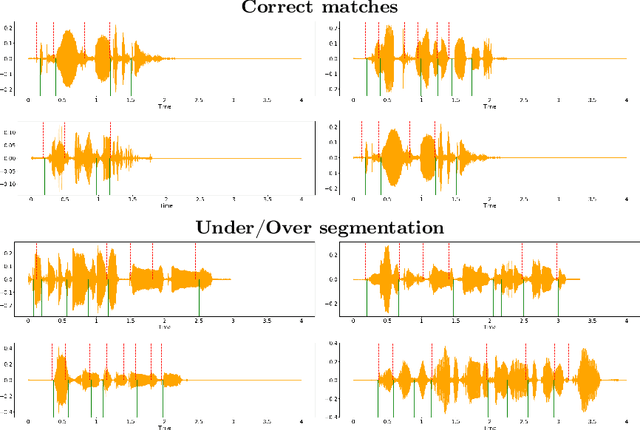
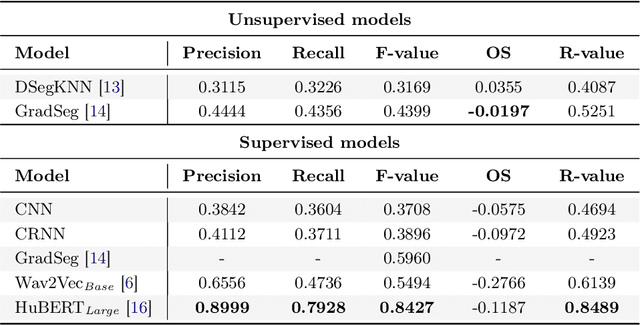
Speech segmentation at both word and phoneme levels is crucial for various speech processing tasks. It significantly aids in extracting meaningful units from an utterance, thus enabling the generation of discrete elements. In this work we propose a model-agnostic framework to perform word boundary detection in a supervised manner also employing a labels augmentation technique and an output-frame selection strategy. We trained and tested on the Buckeye dataset and only tested on TIMIT one, using state-of-the-art encoder models, including pre-trained solutions (Wav2Vec 2.0 and HuBERT), as well as convolutional and convolutional recurrent networks. Our method, with the HuBERT encoder, surpasses the performance of other state-of-the-art architectures, whether trained in supervised or self-supervised settings on the same datasets. Specifically, we achieved F-values of 0.8427 on the Buckeye dataset and 0.7436 on the TIMIT dataset, along with R-values of 0.8489 and 0.7807, respectively. These results establish a new state-of-the-art for both datasets. Beyond the immediate task, our approach offers a robust and efficient preprocessing method for future research in audio tokenization.