 Add to Chrome
 Add to Firefox
 Add to Edge
Understanding Is Done Early: A Depth Division of Labor in Large Language Models and Its Use for Unbounded-Context Memory
Jul 30, 2026
Transformer depth is not used uniformly: lower and middle layers build semantic representations, while upper layers increasingly specialize them for prediction. We turn this division of labor into CoMem (Comprehension Memory), which writes each context chunk only through an intermediate layer, retrieves a fixed number of cached residual states, and recomputes the query-conditioned upper layers over the resulting pack. For a fixed retrieval budget, model-side read compute and memory are independent of stored-context length. We evaluate a continued-trained Qwen3-8B base LM under a unified chat-template-free protocol. The backbone is frozen; the flagship trains only a rank-32 self-distillation LoRA on plain PG19, and we report an adapter-free arm separately. CoMem reaches 97.05 on RULER and 38.27 on LoCoMo versus 34.59 for full-context KV-Direct; the dialogue-memory advantage survives conversation-cluster resampling and an independent judge. Results on additional long-context and long-document tasks expose both the benefits of bounded retrieval and its in-window compression tax. Controlled depth sweeps show that deeper caching lowers per-query recomputation but incurs a fidelity loss that self-distillation substantially repairs. In a separate adapter-free efficiency control on an NVIDIA H20 at 128k, CoMem uses 18.26 GB rather than 89.36 GB and achieves a 7.83x prefill speedup. These results show that long-context memory can be organized along the layer axis, not only the token axis.

Test Case Prioritization for DNNs via Neural Collapse Instability
Jul 22, 2026With the widespread deployment of deep neural networks (DNNs) in safety-critical domains, reducing the cost of model validation under limited testing budgets has become increasingly important. Existing test case prioritization techniques often rely on single-checkpoint confidence signals derived from output probabilities. However, DNNs can be confidently wrong, and the confidence margin between the predicted and competing classes is frequently small, which weakens early fault discovery. To address this limitation, we propose a Neural-Collapse-Inspired Prioritization (NCIP) framework that replaces absolute confidence with cross-checkpoint prediction variability in the terminal training regime, where model geometry becomes highly structured. NCIP introduces two key components. First, it selects an NC-guided representative subset of training checkpoints using an equiangularity score of classifier weights, quantified as the standard deviation of pairwise cosine similarities among class weight vectors. Second, it prioritizes test inputs by their prediction variability across the selected checkpoints, surfacing boundary-adjacent and failure-prone samples that are unstable under checkpoint-induced decision boundary shifts. Extensive experiments across multiple datasets and architectures show that NCIP achieves strong performance in early fault discovery compared with competitive baselines, with 1.5 to 16.6 percent RAUC-ALL gains and 4.9 to 20.6 percent RAUC-500 gains under the same testing budget. NCIP further attains the best average performance across all dataset-model pairs.
VoidPadding: Let [VOID] Handle Padding in Masked Diffusion Language Models so that [EOS] Can Focus on Semantic Termination
Jun 16, 2026MDLMs generate text by denoising a preallocated masked response canvas, making response-length modeling central to instruction tuning. Existing MDLMs often inherit the autoregressive convention of using repeated \texttt{[EOS]} tokens for padding during instruction tuning, giving \texttt{[EOS]} a dual role as both a semantic terminator and a padding token. We show that this dual role is a root cause of \texttt{[EOS]} overflow under large-block decoding. To decouple these roles, we propose VoidPadding, which introduces \texttt{[VOID]} for padding and reserves \texttt{[EOS]} for termination. During inference, the learned \texttt{[EOS]} signal enables early stopping, while the learned \texttt{[VOID]} signal guides adaptive response canvas expansion. On Dream-7B-Instruct, VoidPadding improves the block-size-averaged four-task mean across mathematical reasoning and code generation benchmarks by \(+17.84\) points over the original model and \(+6.95\) points over RainbowPadding, while reducing decoding NFE by 55.7\% on average. Code is available at https://github.com/Haru-LCY/VoidPadding.
Stretchable and High-Precision Optical Tactile Sensor for Trajectory Tracking of Parallel Mechanisms
Dec 24, 2025Stretchable sensors indicate promising prospects for soft robotics, medical devices, and human-machine interactions due to the high compliance of soft materials. Discrete sensing strategies, including sensor arrays and distributed sensors, are broadly involved in tactile sensors across versatile applications. However, it remains a challenge to achieve high spatial resolution with self-decoupled capacity and insensitivity to other off-axis stimuli for stretchable tactile sensors. Herein, we develop a stretchable tactile sensor based on the proposed continuous spectral-filtering principle, allowing superhigh resolution for applied stimuli. This proposed sensor enables a high-linear spatial response (0.996) even during stretching and bending, and high continuous spatial (7 μm) and force (5 mN) resolutions with design scalability and interaction robustness to survive piercing and cutting. We further demonstrate the sensors' performance by integrating them into a planar parallel mechanism for precise trajectory tracking (rotational resolution: 0.02°) in real time.
CFLight: Enhancing Safety with Traffic Signal Control through Counterfactual Learning
Dec 16, 2025Traffic accidents result in millions of injuries and fatalities globally, with a significant number occurring at intersections each year. Traffic Signal Control (TSC) is an effective strategy for enhancing safety at these urban junctures. Despite the growing popularity of Reinforcement Learning (RL) methods in optimizing TSC, these methods often prioritize driving efficiency over safety, thus failing to address the critical balance between these two aspects. Additionally, these methods usually need more interpretability. CounterFactual (CF) learning is a promising approach for various causal analysis fields. In this study, we introduce a novel framework to improve RL for safety aspects in TSC. This framework introduces a novel method based on CF learning to address the question: ``What if, when an unsafe event occurs, we backtrack to perform alternative actions, and will this unsafe event still occur in the subsequent period?'' To answer this question, we propose a new structure causal model to predict the result after executing different actions, and we propose a new CF module that integrates with additional ``X'' modules to promote safe RL practices. Our new algorithm, CFLight, which is derived from this framework, effectively tackles challenging safety events and significantly improves safety at intersections through a near-zero collision control strategy. Through extensive numerical experiments on both real-world and synthetic datasets, we demonstrate that CFLight reduces collisions and improves overall traffic performance compared to conventional RL methods and the recent safe RL model. Moreover, our method represents a generalized and safe framework for RL methods, opening possibilities for applications in other domains. The data and code are available in the github https://github.com/AdvancedAI-ComplexSystem/SmartCity/tree/main/CFLight.
Incomplete Depression Feature Selection with Missing EEG Channels
Nov 10, 2025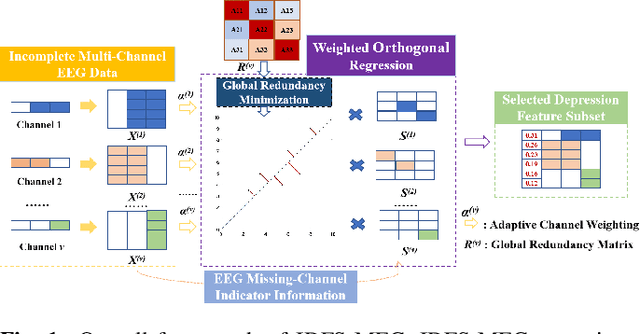
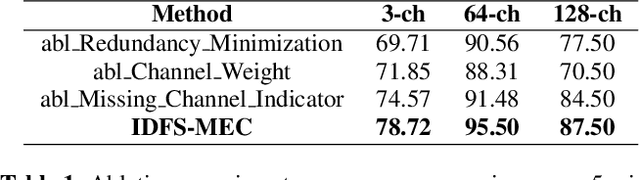
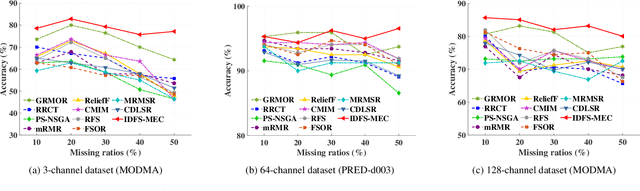
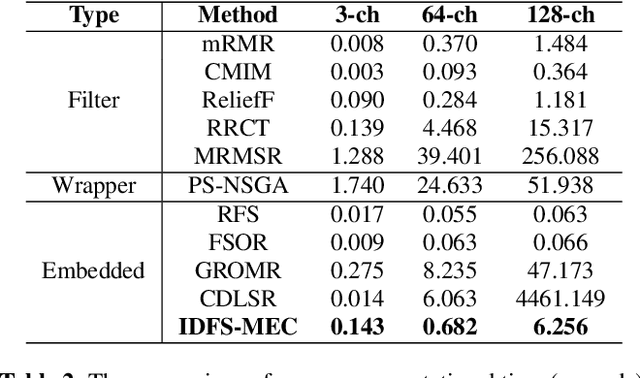
As a critical mental health disorder, depression has severe effects on both human physical and mental well-being. Recent developments in EEG-based depression analysis have shown promise in improving depression detection accuracies. However, EEG features often contain redundant, irrelevant, and noisy information. Additionally, real-world EEG data acquisition frequently faces challenges, such as data loss from electrode detachment and heavy noise interference. To tackle the challenges, we propose a novel feature selection approach for robust depression analysis, called Incomplete Depression Feature Selection with Missing EEG Channels (IDFS-MEC). IDFS-MEC integrates missing-channel indicator information and adaptive channel weighting learning into orthogonal regression to lessen the effects of incomplete channels on model construction, and then utilizes global redundancy minimization learning to reduce redundant information among selected feature subsets. Extensive experiments conducted on MODMA and PRED-d003 datasets reveal that the EEG feature subsets chosen by IDFS-MEC have superior performance than 10 popular feature selection methods among 3-, 64-, and 128-channel settings.
STN: a new tensor network method to identify stimulus category from brain activity pattern
Nov 03, 2022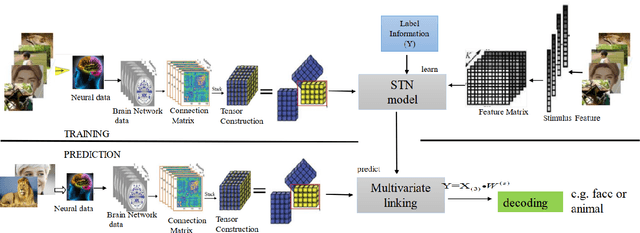
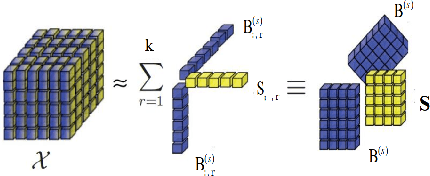
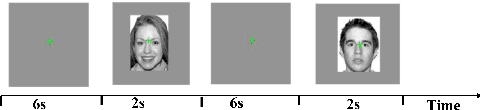
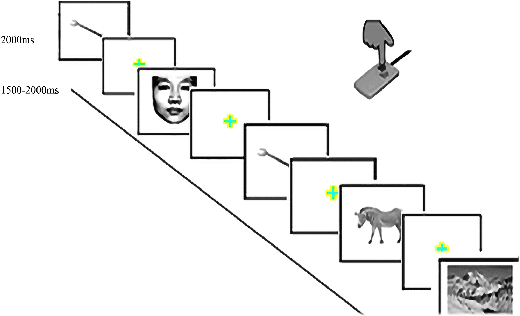
Neural decoding is still a challenge and hot topic in neurocomputing science. Recently, many studies have shown that brain network pattern containing rich spatial and temporal structure information, which represented the activation information of brain under external stimuli. The traditional method is to extract brain network features directly from the common machine learning method, then put these features into the classifier, and realize to decode external stimuli. However, this method cannot effectively extract the multi-dimensional structural information, which is hidden in the brain network. The tensor researchers show that the tensor decomposition model can fully mine unique spatio-temporal structure characteristics in multi-dimensional structure data. This research proposed a stimulus constrain tensor brain model(STN), which involved the tensor decomposition idea and stimulus category constraint information. The model was verified on the real neuroimaging data sets (MEG and fMRI). The experimental results show that the STN model achieved more 11.06% and 18.46% compared with others methods on two modal data sets. These results imply the superiority of extracting discriminative characteristics about STN model, especially for decoding object stimuli with semantic information.