 Add to Chrome
 Add to Firefox
 Add to Edge
Toward High-Fidelity Visual Reconstruction: From EEG-Based Conditioned Generation to Joint-Modal Guided Rebuilding
Mar 20, 2026
Human visual reconstruction aims to reconstruct fine-grained visual stimuli based on subject-provided descriptions and corresponding neural signals. As a widely adopted modality, Electroencephalography (EEG) captures rich visual cognition information, encompassing complex spatial relationships and chromatic details within scenes. However, current approaches are deeply coupled with an alignment framework that forces EEG features to align with text or image semantic representation. The dependency may condense the rich spatial and chromatic details in EEG that achieved mere conditioned image generation rather than high-fidelity visual reconstruction. To address this limitation, we propose a novel Joint-Modal Visual Reconstruction (JMVR) framework. It treats EEG and text as independent modalities for joint learning to preserve EEG-specific information for reconstruction. It further employs a multi-scale EEG encoding strategy to capture both fine- and coarse-grained features, alongside image augmentation to enhance the recovery of perceptual details. Extensive experiments on the THINGS-EEG dataset demonstrate that JMVR achieves SOTA performance against six baseline methods, specifically exhibiting superior capabilities in modeling spatial structure and chromatic fidelity.

Incomplete Depression Feature Selection with Missing EEG Channels
Nov 10, 2025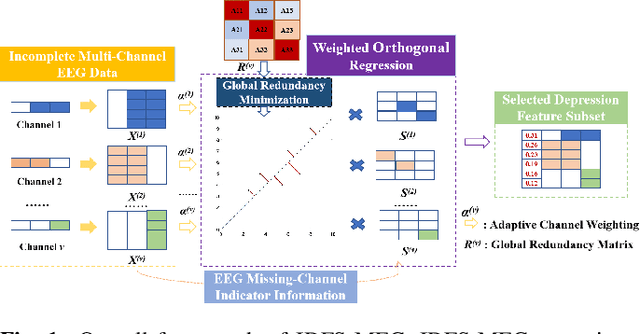
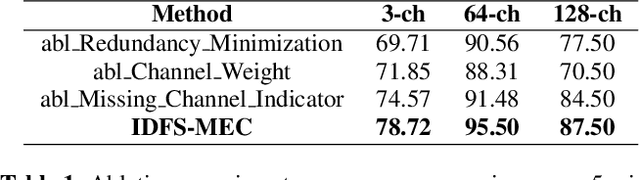
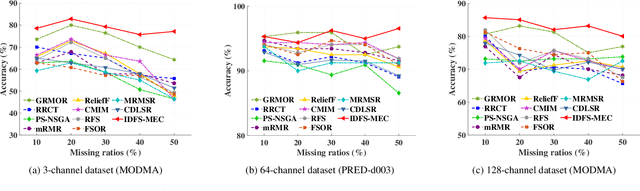
As a critical mental health disorder, depression has severe effects on both human physical and mental well-being. Recent developments in EEG-based depression analysis have shown promise in improving depression detection accuracies. However, EEG features often contain redundant, irrelevant, and noisy information. Additionally, real-world EEG data acquisition frequently faces challenges, such as data loss from electrode detachment and heavy noise interference. To tackle the challenges, we propose a novel feature selection approach for robust depression analysis, called Incomplete Depression Feature Selection with Missing EEG Channels (IDFS-MEC). IDFS-MEC integrates missing-channel indicator information and adaptive channel weighting learning into orthogonal regression to lessen the effects of incomplete channels on model construction, and then utilizes global redundancy minimization learning to reduce redundant information among selected feature subsets. Extensive experiments conducted on MODMA and PRED-d003 datasets reveal that the EEG feature subsets chosen by IDFS-MEC have superior performance than 10 popular feature selection methods among 3-, 64-, and 128-channel settings.