 Add to Chrome
 Add to Firefox
 Add to Edge
Mechanistic Anomaly Detection via Functional Attribution
Apr 21, 2026
We can often verify the correctness of neural network outputs using ground truth labels, but we cannot reliably determine whether the output was produced by normal or anomalous internal mechanisms. Mechanistic anomaly detection (MAD) aims to flag these cases, but existing methods either depend on latent space analysis, which is vulnerable to obfuscation, or are specific to particular architectures and modalities. We reframe MAD as a functional attribution problem: asking to what extent samples from a trusted set can explain the model's output, where attribution failure signals anomalous behavior. We operationalize this using influence functions, measuring functional coupling between test samples and a small reference set via parameter-space sampling. We evaluate across multiple anomaly types and modalities. For backdoors in vision models, our method achieves state-of-the-art detection on BackdoorBench, with an average Defense Effectiveness Rating (DER) of 0.93 across seven attacks and four datasets (next best 0.83). For LLMs, we similarly achieve a significant improvement over baselines for several backdoor types, including on explicitly obfuscated models. Beyond backdoors, our method can detect adversarial and out-of-distribution samples, and distinguishes multiple anomalous mechanisms within a single model. Our results establish functional attribution as an effective, modality-agnostic tool for detecting anomalous behavior in deployed models.

HALO: Robust Out-of-Distribution Detection via Joint Optimisation
Feb 27, 2025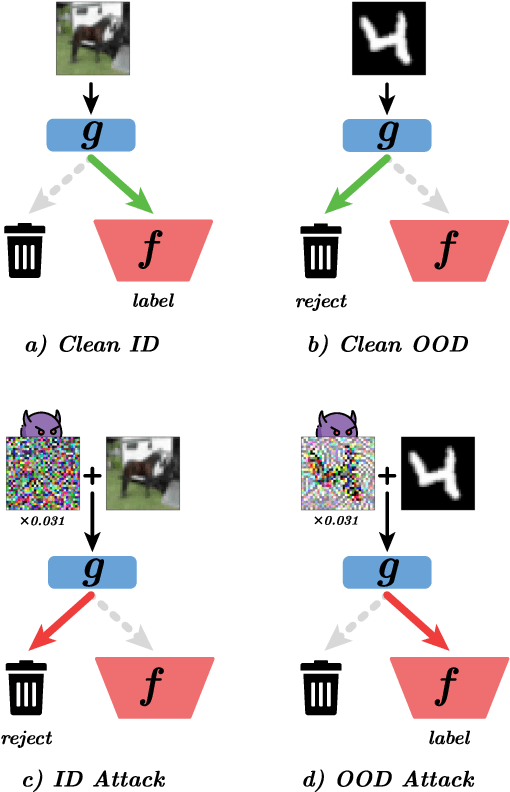
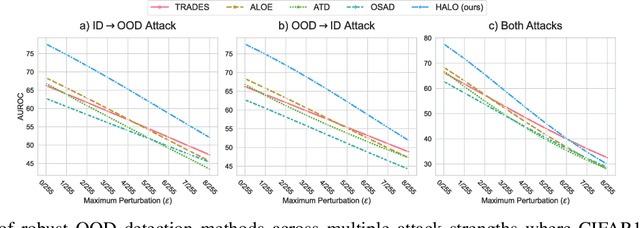
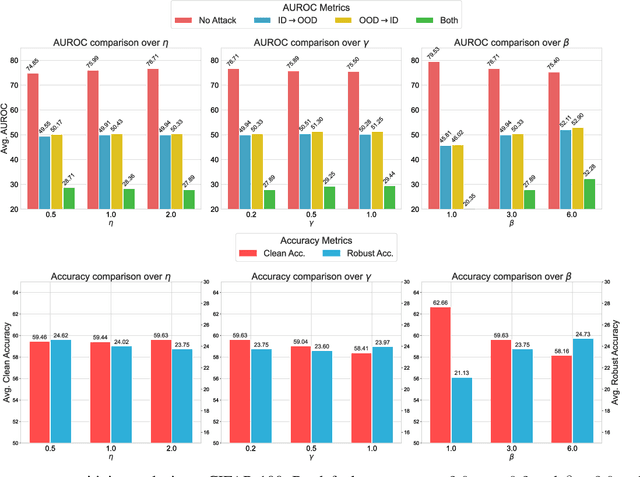

Effective out-of-distribution (OOD) detection is crucial for the safe deployment of machine learning models in real-world scenarios. However, recent work has shown that OOD detection methods are vulnerable to adversarial attacks, potentially leading to critical failures in high-stakes applications. This discovery has motivated work on robust OOD detection methods that are capable of maintaining performance under various attack settings. Prior approaches have made progress on this problem but face a number of limitations: often only exhibiting robustness to attacks on OOD data or failing to maintain strong clean performance. In this work, we adapt an existing robust classification framework, TRADES, extending it to the problem of robust OOD detection and discovering a novel objective function. Recognising the critical importance of a strong clean/robust trade-off for OOD detection, we introduce an additional loss term which boosts classification and detection performance. Our approach, called HALO (Helper-based AdversariaL OOD detection), surpasses existing methods and achieves state-of-the-art performance across a number of datasets and attack settings. Extensive experiments demonstrate an average AUROC improvement of 3.15 in clean settings and 7.07 under adversarial attacks when compared to the next best method. Furthermore, HALO exhibits resistance to transferred attacks, offers tuneable performance through hyperparameter selection, and is compatible with existing OOD detection frameworks out-of-the-box, leaving open the possibility of future performance gains. Code is available at: https://github.com/hugo0076/HALO